DANDONG, China — China and North Korea officially opened their most significant land border crossing on Thursday (Oct 15), aiming to rejuvenate trade and commerce after years of strained ties and pandemic-related disruptions.
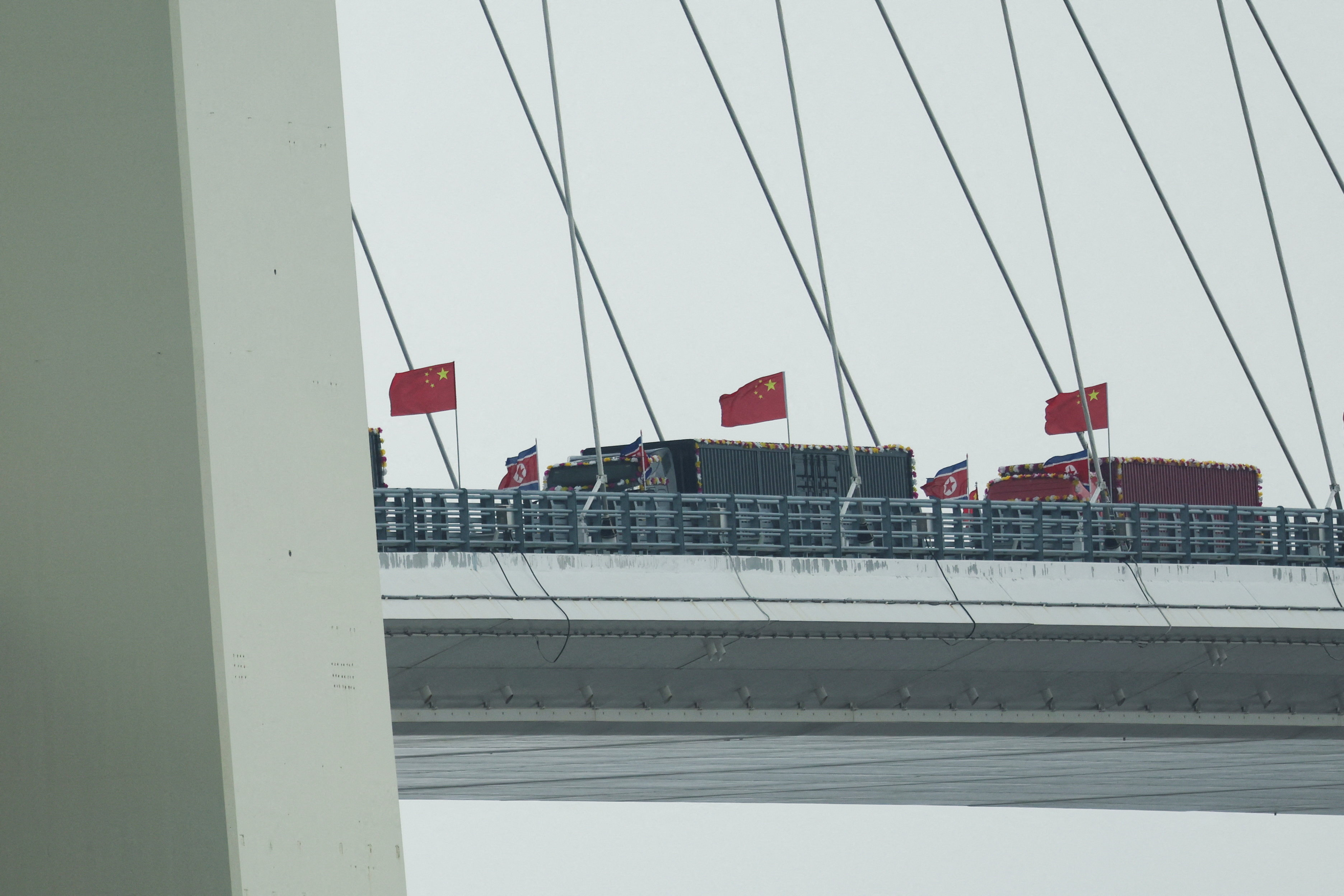
Trucks festooned with the national flags of the neighbours drove across the long-delayed 3km New Yalu River Bridge, its towering pylons also decked in flags, linking the Chinese city of Dandong with North Korea.
Knots of spectators crowded a road on the Chinese side overlooking the cable-stayed bridge completed in 2014 but unused while the North left its approach roads and customs compound unfinished.
"(Bilateral) relations are entering a new phase, embarking on a new chapter," Chinese Premier Li Qiang said in a video address at the opening, the official Xinhua news agency said.
The border crossing would "strongly promote" economic and trade co-operation and further strengthen exchanges between their people, he added.
It also offers an opportunity to improve border clearance procedures, boost connectivity and build co-operation in border areas, Li said.
North Korean Premier Pak Thae Song also delivered a video address, Xinhua said, but the North Korea's state media have yet to report on the event.
'No immediate return to pre-sanctions trade'
The opening is the latest sign of warming ties between Beijing and Pyongyang, after two summits between their leaders in the past year.
Despite the potential economic boost from active trade, however, analysts said North Korea remains cautious of greater dependence on China.
"The bridge is unlikely to lead immediately to a full-scale return to pre-sanctions trade," said Lim Eul-chul at Kyungnam University's Institute for Far Eastern Studies.
But the bridge will help move heavy equipment, raw materials and energy products that North Korea needs for development efforts, he said.
China is by far Pyongyang's largest trading partner, even after a series of UN sanctions banned the flow of goods and workers with the North over the latter's missile and nuclear weapons development.
China and Russia, permanent members of the UN Security Council that voted to approve sanctions resolutions until 2017, have since questioned the legitimacy and efficacy of such bans.
Russia is accused by countries such as the US and South Korea of supplying sensitive military assistance to the North in return for Pyongyang's help in fighting the war in Ukraine.
Delay was setback for Dandong's economy
The delay in opening the bridge was a setback for Dandong, whose economy thrived in the early 21st century as the primary trade gateway to North Korea's isolated economy.
Until now, most goods have crossed about 10 km upstream, using an 83-year-old bridge with a rail track and a single-lane road. That remains the busiest of about 15 crossing points along the roughly 1,350 km border.
Dandong residents welcomed the opening.
"It's been more than a decade since they first said the bridge would open... but coming here today and seeing it for myself makes me incredibly happy," said one of them, a 50-year-old surnamed He.
"Once the bridge opens, this place will become much livelier, attracting more tourists," said another Dandong resident, surnamed Xie.
The bridge opening was "effectively the first visible case" of adoption of agreements struck at a June summit of leaders, a South Korean Unification Ministry official said on Thursday.
Seoul was monitoring whether it would lead to further practical steps as Beijing and Pyongyang seek to build their ties into a more strategic partnership, the official added.
China's exports to North Korea rose to a six-year high of US$2.3 billion (S$2.9 billion) last year, an increase of 25 per cent on the year. Still, that was well below levels before UN sanctions tightened in 2017.
[[nid:747689]]



