This article is part of a package produced by a group of final-year undergraduates from Nanyang Technological University's Wee Kim Wee School of Communication and Information, for the programme Going Overseas For Advanced Reporting, or GO-FAR. They reported from Hong Kong in July and August 2026, where they found the city, almost 30 years after the British handover, grappling with the upheaval of traditions that anchored it.
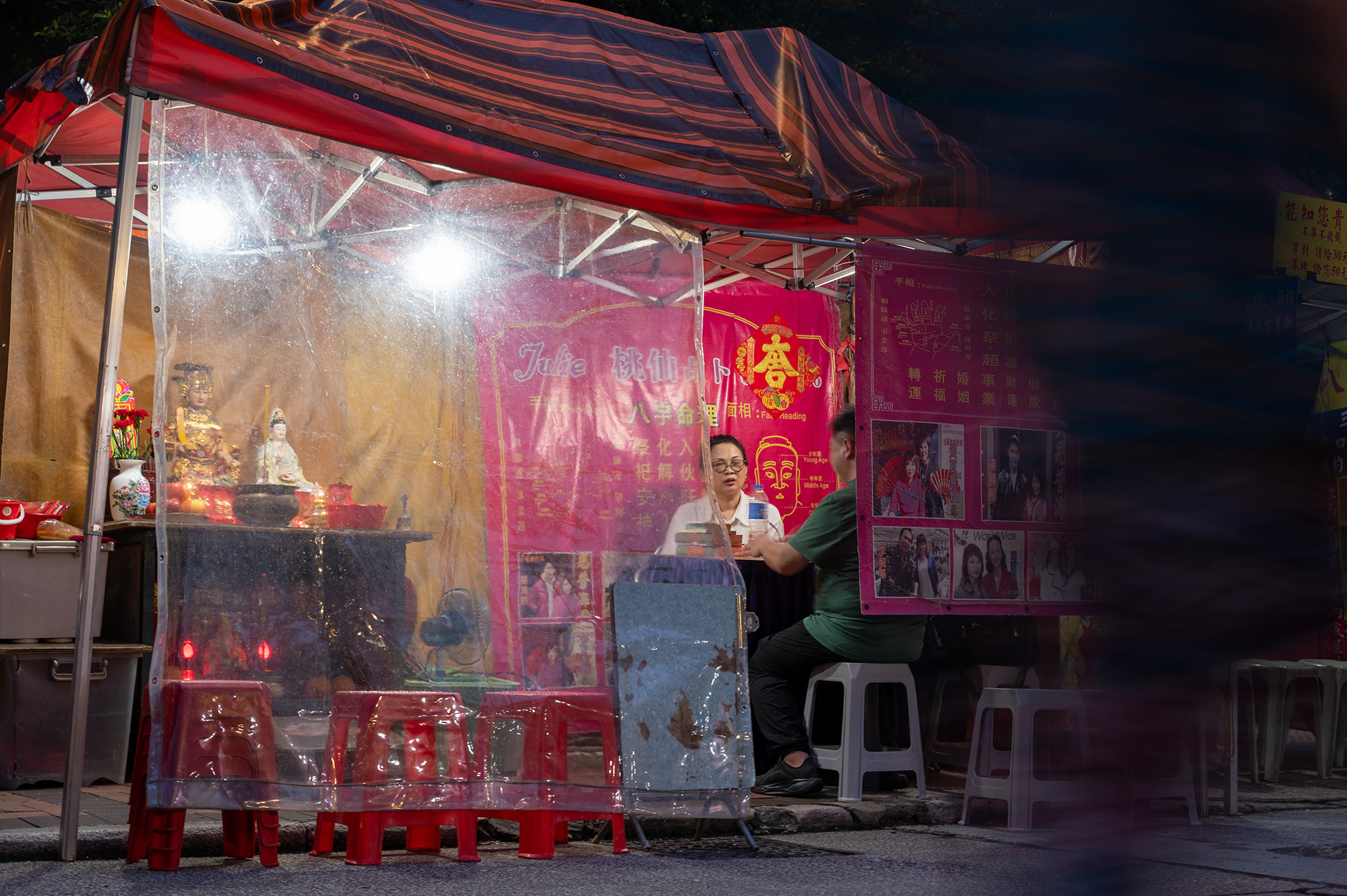
HONG KONG - The inconspicuous, narrow lane of Temple Street in Yau Ma Tei comes alive at dusk as two rows of stalls light up for the evening. Beneath heavy tarps draped over metal frames, anxious patrons sit with their backs facing the street as fortune tellers decode their destinies.
"I didn't just learn how to read fortunes. I was chosen by the deity," said stall owner Julie Siu in Cantonese. "I've heard this voice in my ear since I was young."
Recounting how her father lay in a hospital bed battling late-stage blood cancer 30 years ago, the 54-year-old said the voice told her to save him by feeding him ginseng water for three days.
"How my dad recovered after [I followed the instructions] was miraculous. I was very grateful to the deity, so I entered this line of work to repay its kindness," she added.
Long dominated by self-proclaimed mystics, Hong Kong's ancient metaphysical trade is reinventing itself, moving from street-corner superstition to university classrooms. Prospective students can now enrol in practitioners' private classes or formal courses offered by educational institutions.
At the University of Hong Kong School of Professional and Continuing Education (HKUSPACE), the extension arm of HKU, a first-ever diploma specialising in feng shui studies was introduced in November 2025, admitting around 60 students.
Feng shui practitioners seek to arrange one's environment in ways that improve or safeguard one's health, happiness and prosperity. It is often studied alongside other Chinese metaphysical branches, such as ba zi, which means "eight characters" in Mandarin.
Ba zi uses eight characters derived from one's birth year, month, day, and hour to analyse one's personality and potential, and predict their future.
Lee Boon Jang, who co-leads the institution's accounting and corporate governance programme, launched the course to introduce greater standardisation to the unregulated trade.
There are broadly five major schools of thought in feng shui, each with a different focus.
"If you ask two different masters, [they may] give you two different solutions [to the same problem]. Each has their own way of thinking, so which one is right?"
To address this, Lee designed the curriculum together with three feng shui masters, weaving elements from all five schools of thought into a coherent programme.
With feng shui-related courses at HKUSPACE attracting over 300 enrolments since 2018, Lee believes launching the diploma was timely in meeting growing demand and formalising the practice. The basic level of the diploma costs HK$6,650 (S$1,100).
Growing wiser
Among HKUSPACE's pioneer batch of feng shui trainees is Xie Xiaowen, 36, who first got into the subject by reading related books.
Beyond learning the technical aspects of feng shui and ba zi, the financial consultant said the knowledge reframed how she views adversity in people's lives.
"People will struggle for their goals. Trying their best to achieve something is good, but if something is just not meant for them, then they may fail and feel frustrated," she explained.
"But if they know this is written in their ba zi - already set, already designed - maybe they will let go."
She said that with this understanding, people may find another way to achieve better results, rather than feeling distraught over failures.
Meanwhile, others seek knowledge and skills from trusted veterans.
Building a career
While esteemed practitioners can make up to HK$40 million a year, budding feng shui master Tseng Hin Tang, 31, started out offering his services for free. He conducted about 400 consultations for colleagues, friends and strangers on Instagram.
His interest in metaphysics was first sparked while on a shoot with another feng shui master in 2023.
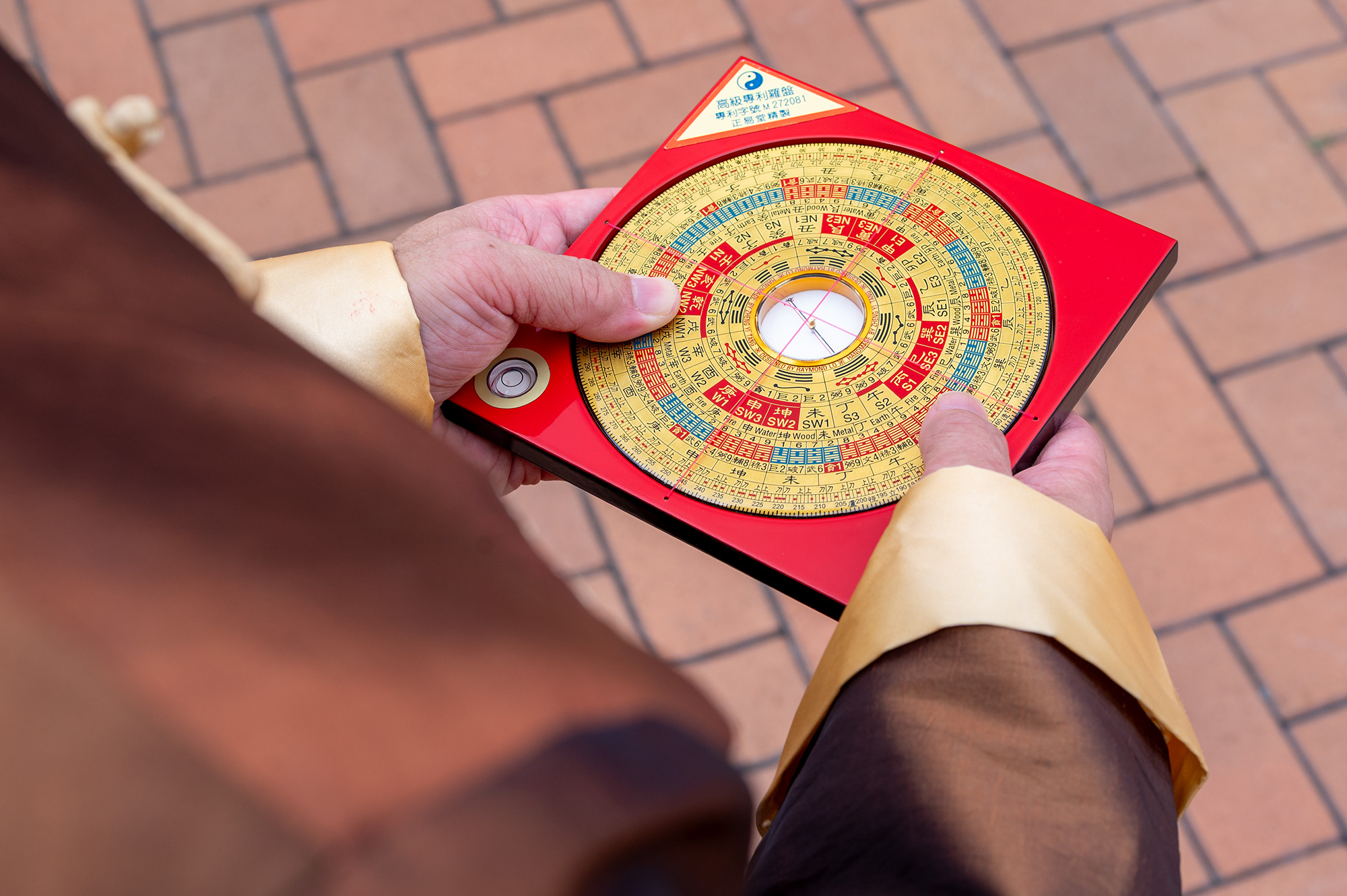
After three years of learning Chinese metaphysics, he attended weekly classes at Raymond Lo's Feng Shui School to formalise his feng shui knowledge.
Internationally accredited feng shui grandmaster Lo founded the school in 1993. Over the years, Lo has taught more than 600 students feng shui, ba zi and I Ching (a philosophical system that provides moral guidance) from his cramped Tsim Sha Tsui office, which accommodates no more than 10 students at a time.
As Tseng reconsidered his career as a video director, he began exploring feng shui and divination methods like qi men dun jia. Unlike ba zi, which paints the big picture of a person's life, qi men dun jia provides time-specific guidance in decision-making. His eventual resignation in May paved the way for a career switch.
"I foresaw that the [video] industry would soon be replaced by AI (artificial intelligence), and... I disliked the prevailing attitude towards [it] in Hong Kong, where we were often looked down upon and considered cheap," he explained.
[[nid:645951]]
Tseng also believes that the interpretive nature of Chinese metaphysical outcomes means the field always necessitates human judgement - and is hence irreplaceable by AI.
"Whether something is good or bad is subject to interpretation in Chinese metaphysics," he said.
For example, while wealth might be objectively positive, both possessing wealth and lacking it can each be interpreted positively and negatively, he added.
"Possessing wealth could mean greater stress to upkeep it, while not having wealth could mean peace of mind and attaining joy more easily... it depends on the person."
Tseng began charging for consultations in January and had seen almost 20 paying clients by August. He charges HK$680 for reading a year's fortune and up to HK$2,380 for reading one's life.
Chinese metaphysics meets the West
Italian interior and product designer Alice Mandelli, 31, is trying to bring her Chinese metaphysical knowledge home to Italy from Hong Kong.
She first encountered feng shui while residing in mainland China's Zhejiang province in 2024.
"I felt as if some spaces would have a different kind of energy... and being a designer, I knew for sure that it was not just about the furniture... [or] arrangement," she explained. "I felt that there was something I didn't know that was really big."
It first dawned on her in a garden. Pointing out the flowing shapes of fences and round windows, Mandelli said every design choice felt intentional and harmonious.
"I even remember [hearing] wind chimes, and... that sound really stayed with me," she added about the typical feng shui feature.
She discovered grandmaster Lo's classes while attending the International Feng Shui Convention in Cambodia in 2025, subsequently enrolling in March and June this year.
To Mandelli, feng shui "just makes sense".
She felt her prior training in form, function and ergonomics left an unaddressed gap that feng shui bridged - how the energy of a space can affect the occupant's well-being.
"People in Italy can be sceptical when you talk about energy, but I want to believe in a world where different values and ways of thinking come together."
Given her goal of enhancing people's well-being through design, Mandelli said she could not dismiss feng shui and its potential to improve a home.
She wants to thoughtfully incorporate feng shui into designs for her Italian customers while remaining respectful of the practice. An example could be opting for metal furniture if an area calls for more metallic elements, she said.
"It's special that I can look at a floor plan and read it in two different ways," she added. "I'm not only asking myself whether the layout works technically, but also what the space is doing to the person using it."
Long live feng shui
Up-and-coming feng shui master Tseng believes that Chinese metaphysics is grounded in some truth, given that it has lasted for thousands of years.
"I might not always believe in feng shui," he confessed, acknowledging its subjectivity. "But I fully believe that there are things at play in our world that we cannot immediately comprehend - and feng shui is one of the ways we can seek answers."
The age-old desire to peek into and shape one's fate, alongside a steady stream of aspiring masters - whether learning under a veteran or seeking formal certification - means that feng shui is here to stay.
[[nid:608974]]
editor@asiaone.com


