

Which countries can we travel to when Covid-19 restrictions ease?

PHOTO: Pexels

Since Covid-19 started, I’ve learned to embrace spending long weekends in Singapore instead of being in a different part of the world.
These breaks now feel more intentional, allowing me to rest up without feeling the urge to fill it with activities.
That being said, I still miss the days of drafting Google docs, creating jam-packed itineraries, finding the most value-for-money travel insurance , and setting countdown timers for my next adventure.
With the Singapore-Hong Kong Air Travel Bubble playing with our hearts…
It felt like music to my ears when the Government announced recently that air travel might be possible from early September onwards.
Do you mean that we get to see this view again soon?
This is when about 80 per cent of the country’s population is fully vaccinated.
Singapore might be establishing travel corridors and allowing overseas travel to countries or regions with their Covid-19 situation under control.
This means that travel restrictions will be reviewed really soon.
So what’s going to happen and what can I look forward to?
Let’s take a quick look!
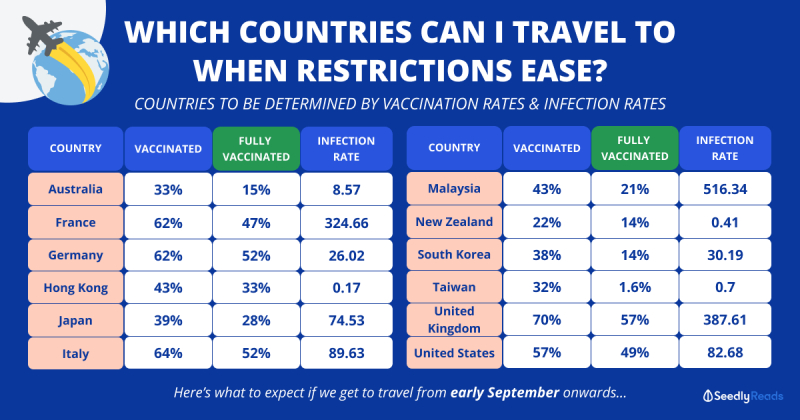
According to an interview with Health Minister Ong Ye Kung, there are two main factors that determine whether countries can be considered as an option for leisure travel.
Here are some statistics of countries that Singaporeans typically head to:
| Country/Region | Vaccination Rate (As of Aug 2, 2021) |
Infection Rate (As of Aug 2, 2021) |
|
|---|---|---|---|
| Vaccinated | Fully vaccinated | Daily new confirmed cases (per million) | |
| Australia | 33 per cent | 15 per cent | 8.57 |
| France | 62 per cent | 47 per cent | 324.66 |
| Germany | 62 per cent | 52 per cent | 26.02 |
| Hong Kong | 43 per cent | 33 per cent | 0.17 |
| Indonesia | 17 per cent | 7.6 per cent | 143.05 |
| Japan | 39 per cent | 28 per cent | 74.53 |
| Italy | 64 per cent | 52 per cent | 89.63 |
| Malaysia | 43 per cent | 21 per cent | 516.34 |
| Maldives | 61 per cent | 49 per cent | 210.63 |
| New Zealand | 22 per cent | 14 per cent | 0.41 |
| South Korea | 38 per cent | 14 per cent | 30.19 |
| Switzerland | 54 per cent | 48 per cent | 82.48 |
| Taiwan | 32 per cent | 1.6 per cent | 0.7 |
| Thailand | 18 per cent | 5.2 per cent | 241.53 |
| UK | 70 per cent | 57 per cent | 387.61 |
| US | 57 per cent | 49 per cent | 240.85 |
| Vietnam | 5.8 per cent | 0.6 per cent | 82.68 |
Source: Our World in Data
While the list of countries approved for leisure travel’s still pending confirmation, Mr Ong mentioned that some possible countries for travel would include the United States, Hong Kong, and some parts of the European Union given their rising vaccination rates.
[[nid:537962]]
If everything goes well, we can probably expect more news with regards to the easing of restrictions in the next couple of weeks.
Also, with people being able to travel with fewer restrictions, Singapore expects to see an increase in imported cases.
However, the focus will be on the number of patients that require intensive care, instead of daily case numbers given the higher rates of vaccination.
FYI, here are the countries that allow travel for business as of July 29, 2021 according to Nikkei Asia.
| Destination | Allowed or not allowed? |
|---|---|
| Australia | Not allowed |
| Bangladesh | Allowed |
| Cambodia | Allowed |
| China | Allowed only to Chongqing, Guangdong, Jiangsu, Shanghai, Tianjin and Zhejiang |
| Hong Kong | Not allowed |
| India | Allowed |
| Indonesia | Not allowed |
| Japan | Not allowed |
| Macao | Not allowed |
| Malaysia | Allowed |
| Mongolia | Allowed |
| New Zealand | Not allowed |
| Pakistan | Allowed |
| Philippines | Allowed |
| South Korea | Allowed |
| UK | Allowed with no or brief quarantine |
| US | Allowed |
| Vietnam | Allowed |
Given how the easing of restrictions is correlated to our vaccination rates, a different set of rules would apply for those who have been fully vaccinated.
According to Finance Minister Lawrence Wong, those who are fully vaccinated may not have to serve the full 14-day stay-home notice (SHN).
This means that we do not have to be stuck in a hotel for two weeks before being able to kickstart our travels!
Instead, he or she might just require either a ‘rigorous testing regime’ or a shorter isolation period of seven days.
[[nid:536250]]
(An individual is considered fully vaccinated two weeks after receiving the second dose.)
For those who are unvaccinated, leisure travel can still happen.
However, they will still be required to abide by additional restrictions.
This might include having to take Covid-19 Polymerase Chain Reaction (PCR) tests and adhering to 14-day SHNs.
As a brief recap, here’s how much a PCR test would cost for a trip to Hong Kong:
Pre-Departure Covid-19 PCR Test in Singapore: Up to S$200
On-Arrival Covid-19 PCR Test in Hong Kong International Airport: HKD$499 (S$87)
Pre-Departure Covid-19 PCR Test in Hong Kong: HKD$499
On-Arrival Covid-19 PCR Test in Singapore Changi Airport: S$160
A total of about S$530 on just tests alone.
According to Brendan Sobie, founder of Singapore-based independent aviation consulting firm Sobie Aviation, there could be sufficient demand for new routes to be launched following the recovery of air travel.
It basically means having new long-haul flights to countries that didn’t previously have a market large enough to support such services.
This could mean having non-stop flights from Singapore to countries like Canada, Hungary, Ireland, and Israel for the first time.
Having the option of traveling again is indeed exciting and heartening at the same time.
It can be seen as an indication of how life is slowly going back to how it used to be, albeit a little slower than what we expected.
[[nid:535236]]
That being said, I’m pretty sure I’d hold off my plans on traveling given how air ticket prices would probably soar to new heights, as everyone scrambles to scratch that wanderlust itch.
I mean, unless I manage to miraculously win TOTO lah…
Also, having something that I used to take for granted taken away from me allows me to appreciate it a lot more as well.
To be able to travel is indeed a privilege, a convenient mental escape for a white-collared worker who spends her days counting down to long weekends.
And I look forward to spending my New Year’s Eve on a crowded street in a faraway city someday again.
This article was first published in Seedly.