

How Malaysia's Budget 2027 benefits ordinary citizens in giving them a share of the country’s wealth and success

The government expects the changes to increase disposable income by up to RM1,600 for about five million taxpayers
PHOTO: Malay Mail

KUALA LUMPUR - Prime Minister and Finance Minister Datuk Seri Anwar Ibrahim tabled Budget 2027 yesterday (Oct 9), the fifth by his administration, appearing to shift greater focus towards ensuring that ordinary Malaysians benefit from economic growth and reforms pursued over the past four years.
The national budget totalling RM510 billion (S$159 billion), up from RM470 billion in Budget 2026, was tabled amid elevated global fuel prices and Malaysia's ageing population, and could be the final one before the 16th General Election (GE16).
After years of focusing on economic stability, fiscal discipline and reforms, Budget 2027 appears to place greater emphasis on ensuring that the gains from these efforts are felt by ordinary Malaysians in their daily lives, with living costs still pinching households.
To this end, Anwar has sought to boost household incomes through higher wages and cash aid, more support for businesses and stronger safety nets through tax reliefs and incentives in Budget 2027.
Reforms remain high on his administration's agenda, with Anwar promising further measures to tighten oversight of government procurement and the management of public funds in 2027.
Here's a snapshot of what makes Budget 2027:
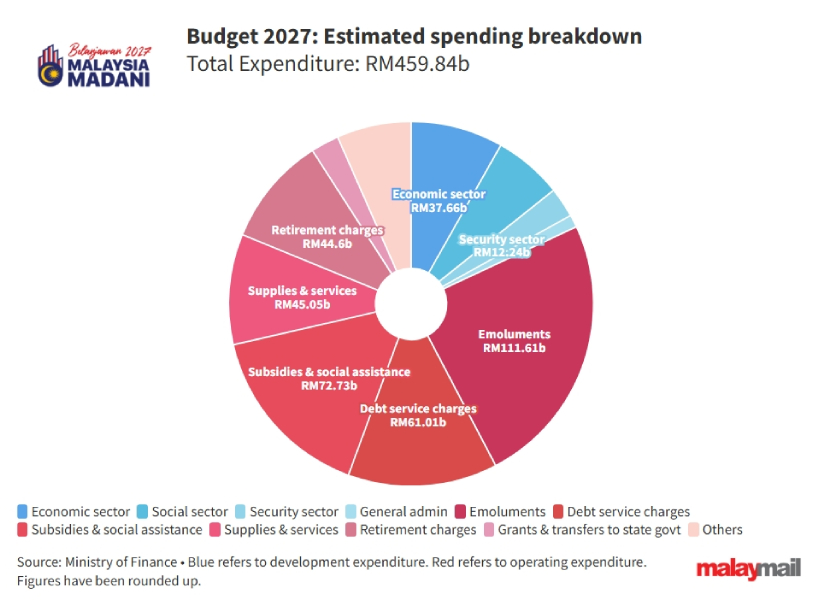
The government will increase the allocation for Sumbangan Tunai Rahmah (STR) and Sumbangan Asas Rahmah (SARA) to RM16 billion, from RM15 billion.
Individual income tax relief will increase from RM9,000 to RM12,000, while tax rates will be lowered by one percentage point for selected income brackets.
The government expects the changes to increase disposable income by up to RM1,600 for about five million taxpayers.
Tax relief will also be expanded to cover postnatal care, care expenses for parents and grandparents, sports shoes, tuition for children, subscriptions to artificial intelligence services, vaccinations and adoption costs for pets from registered centres.
The minimum wage will increase from RM1,700 to RM2,000 a month from June 2027, affecting more than four million workers.
Small and medium enterprises with annual sales below RM50 million will be given time to adjust their business models.
The government also announced a starting minimum wage of RM2,500 a month for semi-skilled occupations and graduates.
Government-linked investment companies and government-linked companies will raise their living-wage benchmark from RM3,100 to RM3,400 a month, benefiting about 230,000 workers.
For e-hailing and p-hailing workers, the government and Grab will jointly fund a RM160 million package from 2027 to improve net income and welfare.
This package is expected to increase median-level e-hailing drivers' net income by up to RM227 a month and p-hailing riders' income by up to RM100 a month. It also includes matching contributions to Social Security Organisation (Perkeso) schemes, with the government's contribution rising from 35 per cent to 50 per cent if platform companies also contribute.
E-hailing and p-hailing workers will also be eligible for Employees Provident Fund (EPF) matching contributions of up to RM600 a year or RM6,000 over their lifetime.
All Malaysian citizens will also be registered automatically as EPF members when they turn 18.
The government will increase several forms of education assistance and expand support for students.
The government will also allocate RM800 million for higher education infrastructure, including lecture rooms, student residences and replacement of ageing equipment.
Education and healthcare remain among the largest areas of federal spending.
The Education Ministry will receive nearly RM69 billion, up from RM66.2 billion this year, Health Ministry will receive RM47.7 billion, the Higher Education Ministry will get RM19.1 billion and the Home Affairs and Defence ministries will each receive RM22 billion.
For schools, the allocation to repair and maintain all types of schools will double from RM1 billion to RM2 billion - am allocation that includes repairs for national schools, Chinese national-type schools, Tamil national-type schools and registered rakyat religious schools, tahfiz institutions and pondok schools.
A further RM1.3 billion will be provided to upgrade 682 dilapidated schools, particularly in Sabah and Sarawak.
The government also expects 3,500 additional classrooms to be completed by the end of this year to accommodate more Year One pupils.
For public healthcare, RM1.2 billion will be allocated to maintain and repair hospitals and clinics, while more than RM770 million will go towards modern medical equipment, including 400 new ambulances and upgraded haemodialysis facilities.
Nine new healthcare facilities will be built, including a specialist complex and day-treatment centre at Hospital Sultanah Aminah in Johor, a specialist dental centre in Kuching, and integrated health complexes in Gerik, Perak, and Rembau, Negeri Sembilan.
More than 9,000 contract doctors will be made permanent medical officers at public healthcare facilities next year. Paramedics and nurses will receive RM200 post-basic incentives monthly while Air Health Service staff will receive RM100 monthly.
The government will also introduce the MediAsas affordable medical plan in January 2027.
EPF members aged below 55 can pay their premiums using their Akaun Sejahera.
Meanwhile, small and medium enterprises (SMEs) with fewer than 75 employees will receive a first-year premium subsidy of RM200 per worker, capped at 50 workers per company.
The scheme is expected to benefit up to 200,000 workers.
PeKa B40 will continue offering free health screenings, medical equipment assistance and cancer-treatment incentives for STR recipients and their spouses aged 40 and above, with RM80 million allocated.
MySalam will also continue, while the Medical Aid Fund will increase from RM40 million to RM60 million.
Welfare assistance for senior citizens will receive RM1.3 billion, benefiting nearly 200,000 recipients.
The monthly allowance for caring for bedridden people with disabilities and the chronically ill will increase from RM500 to RM600, while the income threshold for the disabled workers' allowance will increase from RM1,700 to RM2,000.
Anwar also reduced the service tax rate for elderly care services from eight to six per cent, with a full exemption on fees up to RM96,000 annually. Some 8,000 caregivers will also be trained through an allocation of RM40 million under HRD Corp.
Pupils with special educational needs will also receive a higher allowance of RM200, while the teaching incentive for special education teachers will increase from RM250 to RM300 a month.
Two new Permata Kurnia centres - a Malaysian early intervention and education programme for children with autism - will be built in Melaka and Pahang, alongside more than 130 new Tabika Tunas Istimewa classes in rural areas.
Public transport users will benefit from continued subsidised passes and investments to improve services.
The first phase of the ECRL, from Kota Bharu to the Gombak Integrated Transport Terminal, is expected to begin operating in December 2026, while a bus station will also be built at the Kota Bharu ECRL station.
Rural communities will receive RM3.3 billion for basic infrastructure, including roads, community facilities, clean water and electricity. The allocation for rural roads will rise to RM2.3 billion.
The National Non-Revenue Water programme will receive RM2.5 billion to replace 1,900km of ageing critical pipes.
Under the Jendela connectivity initiative, the government plans to extend 4G coverage to all Orang Asli villages, improve internet connectivity along 7,000km of roads and 1,700km of railway lines, and implement the Madani Undersea Cable project.
Road projects in Sabah and Sarawak will receive RM3.3 billion, while another RM350 million will be set aside for federal road maintenance by small contractors in both states.
Sabah will receive RM18.7 billion in federal allocation, up from RM17.6 billion this year, while Sarawak will receive RM16.2 billion, up from RM15.1 billion.
In Sabah, RM204 million will be spent on installing STATCOM systems at the Dam Road and Segaliud substations, while the Southern Link transmission line project will continue.
The federal government will also provide RM600 million to ensure electricity supply continuity in Sabah.
Flood mitigation projects will continue in Kuching, Sarawak, while the second phase of Sungai Golok in Kelantan and Sungai Kemaman in Terengganu.
Nearly RM320 million will be allocated to repair and upgrade slopes, drains and monsoon drains under local authorities, while the National Disaster Management Agency will receive RM260 million.
Financial assistance to repair homes damaged by disasters will increase from RM5,000 to RM10,000.
Nearly RM1 billion will be allocated for Rumah Mesra Rakyat and Residensi Rakyat housing projects. Four new housing projects will be implemented in Kulai, Johor; Nilai, Negeri Sembilan; Paya Rumput, Melaka; and Lembah Pertang, Terengganu.
The Syarikat Jaminan Kredit Perumahan will provide housing financing guarantees of up to RM20 billion, aimed at helping 80,000 borrowers.
In Kuala Lumpur, the Dewan Bandaraya Kuala Lumpur (DBKL) will set aside RM400 million to create 120 acres of new green spaces, restore existing parks and upgrade public facilities and housing.
A 100-acre leased site in Bukit Kiara will be gazetted as a Federal Park.
DBKL will also build 22km of covered pedestrian walkways linking places including the National Mosque, Dataran Merdeka and Pasar Seni, as well as residential areas with shops, schools, clinics and public transport.
The government has allocated RM2.3 billion for public servants' quarters.
New army family housing will be built in Skudai, Johor, alongside quarters in Langkap, Perak, and Papar, Sabah, benefiting about 900 personnel.
Allowances for volunteers in Rela, volunteer fire brigades, volunteer police and civil defence will rise to RM9 an hour for volunteers and RM10.80 an hour for supervisors.
The RM339 million allocation is expected to benefit about 50,000 volunteers.
[[nid:747244]]