BANGKOK — Asian shares tumbled Wednesday (March 4), with South Korea's benchmark plunging as much as 11 per cent, while oil prices climbed even higher.
Worries over the widening war with Iran have hammered most world markets. Higher oil prices and how much they might worsen inflation are spooking investors worried that more spikes for oil prices may grind down the global economy and sap corporate profits.
South Korea's Kospi led the regional losses as energy security concerns vanquished optimism over the boost Big Tech companies like Samsung Electronics and SK Hynix have been getting from expanding use of artificial intelligence.
By midday, the Kospi was down 9.6 per cent at 5,235.72. Samsung's shares dropped more than 10 per cent, while SK Hynix gave back eight per cent.
The Korea Exchange temporarily halted trading for the Kospi index, while a circuit breaker was also triggered on the tech-oriented Kosdaq after it fell by more than eight per cent.
South Korea's stock market has been one of the world's best performers this year, driven by semiconductor stocks lifted by the global boom in artificial intelligence. But concerns are growing over the outlook for the economy that's heavily dependent on trade and fuel imports, as the war in the Middle East spirals and Iran threatens to shut down the Strait of Hormuz, the narrow gateway to the Persian Gulf through which roughly a fifth of globally traded oil passes.
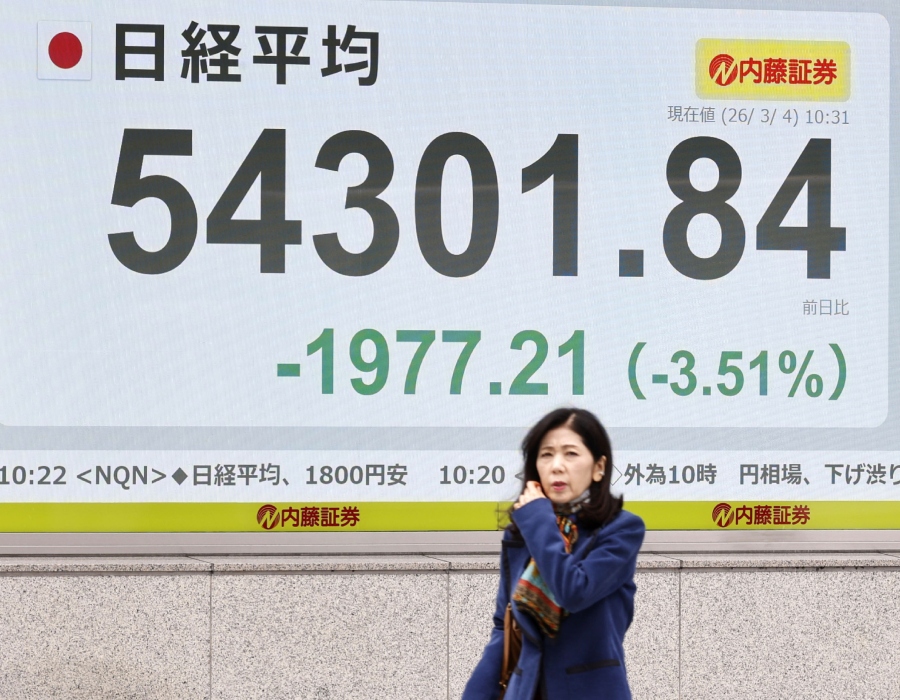
In Tokyo, the Nikkei 225 shed 3.9 per cent to 54,090.11. Japan, like South Korea and Taiwan, depends heavily on imports of oil and natural gas from the Middle East that are now stranded in the Persian Gulf.
Elsewhere in Asia, the Hang Seng in Hong Kong fell 2.8 per cent to 25,037.92 and the Shanghai Composite index shed 1.3 per cent to 4,069.09.
In Australia, the S&P/ASX 200 declined two per cent to 8,896.50.
Taiwan's Taiex lost 3.4 per cent and shares in Jakarta sank 3.7 per cent.
On Tuesday, the S&P 500 finished with a loss of 0.9 per cent, at 6,816.63, after dropping as much as 2.5 per cent on concerns over the war's damage to the economy. The Dow Jones Industrial Average pared its loss to 0.8 per cent, closing at 48,501.27.
The Nasdaq composite fell one per cent to 22,516.69.
In the bond market, Treasury yields leaped in the morning with worries about inflation. The yield on the 10-year Treasury briefly rose above 4.10 per cent before pulling back just below 4.06 per cent. It was at 4.05 per cent late Monday and just 3.97 per cent on Friday.
Higher yields can make it more expensive for US households and businesses to borrow money, affecting everything from mortgages to bond issuances. They also put downward pressure on prices for stocks and all kinds of other investments.
Some analysts say they don't think this is the beginning of a long-term down market and that stocks could rebound if the war doesn't last that long. But they acknowledge it could take a while for that to become clear, and Tuesday's swings for markets showed how uncertain things are.
The more evident impact was on the average price of a gallon of gasoline, which jumped 11 cents overnight in the US Drivers in Europe and some Asian cities waited in line to fill their tanks with fuel.
In the US, a gallon of regular was selling for US$3.11 (S$3.98) on average, according to motor club AAA, surprising some drivers at the pump. Gasoline prices were already rising before the US launched strikes on Iran as refiners switch over to summer blends of fuel.
While the US does not face a shortage as a net oil exporter, prices are influenced by global market trends.
Higher inflation partly due to the war could tie the Federal Reserve's hands and keep it from cutting interest rates. The Fed lowered rates several times last year and indicated more cuts were to come in 2026. That would help boost the economy and job market, but lower rates can also worsen inflation.
The price of US benchmark crude oil climbed 1.2 per cent to $75.46 per barrel. Brent crude, the international standard, gained 1.5 per cent to $82.61 per barrel.
The dollar was nearly unchanged at 157.55 Japanese yen (S$1.28). The euro slipped to $1.1599 from $1.1600.
[[nid:730767]]



