

Asian stocks mostly lower after Wall Street's worst day since start of Iran war
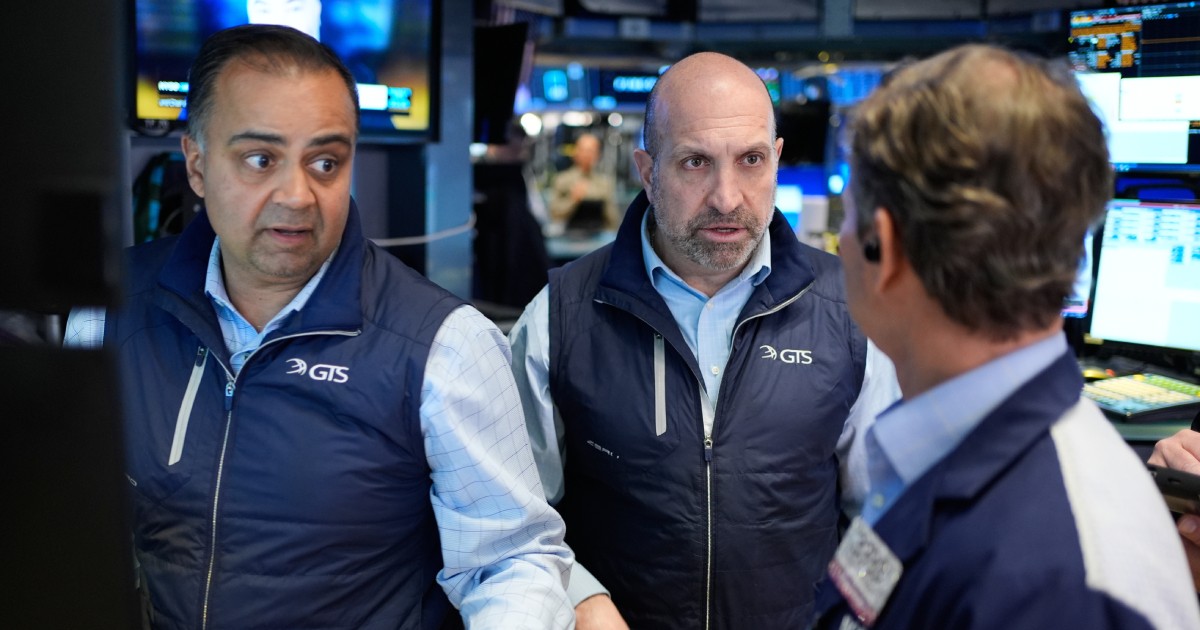
James Denaro (centre) and Dilip Patel work on the floor at the New York Stock Exchange in New York on Wednesday (March 25).
PHOTO: Associated Press

HONG KONG — Asian shares mostly fell and oil gained again Friday (March 27) after Wall Street had its worst day since the start of the Iran war over growing doubts about a de-escalation.
Tokyo's Nikkei 225 closed 0.4 per cent lower at 53,373.07.
South Korea's Kospi also lost 0.4 per cent to 5,438.87, narrowing the sharp drop earlier in the day at trading close.
Hong Kong's Hang Seng was up 0.4 per cent to 24,952.98 after dipping earlier in the day, while the Shanghai Composite index traded 0.6 per cent higher at 3,913.72.
Australia's S&P/ASX 200 fell 0.1 per cent to 8,516.30.
Taiwan's Taiex was 0.7 per cent lower, while India's Sensex lost 1.7 per cent.
On Thursday, Wall Street fell to its worst drop since the Iran war began, with the S&P 500 sinking 1.7 per cent for its worst day since January to 6,477.16.
The Dow Jones Industrial Average fell one per cent to 45,960.11.
The Nasdaq composite slumped 2.4 per cent to 21,408.08, and is off 10 per cent below its recent all-time high in what is considered a "correction".
Expectations this week of de-escalation negotiations between Washington and Tehran have sent markets into disarray.
Shortly after Wall Street trading closed Thursday, US President Donald Trump said he was postponing a threatened attack on Iran's energy facilities as he further delayed until April 6 a deadline for Iran to reopen the Strait of Hormuz, a critical waterway for oil and gas transport.
US futures were up 0.3 per cent on Friday.
Oil prices gained in early Friday trading.
Brent crude futures, the international standard, was one per cent higher at US$102.92 (S$132.41) per barrel.
Benchmark US crude rose 0.8 per cent to US$95.25 a barrel.
Doubts over a possible end to the war grew after Iran rejected a US ceasefire proposal and issued a counterproposal, while the US was sending more troops to the region.
The war, now in its fourth week, is likely to fuel global inflation and impact economic growth of many countries amid rising energy costs and trade disruptions.
The Strait of Hormuz has been largely closed since the start of the Iran war, although Iran has said the strait is only closed to its enemies.
It appears recently to have set up a "toll booth" for vessels transiting the strait, with Lloyd's List Intelligence reporting that some ships are paying for passage in China's yuan currency.
In other dealings early Friday, gold and silver prices rose. Gold's price was up 1.6 per cent to US$4,446.90 per ounce.
The price of silver was 2.7 per cent higher to $69.74.
The US dollar rose to 159.95 Japanese yen (S$1.29) from 159.81 yen.
The euro was trading at US$1.1525, down from US$1.1527.
[[nid:731851]]