

Condo rental prices and volumes hit all-time highs in July 2026

Singapore's condo rental market reached two milestones, with both rental prices and transaction volumes climbing to their highest levels on record.
PHOTO: AsiaOne/Danial Zahrin

Singapore's condo rental market reached two milestones in July 2026, with both rental prices and transaction volumes climbing to their highest levels on record.
The strong month came as leasing activity picked up after a quieter June, with the post-school-holiday period likely contributing to the rebound in transactions.
The HDB rental market also strengthened in July, with both rents and rental activity increasing from the previous month. However, unlike the condo market, HDB rental volumes remained lower year-on-year.

Overall condo rents increased by 1.6 per cent from June 2026, bringing prices to a new all-time high.
Rental prices rose across all three market segments:

The OCR recorded the strongest monthly growth, with rents rising 2.2 per cent. While July's increase pushed condo rents past their previous record, the longer-term trend has been more measured.
Overall condo rents were 2.5 per cent higher than in July 2025, considerably more moderate than the latest month-on-month increase might suggest.
Luqman Hakim, Chief Data & Analytics Officer at 99.co, noted that the latest record should therefore be viewed in context, "While rents remain elevated, growth over a longer period has been more gradual", he noted.
This is also reflected in broader URA data, which showed private residential rents rising 0.7 per cent in Q2 2026 and 1 per cent over the first half of the year.
In other words, July saw a noticeable step up in rents, but it does not necessarily point to rental prices continuing to rise at the same pace in the months ahead.
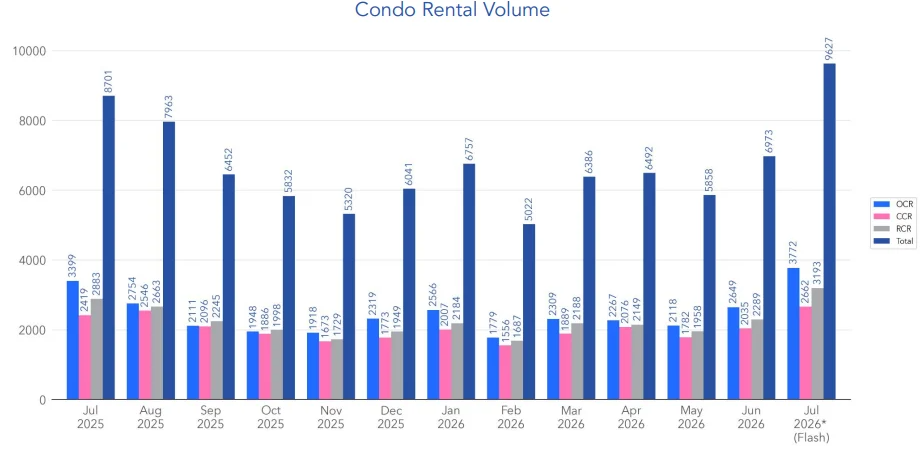
The bigger movement in July came from transaction activity. An estimated 9,627 condo units were rented, up from 6,973 units in June.
This represented a 38.1 per cent month-on-month increase and marked the highest monthly condo rental volume on record.
Rental activity was also strong when compared over a longer period:
The OCR accounted for the largest proportion of condo rental transactions at 39.2 per cent, followed by the RCR at 33.2 per cent and CCR at 27.7 per cent.
However, the increase from June may partly be seasonal rather than a sudden surge in underlying rental demand. According to Luqman, leasing activity typically picks up after the June holiday period.
A similar pattern was recorded in July 2024, when condo rental volumes jumped 35.1 per cent month-on-month as activity resumed following the school holidays. July 2026's 38.1 per cent increase therefore appears particularly large partly because it follows a softer June.
Beyond seasonal factors, the slower pace of new private housing completions could also be supporting rents. In the first half of 2026, 2,483 private residential units, including ECs, were completed, following 7,996 completions for the whole of 2025.
With fewer new homes being completed in the immediate term compared with recent years, the potential rental pool may also expand more gradually. This could keep rents firm, particularly for homes in well-connected locations.
Still, July's 1.6 per cent monthly increase should not be taken to mean similarly large rental gains will continue month after month.
The more moderate year-on-year increase, together with URA's broader rental data, points to a market where rents remain elevated but have been growing at a gentler pace over a longer horizon.

The HDB rental market also recorded stronger prices in July. Overall HDB rents increased by 1.7 per cent month-on-month and were 1.5 per cent higher than a year earlier.
Rents rose in both estate categories:
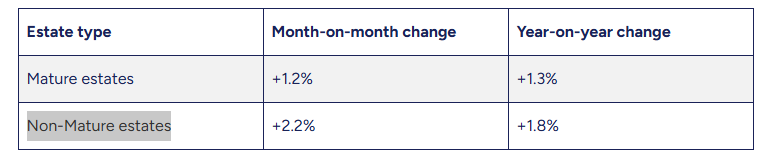
All flat types also recorded month-on-month rental increases, with Executive flats seeing the largest rise.
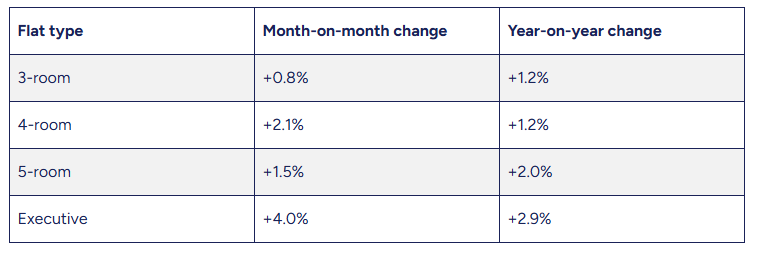
Despite the relatively strong monthly increase, the annual changes were again more moderate, with rents across all flat types increasing by less than 3 per cent year-on-year.
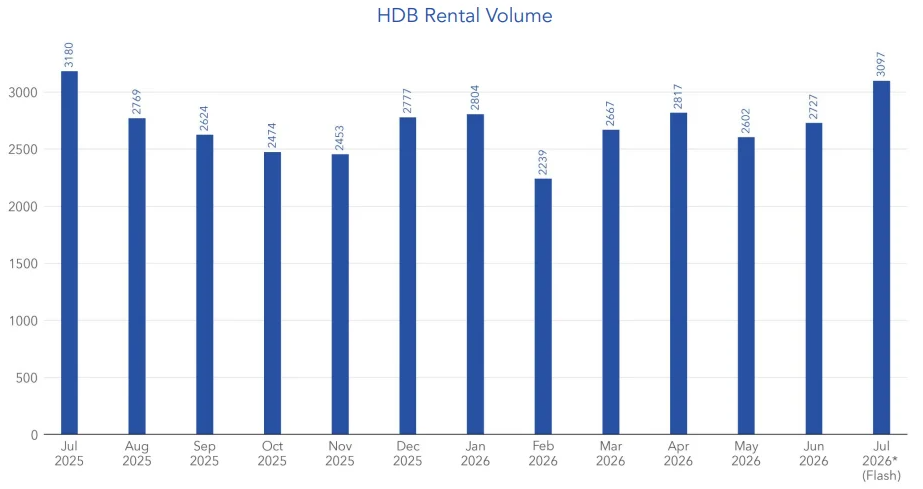
An estimated 3,097 HDB flats were rented in July, up from 2,727 units in June. This represented a 13.6 per cent month-on-month increase. Unlike the condo market, however, HDB rental volumes remained below their levels from a year earlier.
Volumes were:
Four-room flats continued to account for the largest share of HDB rental transactions at 37.5 per cent. Three-room flats made up another 31.8 per cent, followed by five-room flats at 24.4 per cent and Executive flats at 6.3 per cent.
HDB flats remain a relatively more affordable alternative for tenants who do not require private condominium facilities.
More flats could also enter the potential rental pool over time. Some 13,480 HDB flats are expected to reach their Minimum Occupation Period (MOP) by the end of 2026, expanding the number of homes whose owners may potentially sell or rent them out.
While not every newly MOP-ed flat will enter the rental market, additional supply could increase competition among landlords and provide tenants with more options. As Luqman explained, this could eventually help moderate rental growth.
[[nid:742792]]