

Over 600,000 holders of Singtel discounted shares to get direct ownership to sell for cash

Around 615,000 Singaporeans aged 50 and above will be able to cash out their Singtel special discounted shares.
PHOTO: AsiaOne file

SINGAPORE - Around 615,000 Singaporeans aged 50 and above are in for a surprise windfall should they be holders of Singtel special discounted shares (SDS).
The Central Provident Fund (Amendment) Bill was introduced in Parliament on April 7 to enable the proposed transfer of Singtel SDS from holders' CPF accounts to their Central Depository (CDP) accounts, enabling them to hold the shares under their own names and manage their shares directly.
Subject to the Bill being passed, the CPF Board will work with Singtel, CDP and other stakeholders to facilitate the transfer, after which the CPF Board will no longer be the trustee of the Singtel SDS.
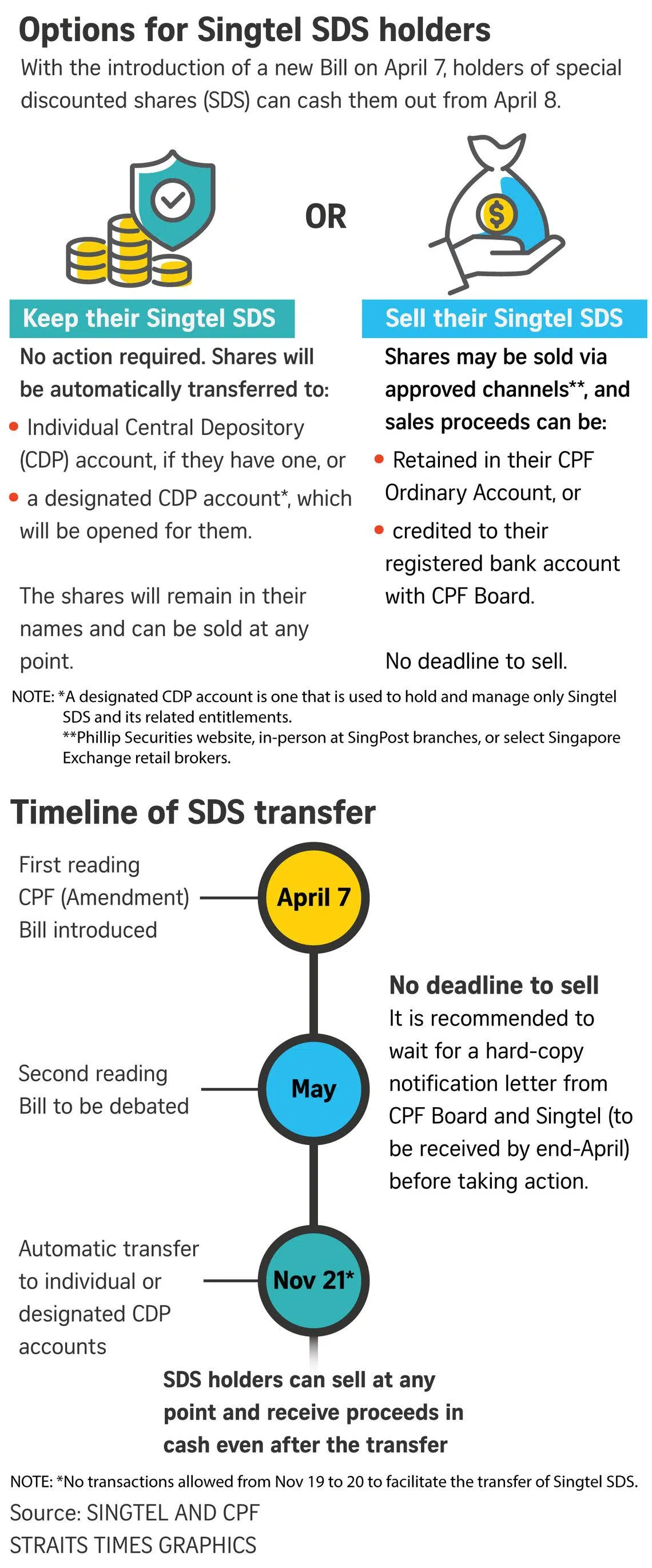
From April 8 onwards, Singtel SDS holders may also sell their shares for cash if they wish.
According to Singtel data, the median Singtel SDS holder owns 1,360 shares at an average purchase cost of $2,000. At the current market price of around $5 per Singtel share, those shares are now worth about $6,800.
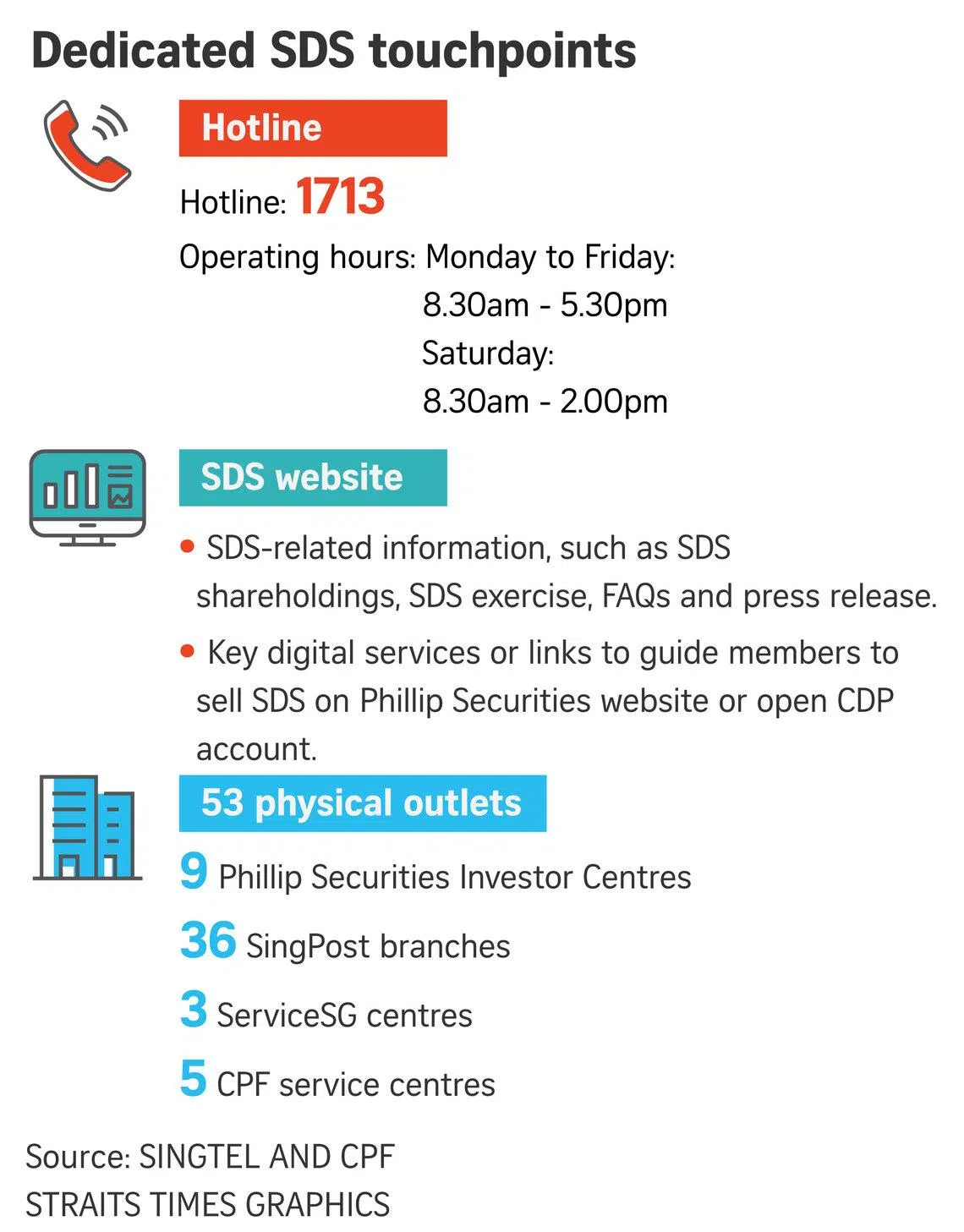
Singtel SDS holders may sell their shares through SingPost branches or on the website of local broker Phillip Securities. They can choose to retain the proceeds in their CPF Ordinary Account, or receive them in cash in their bank account registered with the CPF Board.
Singtel SDS were offered to CPF members in 1993, when they had the option to use their CPF savings to purchase the shares at a discount to Singtel's listing price of $1.90. A second tranche of Singtel SDS was offered in 1996. Additional loyalty shares were also distributed to SDS holders.
The median SDS holder would also have received around $5,000 in cumulative dividends since 1993. CPF said this alone would have more than covered the CPF savings used to purchase the Singtel SDS and the interest that holders would otherwise have received in their CPF Ordinary Account.
Should SDS holders decide to sell their shares, proceeds from the SDS sale will be paid within 14 business days from the date of their sale instruction, Singtel and CPF said.
For those who decide to hold on to their shares, Singtel will transfer their SDS from the CPF Board to the CDP accounts of affected shareholders, subject to Parliament's approval of the CPF (Amendment) Bill in May.
Singtel and CPF said the transfer is planned to take place on Nov 21. After the transfer, shareholders will be able to hold their Singtel ordinary shares and SDS within the same CDP account.
A designated CDP account will be opened for SDS holders who do not already have one.
All SDS holders will receive a notification letter in the post from the CPF board and Singtel by end-April, which will inform them of their exact Singtel SDS holdings, options available to them, and relevant touchpoints if they require clarifications.
They may also visit the official website at sds.singtel.com or call the hotline on 1713 for more information.
Given that a significant number of SDS holders are elderly citizens who may not be digitally savvy, Singtel and the CPF Board will also partner with the Agency for Integrated Care to reach out to this vulnerable community and inform them of the options available.
About 20,000 of these SDS holders have lower CPF balances and do not have CDP accounts, they said.
The SDS scheme was introduced in 1993 as part of the Government's efforts to give Singaporeans a stake in the Republic's economic success through share ownership.
Singtel was the first company to offer SDS shares when it transitioned from a statutory board to a listed company that year, and remains the only company to offer shares under this scheme.
The CPF Board was appointed as trustee to facilitate the share purchase, as share ownership was still a foreign concept among many Singaporeans at the time.
Today, with stock market trading ubiquitous, the SDS scheme has met its intent and the trustee arrangement to support share ownership is no longer necessary, CPF said.
Of the 615,000 SDS holders, close to 60 per cent already own individual CDP accounts, and around 25 per cent of them also own other Singtel ordinary shares.
The transfer of shares from the CPF Board to individual CDP accounts would allow Singaporeans to consolidate all their holdings, making it easier for them to track and trade their shares.
The move would also accord SDS holders full and direct shareholder rights, as they would previously have to go through a cumbersome process of applying to the CPF Board for any shareholder activities, including attending annual general meetings.
With this simplified shareholding structure, Singtel said it would have greater flexibility to carry out corporate actions in a timely, cost-efficient and less complex manner, giving the company more options to reward shareholders such as by issuing owner shares or dividends in specie, as well as fund growth initiatives.
The company's group chief financial officer Arthur Lang said the 710 million-odd Singtel SDS constitute 4.3 per cent of the telecommunications company's total shares outstanding. This amounts to approximately $3.6 billion in shareholdings out of Singtel's market cap of around $83 billion.
Furthermore, historical SDS sales make up less than 0.5 per cent of Singtel's average daily trading volumes. Thus, there is ample liquidity to absorb any potential increase in sales, he noted.
Mr Lang added that the company is well on track with its Singtel28 strategy, its growth plan announced in 2024, noting that Singtel has more than doubled its market cap. It intends to increase its investments in digital infrastructure, including cloud and artificial intelligence, alongside its growing data centre business.
The telco will become one of Asia's leading data centre players following its acquisition of ST Telemedia Global Data Centres (STT GDC) for $6.6 billion, which it announced in February.
Singtel's shares briefly rose 0.4 per cent to $5.06 when the market opened on April 7 before falling to $5 at the midday break.
Following the introduction of the Bill in Parliament, the counter rose 0.8 per cent to $5.04 at 1.31pm before dipping to $5.03. It closed the day 1.4 per cent lower at $4.96.
[[nid:732728]]
This article was first published in The Straits Times. Permission required for reproduction.