

Over 2,000 homes could come to Upper Changi and Simei

Three plots near Expo and Simei MRT stations could accommodate substantially more homes.
PHOTO: AsiaOne/Danial Zahrin

Three plots near Expo and Simei MRT stations could accommodate substantially more homes under proposed changes to Singapore's land-use plans. Here is what the plans may mean for future buyers and the wider housing market in the east.
Home buyers hoping to live in the east could eventually have more options near Expo and Simei MRT stations.
On Sept 18, the Urban Redevelopment Authority (URA) published proposed amendments to raise the gross plot ratios of three housing sites in Upper Changi and Simei. If approved, the changes would allow more floor area, and therefore potentially more homes, to be developed on each plot.
The three sites form part of five plots in the area that have been earmarked for housing. Collectively, the five sites could accommodate more than 2,000 homes if they are developed entirely for public housing.
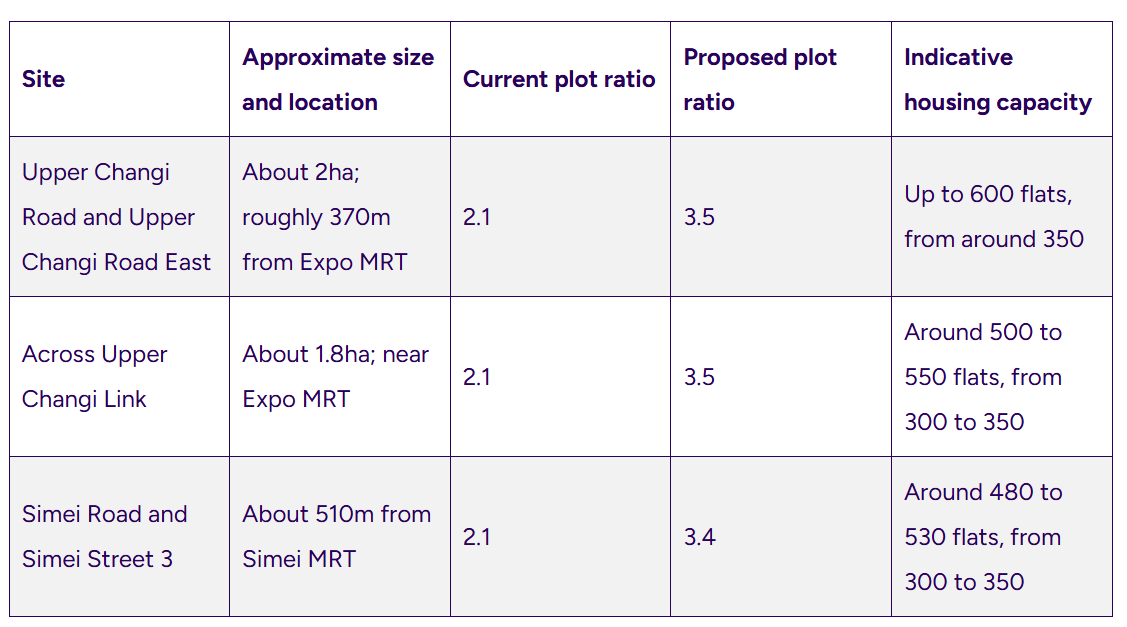
The largest of the three plots spans about 2ha and is approximately 370m from Expo MRT station. Its proposed plot ratio is 3.5, up from 2.1. At the higher density, the site could accommodate up to 600 flats. This would be around 70 per cent more than the roughly 350 flats estimated under the existing plot ratio.
The proposed amendments also set aside parts of the wider site for open space and roads. This suggests that the planning changes cover more than the residential blocks alone, although the detailed layout has not been released.
The second plot is across Upper Changi Link and covers about 1.8ha. Its plot ratio could similarly increase from 2.1 to 3.5. It is estimated to accommodate around 500 to 550 flats, compared with approximately 300 to 350 flats at its existing density.
URA's proposed amendments for the wider area include residential, park and road zones, with some land currently designated as a waterbody or road to be rezoned as park space. The eventual boundaries and connections will depend on the detailed site plan.
The third plot is near the junction of Simei Road and Simei Street 3, about 510m from Simei MRT station. URA has proposed raising its plot ratio from 2.1 to 3.4, slightly below the proposed ratio for the two Upper Changi plots.
The site could yield around 480 to 530 flats, up from the roughly 300 to 350 flats estimated under its current plot ratio. Part of the land is also proposed to be rezoned for a road.
The three sites above are among five plots in Upper Changi and Simei earmarked for housing. The other two could collectively accommodate up to 800 homes if they are developed entirely as public housing.
However, URA's 18 September amendments only cover the three sites above. Plot-level sizes, locations, proposed densities and individual housing estimates for the other two were not provided in the notice. Until more detailed plans are released, it would therefore be premature to assign a likely number or type of homes to either plot.
This places the potential capacity of all five sites at roughly 2,380 to 2,480 homes. The eventual number may differ depending on whether the sites are allocated for public or private housing, as well as their final layouts, unit sizes and supporting facilities.
URA first identified parts of Upper Changi for possible public and private housing during its Long-Term Plan Review in 2022.
The surrounding area currently contains a sizeable number of private condominiums and landed homes. Introducing public housing could create a broader mix of homes and allow more households to live near existing transport links, workplaces and educational institutions.
The location is one of the clearest advantages. Expo MRT is an interchange between the East-West and Downtown lines, while Upper Changi MRT is on the Downtown Line and Simei MRT is on the East-West Line. Depending on the site, residents could have direct rail connections towards the city, Tampines and Changi Airport.
The plots are also near Singapore University of Technology and Design and Changi Business Park. This could make future homes relevant not only to families with ties to the east, but also to buyers who work or study nearby and want to shorten their daily commute.
New housing may eventually support demand for more neighbourhood amenities as the residential population grows. However, the exact shops, community facilities, schools and pedestrian connections serving the sites will only become clearer when detailed plans are released.
Early demand from Simei Symphony suggests that new public housing in this part of the east can attract considerable interest.
Launched in July 2025 beside Upper Changi MRT station, Simei Symphony was the first BTO project offered in Simei in more than a decade. There were more than eight first-time applicants for each of its 100 five-room flats, while its 140 4-room flats drew more than six first-time applicants per unit.
The response may partly reflect the long gap since the previous Simei BTO launch, as well as the project's access to the MRT network and established amenities in the east. It does not guarantee that every future project will record the same application rates, especially as demand will depend on pricing, flat supply and the buyer eligibility rules in place at the time.
Still, the figures indicate a pool of buyers looking for new flats in or around Simei and Upper Changi. More sites could give these households additional opportunities instead of concentrating demand in a single project.
The proposed sites would add to the longer-term housing pipeline in the east, but their effect on the market is unlikely to be immediate.
For buyers, the main benefit is greater choice near MRT stations in an area where new public housing has been relatively limited. A larger and more varied supply could serve households that want to live near family members, workplaces or schools in the east.
Existing homeowners may also benefit from new amenities and improved connections that sometimes accompany a larger residential population. At the same time, nearby residents should expect that future construction could bring temporary noise, traffic and other disruption once development begins.
It is too early to conclude how the plans will affect resale prices. Proximity to an MRT station can support buyer interest, but future values will still depend on factors such as the type and pricing of the new homes, the supply available at the time, lease age, unit attributes and broader market conditions.
The proposed amendments were made available for inspection and public feedback from Sept 18 to Oct 2. They will be submitted to the Minister for National Development for approval before any approved changes are incorporated into the Master Plan.
Even then, the revised plot ratios would establish what may be developed on the land rather than confirm that construction will begin immediately. Separate announcements would still be needed to establish whether the plots will contain public or private housing, when they will be developed and how many homes will ultimately be built.
The proposed increase in density reflects a broader planning approach of placing more homes close to public transport. For Upper Changi and Simei, it could also diversify the housing mix in an area with many private developments and landed estates.
If all five earmarked plots eventually become public housing, more than 2,000 households could gain the opportunity to live near MRT stations, Changi Business Park and SUTD. Yet the proposal remains an early planning step. The type of housing, launch timing, prices and final number of homes will ultimately determine how accessible, and how competitive, these future projects will be.
[[nid:745658]]