

Two-thirds of Sentosa Cove properties resell at a loss, with average loss topping $1m since 2023
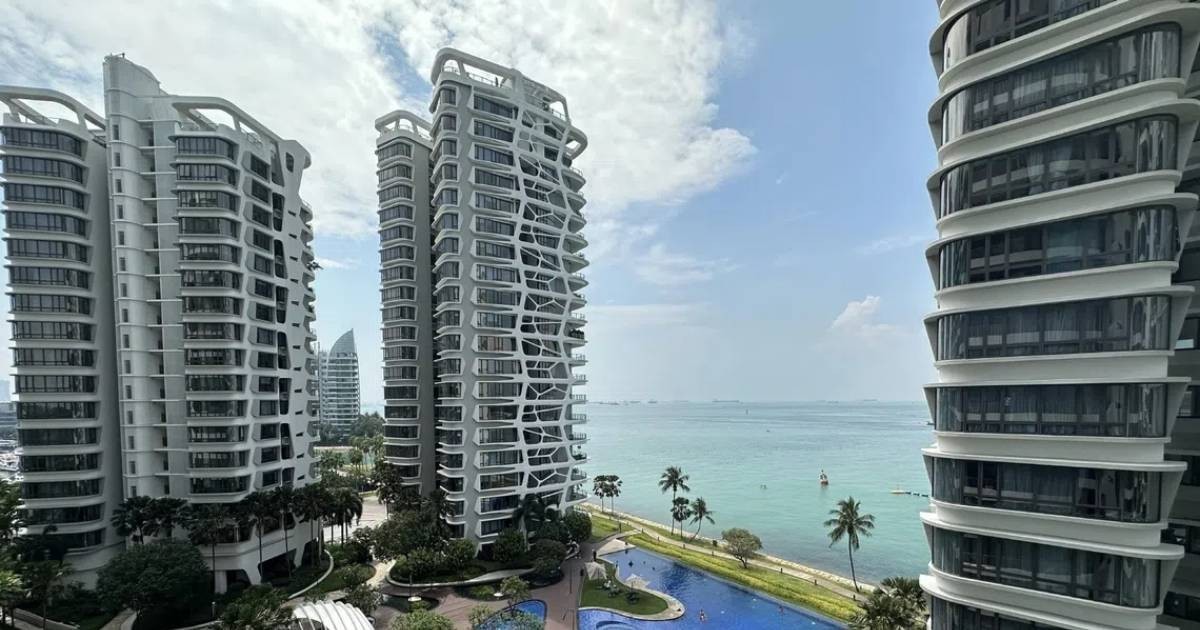
The 302-unit Cape Royale, completed in 2013, has been the last major new condominium development in Sentosa Cove.
PHOTO: The Straits Times

SINGAPORE — Nearly two-thirds of Sentosa Cove properties changed hands at a loss in the last three years, while resale gains on profitable transactions shrank by some 60 per cent, research by analysts showed.
Landed homes seem to fare slightly better than condominiums, with roughly half of landed resale deals closing above water since 2023.
Sentosa is the only place in Singapore where foreigners can buy a landed property, subject to approval from the Government.
Capital values of the 99-year-leasehold homes built on Sentosa have long trailed those of properties on the mainland.
Several factors, from accessibility to pricing, explain its niche demand.
But, since 2023, steep increases in stamp duties for foreign buyers have curtailed demand for the luxury homes on the island, heavily promoted from the start as a playground for the wealthy.
Data compiled by Mogul.sg, covering landed and non-landed homes, showed that 64.5 per cent of resale transactions between May 2023 and June 2026 were unprofitable, up from 62.8 per cent between March 2020 and April 2023.
While the average loss on loss-making transactions narrowed to $1.28 million from $1.56 million, gross gains on profitable resales fell by about 62 per cent to $655,590 from $1.75 million, noted Mogul.sg.
The figures exclude stamp duties, property tax, legal fees and agent commissions.
“Overall, things are not looking good for the property owners of Sentosa Cove,” said Nicholas Mak, chief research officer at Mogul.sg.
Separate analyses by property consultancies Cushman & Wakefield and Newmark also found that most resale transactions in the enclave were unprofitable.
Between 2021 and the first half of 2026, Cushman & Wakefield found that just 83 out of 244 non-landed resale transactions were profitable. For landed resale homes, 23 out of 47 transactions were profitable.
Wong Xian Yang, head of research for Singapore and South-east Asia at Cushman & Wakefield, said that landed homes generally held their value better than non-landed properties.
Still, slightly more than half of landed resale transactions remained loss-making, “indicating that pricing pressures were not confined to the condominium segment”.
As at the second quarter of 2026, Sentosa had about 392 landed homes against 1,766 non-landed homes, according to Cushman & Wakefield.
Newmark’s analysis showed a similar deterioration in profitability.
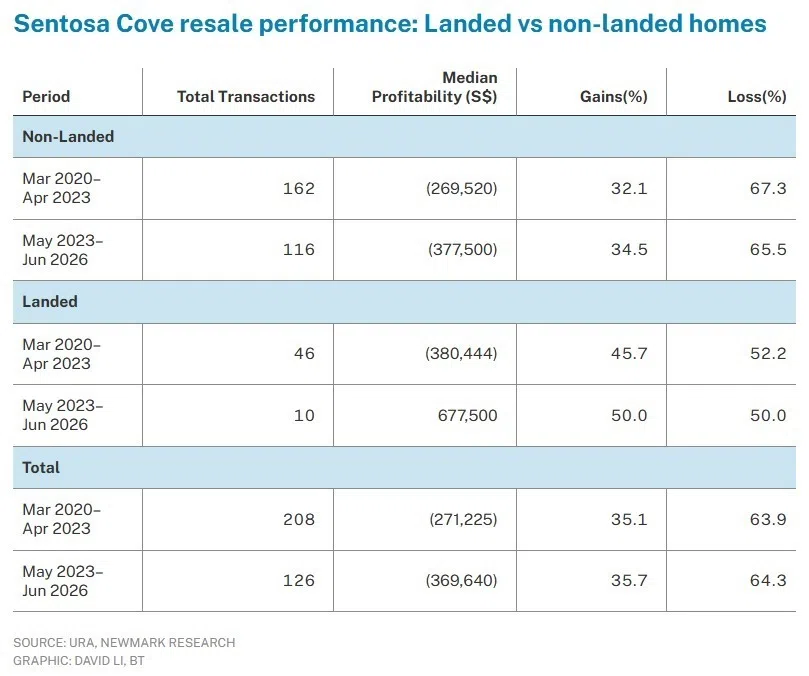
Combined resale volume for landed and non-landed homes fell to 126 between May 2023 and June 2026, from 208 between March 2020 and April 2023.
The median loss widened 36.3 per cent, from $271,225 to $369,640, while the share of loss-making transactions edged up to 64.3 per cent, from 63.9 per cent.
Landed homes were an exception.
Newmark’s data showed that the median profit for landed resales was $677,500 between May 2023 and June 2026, compared with a median loss of $380,444 in the preceding period.
The sample was small, with 10 landed transactions in the later period, split evenly between profitable and loss-making deals.
For non-landed homes, the median loss widened to $377,500 from $269,520 over the same periods, while the proportion of loss-making transactions fell to 65.5 per cent from 67.3 per cent.
Analysts pointed to a small buyer pool as one factor weighing on Sentosa Cove.
“Sentosa is a lifestyle-driven location that appeals more to foreign buyers than to local purchasers,” said Shanting Wong, head of research for Singapore at Newmark.
Local buyers appear less inclined towards the location given their familiarity with living on the mainland, she added.
Cushman & Wakefield’s Wong noted that Sentosa Cove appeals to buyers seeking large luxury homes in an exclusive waterfront setting, at prices per sq ft (psf) lower than comparable homes in Singapore’s traditional prime districts.
While condo units at the enclave typically range from about 1,900 sq ft to 2,400 sq ft, demand remains relatively niche as “many local households still prioritise living closer to schools and amenities on the mainland”, he said.
Alan Cheong, Savills’ executive director of research and consultancy, said the profile of buyers has also evolved.
“When Sentosa Cove was incepted, it attracted a different profile of high-net-worth individuals. Some were the nouveau riche,” he said.
As business cycles changed, some later struggled to maintain their wealth, prompting them to sell their properties, he added.
The weak resale market for the area comes despite a recent recovery in non-landed prices.
Citing Realis data, Cheong said non-landed resale prices at Sentosa Cove rose 5.7 per cent in the second quarter of 2026 from the previous quarter, and 7.5 per cent from a year earlier.
In contrast, non-landed resale prices in the wider Core Central Region (CCR) fell 2.4 per cent from the previous quarter and 1.2 per cent from a year earlier.
From the first quarter of 2021 to the second quarter of 2026, non-landed resale prices at Sentosa Cove rose 18.1 per cent on a psf basis.
Transaction volume dried up after successive rounds of cooling measures. There were 68 non-landed deals in the first half of 2021, against 35 in the first half of 2026.
“The longer prices for non-landed homes at Sentosa Cove languish below $2,000 psf, the greater the chances for them to outperform those on the main island,” Cheong said.
Cushman & Wakefield’s Wong said that Sentosa Cove prices have lagged the mainland for several years, and could potentially benefit from “catch-up” demand as its relative value proposition strengthens — provided overall private residential prices remain on an uptrend.
Cheong cautioned, however, that decaying leases on Sentosa Cove properties could eventually act as a drag on prices, although he expects that to be some years away.
Newmark’s Wong said that high-net-worth buyers may also view the decaying lease tenure on non-landed homes as less favourable compared with freehold or 999-year projects in the CCR.
Landed homes remain an option, she added, particularly as foreigners are permitted to buy landed property there.
Sentosa Cove’s longer-term outlook could be shaped by the limited supply of new residential land.
No new residential land parcels have been sold there since 2008, when a joint venture between Ho Bee Land and IOI Properties acquired the site that would become Cape Royale.
The 302-unit condominium, completed in 2013, was the last major new condominium development in Sentosa Cove.
Ho Bee Land, Sentosa Cove’s pioneer developer, built eight projects there, starting with the 200-unit The Berth by the Cove in 2004.
Early sales were brisk, buoyed by the integrated resort build-out and the enclave’s status as the only place in Singapore where foreigners could apply to buy landed homes.
Transactions peaked at 522 in 2006, according to Era.
Volumes slumped after the 2008 global financial crisis, and successive rounds of higher additional buyer’s stamp duty have kept foreigners at bay since.
Mak also noted that The Residences at W Singapore Sentosa Cove was relaunched by developer City Developments Ltd (CDL) in April 2024.
The 228-unit project was originally launched in 2010, when just 20 units were sold.
The unsold stock was subsequently marketed again 14 years later, at prices that were almost 40 per cent lower than their 2010 launch.
CDL re-pitched the project at an average of $1,780 psf, 36 per cent below the $2,793 psf average transacted price at its initial launch, based on Mogul.sg’s data.
A total of 65 units were sold at the April 2024 relaunch.
“The buyers could not enjoy the progressive payment scheme offered for projects under development. It is similar to buying a resale property,” Mak said.
The latest phase of the Greater Sentosa Master Plan, unveiled by Sentosa Development Corporation in July, will bring the 120ha Brani Island into the Sentosa precinct over the next two decades.
The transformation will be rolled out progressively from the early 2030s, with new attractions, hotels, rejuvenated beaches and improved connectivity, including a new Island Heart transport hub linking Sentosa and Brani.
However, Newmark’s Wong expects the plan to have a more limited impact on residential demand.
“Unless new plots of land are released in the area, resale volumes and prices may not see significant movement and could continue to trail those on mainland Singapore,” she said.
[[nid:742159]]
This article was first published in The Straits Times. Permission required for reproduction.