

How Telegram, memes, and even porn sites became crucial tools in the Hong Kong extradition bill protests


In case you haven’t kept up with the news, Hong Kong has been facing a wee bit of drama lately.
Millions of passionate Hong Kongers took to the city’s streets over the last couple of weeks to protest a bill that would allow criminal suspects to be extradited from the country to be tried in mainland China — a massive demonstration against what’s perceived to be China’s increasing influence over Hong Kong.
In response to the marches — which have been largely peaceful except for the clashes between protestors and cops last Wednesday — Hong Kong leader Carrie Lam decided to suspend the controversial bill yesterday. No timetable has been set to relaunch the bill, and a source within the Hong Kong government informed the South China Morning Post that the legislation would eventually die a “natural death”.
The suspension would be a temporary success for the masses of Hong Kongers opposed to the bill, even though their fight continues to get the pro-Beijing Lam to resign. In today’s information-driven era, technology has played a huge part in amassing overwhelming support from both the local and international community. Here’s a look at how apps and social media were crucial tools for the protests.
So far today's anti-extradition protests in Hong Kong looking just as big as last Sunday's march. Not sure Carrie Lam's career can survive this. pic.twitter.com/2zJhioku0r
— Sean Gleeson (@seanjgleeson) June 16, 2019

The Telegram messaging service became one of Hong Kong’s most downloaded apps last week, and that’s because it offers a Secret Chat function. It’s super-secure and properly encrypted (three layers of encryption compared to the two layers in WhatsApp), while messages sent in Secret Chat can self-destruct after a set time.
A 22-year-old student by the name of Ivan Ip served as an administrator for a Telegram group of over 27,000 members, which was used to broadcast information about the extradition bill protests. Unfortunately, the group chat was not set to “secret”, and authorities managed to identify and arrest Ip at his own home on “public nuisance” charges. According to Ip, the police demanded that he unlock his phone, transfer all his Telegram data to the authorities, and reveal the identities of other admins in the group chat.
IP addresses coming mostly from China. Historically, all state actor-sized DDoS (200-400 Gb/s of junk) we experienced coincided in time with protests in Hong Kong (coordinated on @telegram). This case was not an exception.
— Pavel Durov (@durov) June 12, 2019
The popularity of Telegram during the protests also prompted a massive cyber-attack on the service, and the app’s founder Pavel Durov has since named the origin of the attack as China. The messaging service experienced a powerful Distributed Denial of Service (DDoS) attack on its servers, which resulted in disrupted connections on Telegram.
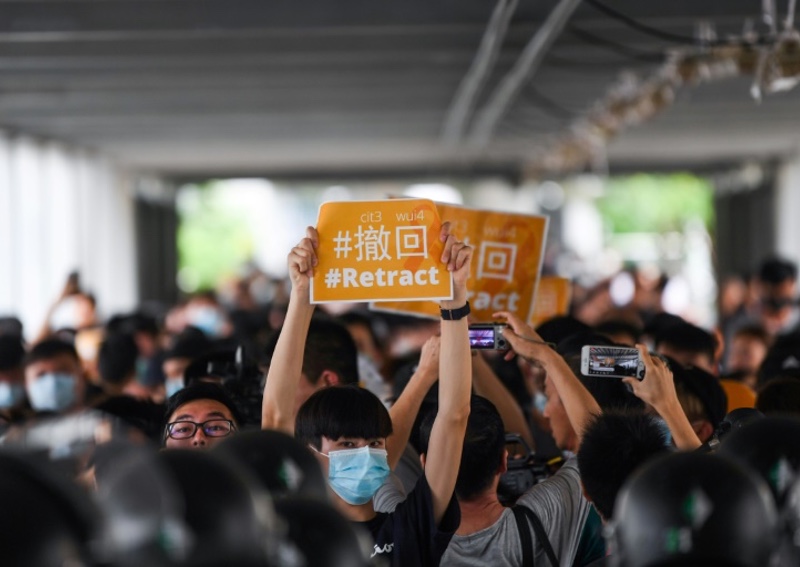
With the awareness of China’s surveillance tech capabilities, protestors have gone through great lengths to ensure their digital footprints were scrubbed clean.
[[nid:447808]]
Participants in the marches turned off location tracking on their phones and used cash to buy metro station tickets instead of their stored value smart cards, which could be used to track commuter movements.
During the protests, demonstrators also donned masks, goggles and helmets — all of which serve as protection against facial recognition tech, as well as physical threats like pepper spray and tear gas.
Facebook is not the most secure of places, but the world’s most iconic social media platform also served as a way to share information about demonstration logistics and planning. Aside from broadcasts on associated demonstration events, there were also posts calling for volunteers in clean-up efforts to clear the trash left behind during the marches.
But perhaps more importantly, social media was where the international community saw how the protest unfolded. A number of videos from the ground went viral online, including one that showed the enormous crowd parting ways respectfully to let an ambulance pass through.
This is beautiful - several staff from a Thai restaurant have expressed support to the #antiELAB protesters as they show placards showing “i love you” & “take care of yourself” #extraditionbill @SCMPNews pic.twitter.com/2vivzjtN9t
— Jeffie Lam (@jeffielam) June 16, 2019
Two young women stand across from police, making their message loud & clear w a sign that imitates the style of the one police show protesters before attacking us. I couldn’t agree more. pic.twitter.com/9DXdRsX0li
— Kong Tsung-gan / 江松澗 (@KongTsungGan) June 16, 2019
Of course, viral videos also showcased the ugly side of protests. Clips of civilians and the authorities clashing went up, prompting widespread backlash about alleged police brutality.
Videos were streamed live on Facebook, while time-lapse clips showed the immensity of the crowds that came out to march against the extradition bill.
Ah, dank internet humour. An awesome cure to some of the most shocking periods of time in Hong Kong’s history.
Toby has big Hong Kong energy from r/HongKong
for GoT fans in HK from r/HongKong
Hell, even Hong Kong’s adult sites played their part in the protest. According to Quartz, one of the city’s porn sites voiced support by telling its visitors to attend the protests instead of “jerking off at home”.
Another site suspended operations on Tuesday as a form of strike against the extradition law, warning visitors of the perils of letting the bill pass in Hong Kong.
ilyas@asiaone.com