

'I don't want mama to go to work': Can working mums in Singapore truly have it all?

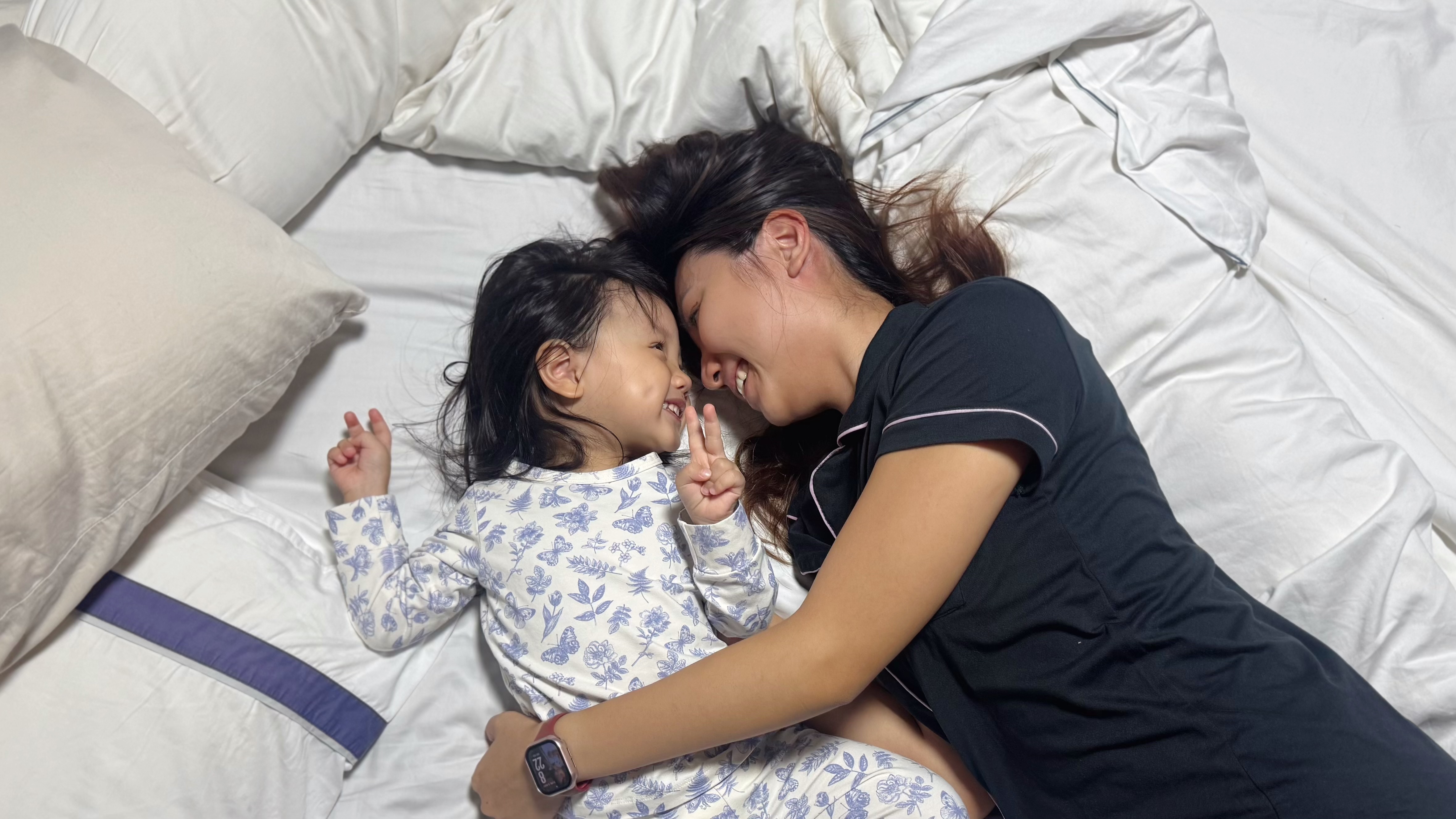
Dr Elizabeth Chan together with her two-year-old daughter.
PHOTO: Elizabeth Chan

 PUBLISHED ONMay 09, 2026 2:00 AMBYDannon Har
On a bad day, mother of two Kam Kai Qi is left with little physical, mental and emotional capacity to spend time with her kids.
The 36-year-old lawyer, who works 42 hours a week at minimum, would like shorter working hours so that she has more than just "scraps of herself" left at the end of the day for her family, she admits. "But the reality is a harsh trade-off".
Her boys — aged four and two — bring great joy and fulfilment to her life, she tells AsiaOne, and it's her wish to be able to spend more quality time with them.
Working from home twice a week helps. Combined with some flexibility of work hours, she puts the time to good use by dropping off her kids and picking them up from school, thereby spending more time with them.
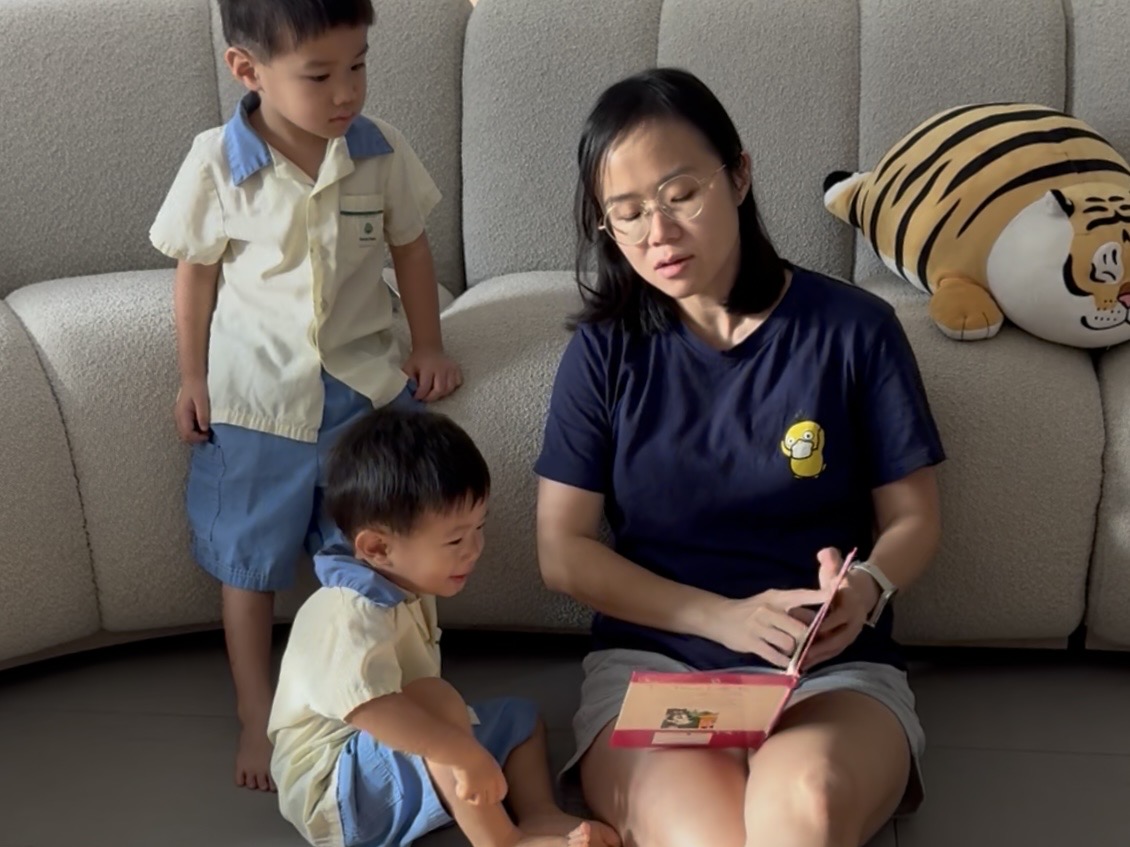
"It would be nice to have more of that," shares Kai Qi, who feels that there is a constant tension between her professional and maternal roles.
"You clearly cannot give 100 per cent of yourself to each role. There is a sense that you are always shortchanging one for the other."
This sentiment is not unique to Kai Qi.
For entrepreneur Aruna Daniel, it's the mental load that gets to her. "As a business owner, there is always something on my mind," said the mother of a three-year-old daughter.
The 36-year-old former linguist and early childhood educator now runs Phoneme Baby, an online platform that helps children with phonics.
[embed]https://www.instagram.com/p/DM__NtRTYmV/[/embed]
"I usually get about three to four hours of work in before I switch into home mode, which means cooking, cleaning and trying to fetch her from school before 4pm so we have quality time before dinner and bedtime," she tells us.
But between thinking about her business needs and the needs of her family, her brain is rarely able to be "fully switched off".
This creates a struggle because she wishes to be fully present, both physically and mentally, for her child.
Mother of a two-year-old girl, family physician Elizabeth Chan, feels that "the goodbyes in the mornings are still the hardest part".
"Most days are fine, but there are mornings when my daughter says 'I don't want mama to go to work,'" says the 35-year-old. "Those moments are never easy."
The pair share a strong bond. Till this day, Elizabeth still breastfeeds. Her daughter usually latches twice daily — once in the morning before she goes to work and once in the evening before bedtime.
"She mostly latches for comfort and connection, and it's something we both still enjoy," she shares. "I'm happy to continue for as long as my body allows and as long as she still enjoys it."
Before giving birth, Elizabeth imagined that she would return to full-time work after maternity leave and be able to "compartmentalise work and home quite well".
However, everything changed when her daughter arrived. She admitted that she was obsessing over her child's every need, to the extent she even considered becoming a stay-at-home mum.
After learning to trust those around her to help with caregiving duties, she eventually transitioned to a part-time role in a polyclinic, which gives her flexibility to spend more time with her daughter while still being able to work.
She soon realised how important it was to her to maintain her professional life.
"Being able to serve the community and help patients gives me a strong sense of purpose, and I am also passionate about teaching medical students and contributing to the future of medicine," she tells us.
"Continuing to work helps me stay balanced and reminds me that I am both a mother and an individual with my own passions and purpose."
Kai Qi, similarly, once considered becoming a stay-at-home mum. But as someone with a self-professed 'type A' personality, she was glad she didn't take the plunge.
"I realised that my temperament and personality would probably not be suitable," she admits, adding that she might even become resentful about sacrificing her career.
"And that can't be healthy for my relationship with my husband and with my kids. I prefer to have a balance between mothering and my career or other pursuits."
For Aruna, doing work that she felt ownership over matters greatly to her sense of self. Building her business allows her to feel a sense of contribution to something other than her child.
"We need both," she explains. "We need to pour into our children, and we need something that pours back into us."
"Not because motherhood is not enough, but because the work I do genuinely helps families, and that purpose fuels me to show up as a better mum too."
It may seem like these modern mums are working overtime to 'have it all', but counterintuitively, giving their personal interests some level of priority has allowed them to become better parents, they say.
"On the days when I am stretched thin and overwhelmed, my patience runs short and my girl feels it," Aruna admits. "On the days when I'm at rest on the inside, I show up better for her."

She illustrates that in today's world, where there is a lot of noise on social media about the 'right way' to be a parent, while also having to deal with differing opinions in the real world from parents, in-laws and friends, it is ever more important to come back to what brings you and your family peace.
"At the end of the day, our children do not need a perfect mother. They need a mum who's present and in a good state of mind," Aruna said.
This degree of self-awareness is perhaps what sets this generation of parents apart from previous ones.
Elizabeth sets aside time to recharge herself. She might go for a facial, hair appointment or attend a spin class once a week after work, before picking her daughter up from enrichment class.
Once every fortnight, she'll also have a girls' night out with her sister while her husband and helper take care of the child.
[embed]https://www.instagram.com/p/DUGPlQ8k7pw/[/embed]
"It's important to make time to take care of yourself," Elizabeth said. "When your cup is full, you're able to show up more fully for your child and your family."
After a day at work, Kai Qi similarly tries to have a bit of downtime for herself after she has put the kids to sleep. She believes that it's okay to take things easier and be kinder to oneself, even in today's demanding, fast-paced world.
"The truth is, we probably have many more years to go in our careers and in forming deep, meaningful relationships with our kids," she said, albeit acknowledging that there is only a small window of time when it comes to children's formative years.
"So it'd actually be completely okay to go at our own pace, and to go slow when life calls for it."
Like spring, a season of new beginnings, motherhood is akin to a period of change that new life brings.
Kai Qi quotes Michelle Obama on this, who famously said in a 2025 podcast interview on Aspire with Emma Grede that "It's impossible to have it all".
The former US First Lady and mother of two explained that women who 'have it all' is a myth.
While it is possible for a mother to achieve fulfilment in her personal life, career, family and relationships, it never happens all at the same time. Rather, it unfolds across seasons.
[embed]https://www.instagram.com/p/DWdqEFtzg2b/[/embed]
"Some seasons just aren't for climbing. They're meant for stabilising," acknowledges Kai Qi. "If and when I'm ready to build something for myself again, I can always start climbing again."
One lesson Aruna has learnt on her motherhood journey is saying 'no'. But not for an indefinite period, just for right now.
"If family and work are your two big priorities for the season, guard those and don't try to do everything all at once," she advises. "It is not failure to say 'no', it is wisdom."
"But please, put your health and your peace at the top of that priority list. Your children, your relationship, your work, they all flourish when you do."
It's easier said than done, of course, as Elizabeth attests to. Even as she strives to make it all work at home and in the office, she still contends with feelings of 'mum guilt'.
This became acute when she realised that sometimes, she actually looked forward to going to work.
"Work gives me space to rest my worries for a while and reminds me that I am not just a mum. I am still a doctor and still myself," she shared.
That realisation helped her understand that motherhood didn't replace the person she was before giving birth. Rather, it became an additional, meaningful part of who she is now.
"It's okay for your life to look different after becoming a mother. Instead of trying to return to exactly who you were before, it helps to embrace the changes that come with this new season."
[[nid:732575]]
Despite the struggles, Elizabeth remains sanguine about motherhood and wishes to have another child.
"We do feel that our family is not yet complete, and we are hoping for one more child," she shares.
"Having my daughter has been one of the greatest blessings in my life. I also strongly believe she would make a wonderful older sister."
Aruna too is planning for a second child and will be happy to stop at two.
Kai Qi, already with two boys, is considering very carefully before three is on the cards.

She cites her personal bandwidth, financial goals, workplace support and the exponentially greater demand in time and energy needed for three children, as key concerns.
When asked about her thoughts on the record-low fertility rate among Singaporeans, Kai Qi thinks it's high time society asked itself the hard questions.
"We didn't arrive here in a single day, so we should take a long, hard look at how we ended up here," she said.
"How did having kids become something less joyful and more of a burden? How did life become so squeezed that it leaves no space to consider having a family?"
[[nid:734798]]
No part of this article can be reproduced without permission from AsiaOne.