

28 HDB projects could get new refuse chute doors to prevent dumping of bulky items

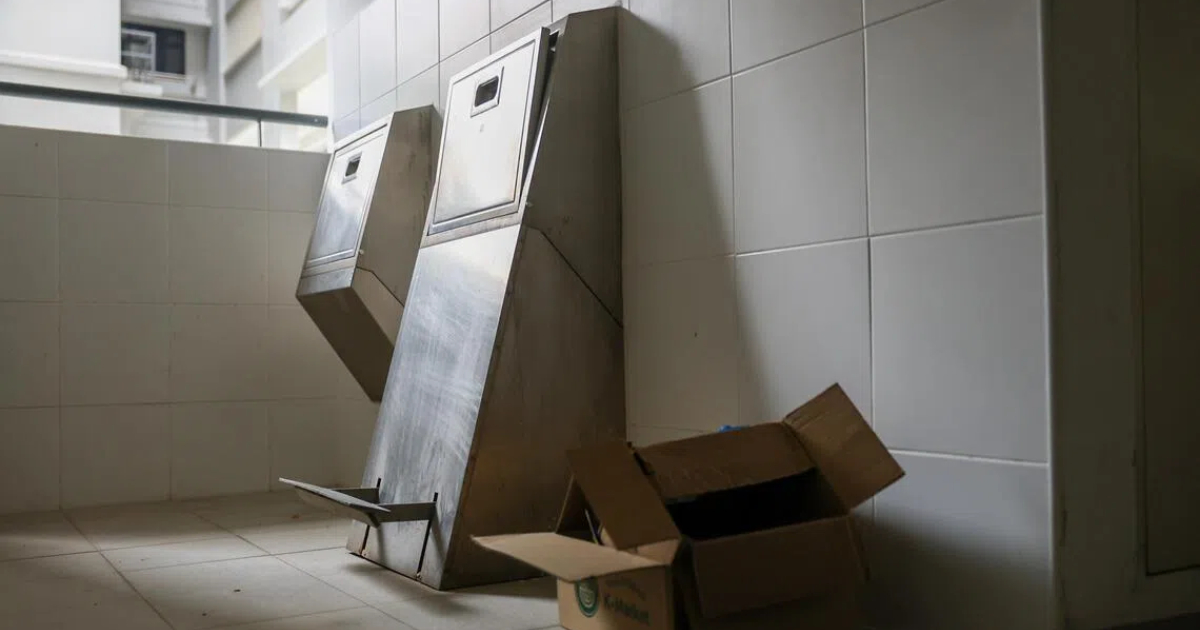
An old refuse chute hopper at Woodleigh Hillside, one of three projects where HDB said it will pilot the new hopper.
PHOTO: The Straits Times

Twenty-eight HDB projects in towns such as Tampines, Bidadari and Punggol could get new rubbish chute hoppers to prevent residents from disposing of bulky items into the chutes.
This comes after instances of chokes in the pneumatic waste conveyance system (PWCS), caused by the improper disposal of bulky items and renovation debris, were reported by The Straits Times in 2025.
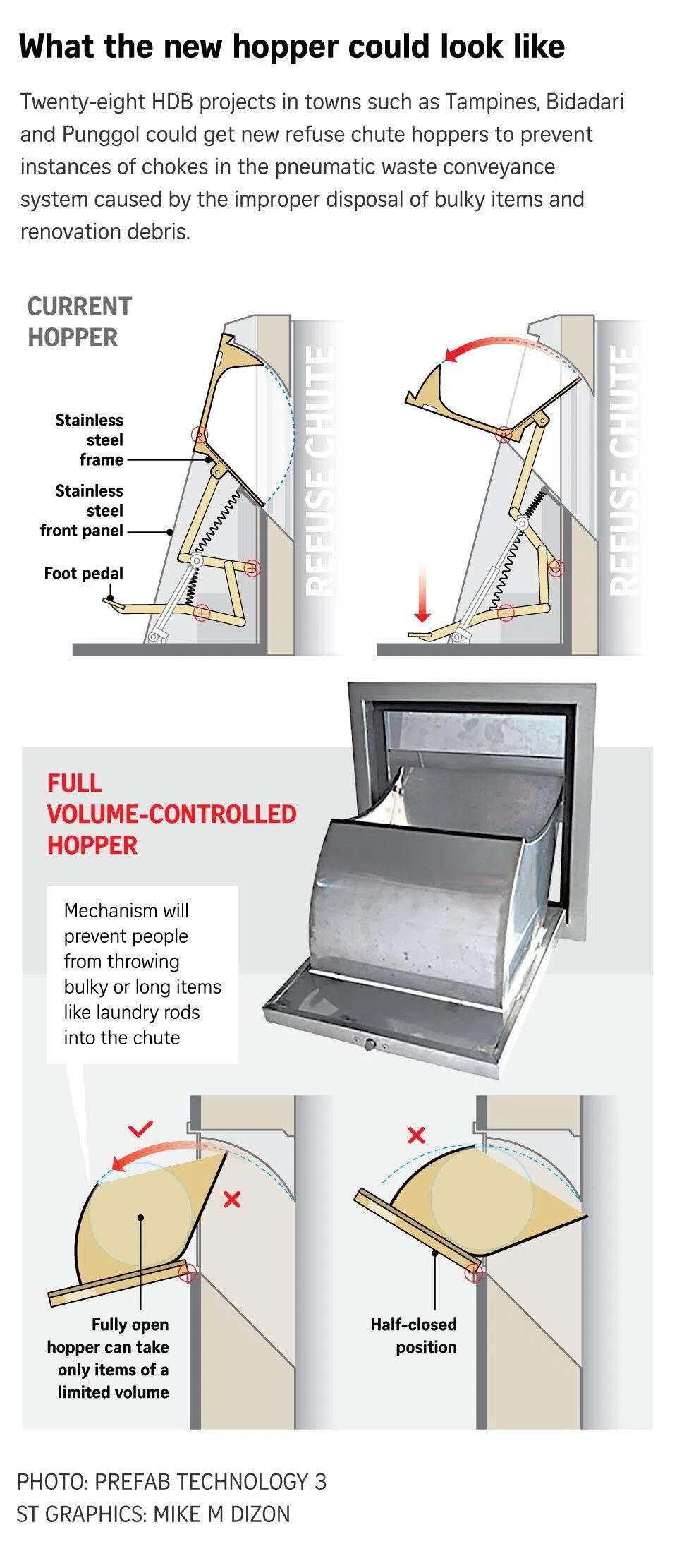
The Housing Board on April 27 called a tender for the supply and installation of full volume-controlled refuse chute hoppers – the doors to the rubbish chutes – which have a smaller opening and a mechanism at the back to prevent the disposal of large or long items into the refuse chutes.
The chokes are often caused by indiscriminate dumping of items such as large cardboard boxes, curtain rods, mop handles, buckets and renovation debris.
The new hoppers are set to be retrofitted in older Build-To-Order (BTO) developments that use the PWCS.
Tender documents on government procurement portal GeBIZ stated that the hopper must be designed to accommodate bagged waste measuring at least 30cm in diameter, but no more than 80 per cent of the conveyance pipe’s diameter.
“This will allow the disposal of bagged waste of typical sizes and prevent oversized waste from choking the hopper and the chute,” the document said.
The hopper must also be airtight and have both self-closing and soft-closing features.
In response to ST queries, HDB said it will pilot the full volume-controlled hopper in three projects that were built before such hoppers were rolled out.
BTO projects tendered from 2020 have the new hoppers, in line with environmental health and building standards, it said.
“If these works proceed smoothly and are welcomed by residents, we will explore extending the retrofit works to the remaining 25 projects,” it added.
The PWCS uses vacuum-like suction to transport household waste via underground pipes to a centralised bin centre, where it is stored before being taken by waste disposal trucks to incineration plants. However, the improper disposal of bulky items and renovation debris has caused frequent chokes in some housing estates.
A contractor who supplies and maintains the PWCS in several HDB precincts told ST previously that his workers had to manually remove rubbish from chutes and pipes in some estates almost daily after the PWCS was installed.
HDB said the new hopper would allow only typical household waste, such as bagged garbage and food waste, to go through the chute. Bulkier items such as curtain rods, mop handles and buckets will not be able to enter the chute.
The new design thus reduces the risk of chute blockages and ensures the PWCS operates smoothly.
The board said blockages in PWCS tend to occur more frequently during the first year of operations as residents carry out renovations and move into their flats.
Such chokes typically start decreasing after six to nine months, and fall to a low level by the end of the first year, it added.
The three HDB projects planned for the first phase are West Plains @ Bukit Batok, Valley Spring @ Yishun and Woodleigh Hillside in Bidadari. Works at the first project are expected to begin in the fourth quarter of 2026.
These projects, as well as the others listed in the tender document, are subject to changes.
The first phase must be completed within 12 months, while the second phase – for the remaining projects – must be completed within four years.
In all, 239 blocks across the 28 projects could be retrofitted with the new hoppers.
Woodleigh Hillside resident Priscilla Chan, 34, said that while she has not encountered chokes since she moved into her flat about three years ago, the new hoppers sound like a good move to prevent such occurrences.
But she added that there should be designated spaces in each block for residents to throw bulky items such as cardboard boxes.
“People end up throwing their bulky items in the recycling bin or leaving them near the lift lobby as there are no big bins around,” said Chan, who works in human resources.
Phua Xiang Yin, 37, a recruitment consultant, said she is mindful of bagging her garbage into small plastic bags before throwing it into the refuse chute. She would throw bigger items, such as cardboard boxes from deliveries, into bins at the void deck.
“The issue is that the big green bin is not always there,” she added.
The tender document states that when the works are being carried out, green and blue waste disposal bins must be provided on all floors and cleared three times a day.
After the works are completed for each block, the contractor has to get feedback from residents on work quality and their experience before work can start on the next block.
The contractor must also paste educational posters above the hopper on each storey.
Two full-time customer relations officers must also be deployed to attend to residents’ feedback, with the service maintained for the entire duration of retrofitting works, plus another 12 months after handover of each block to the town council.
HDB said that residents should not place long objects, bulky items, heavy objects, renovation debris or flammable materials into the chutes. Residents may contact their town council if they need help to dispose of bulky items.
Enforcement action will be taken against errant contractors, it added.
The tender will close on July 6.
This article was first published in The Straits Times. Permission required for reproduction.