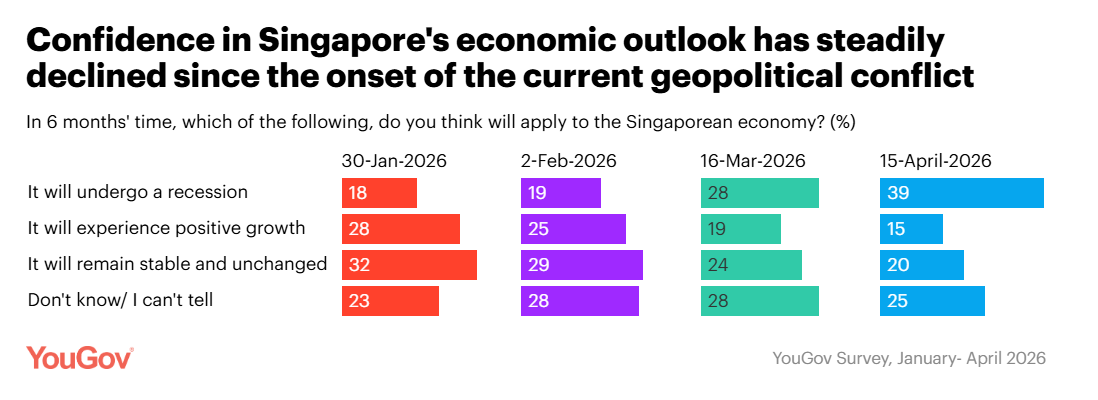
Almost 40 per cent of Singaporeans believe the country will slip into a recession in six months' time, amid the ongoing conflict in the Middle East.
The findings from global market research firm YouGov, released on Tuesday (May 12), mark a sharp rise from Feb 2 — 26 days before the United States and Israel launched attacks on Iran — when only 19 per cent of Singaporeans said they believe the country would fall into a recession within the next six months.
In its latest tranche of the monthly Singapore Consumer Sentiment Tracker, which polled 1,000 Singaporeans on April 15, just 15 per cent of respondents felt Singapore will experience economic growth; 20 per cent said the economy will remain stable and unchanged, while 25 per cent said they don't know or can't tell.
The proportion of respondents who felt Singapore will undergo a recession was 39 per cent, up from just 18 per cent of those polled on Jan 30.
Commenting about the survey, which highlights public confidence and consumer spending in Singapore, YouGov said: "Sentiment has steadily declined since the onset of the current geopolitical conflict in late February."
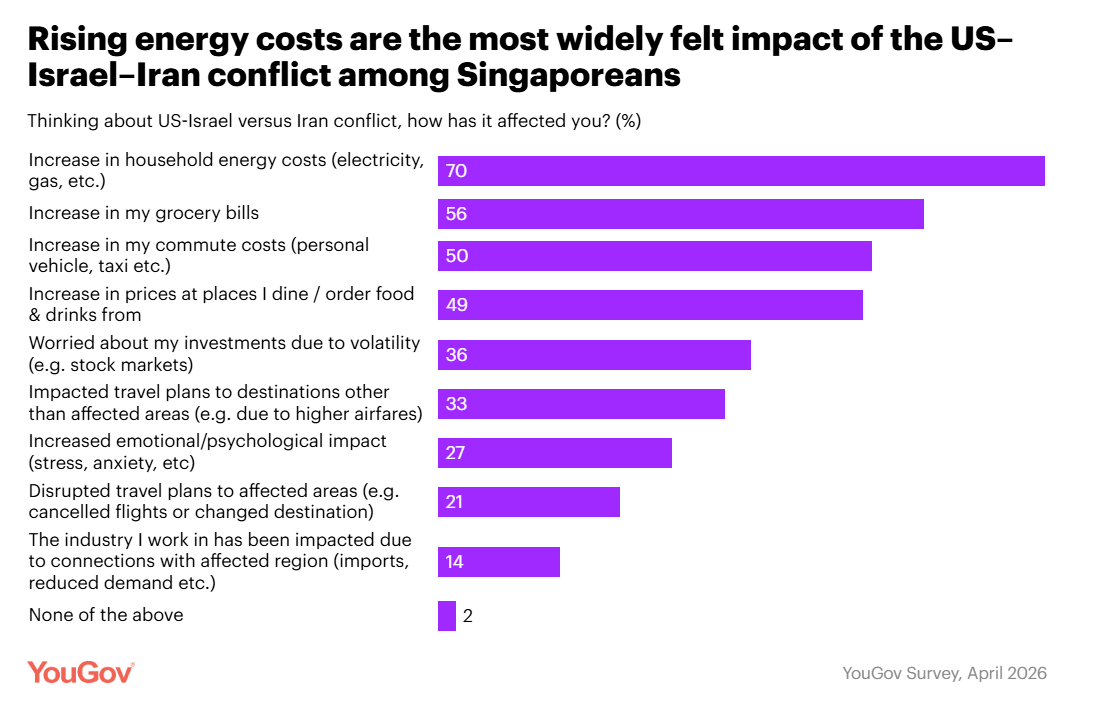
Meanwhile, on the impact of the Iran war, 70 per cent of Singaporeans polled said the conflict has driven up household energy costs.
This was followed by 56 per cent and 50 per cent of respondents who saw a hike in their grocery bills and transportation costs respectively.
"The broader uncertainty is also taking a toll on mental wellbeing, with 27 per cent of Singaporeans reporting stress or anxiety linked to these developments," said YouGov.
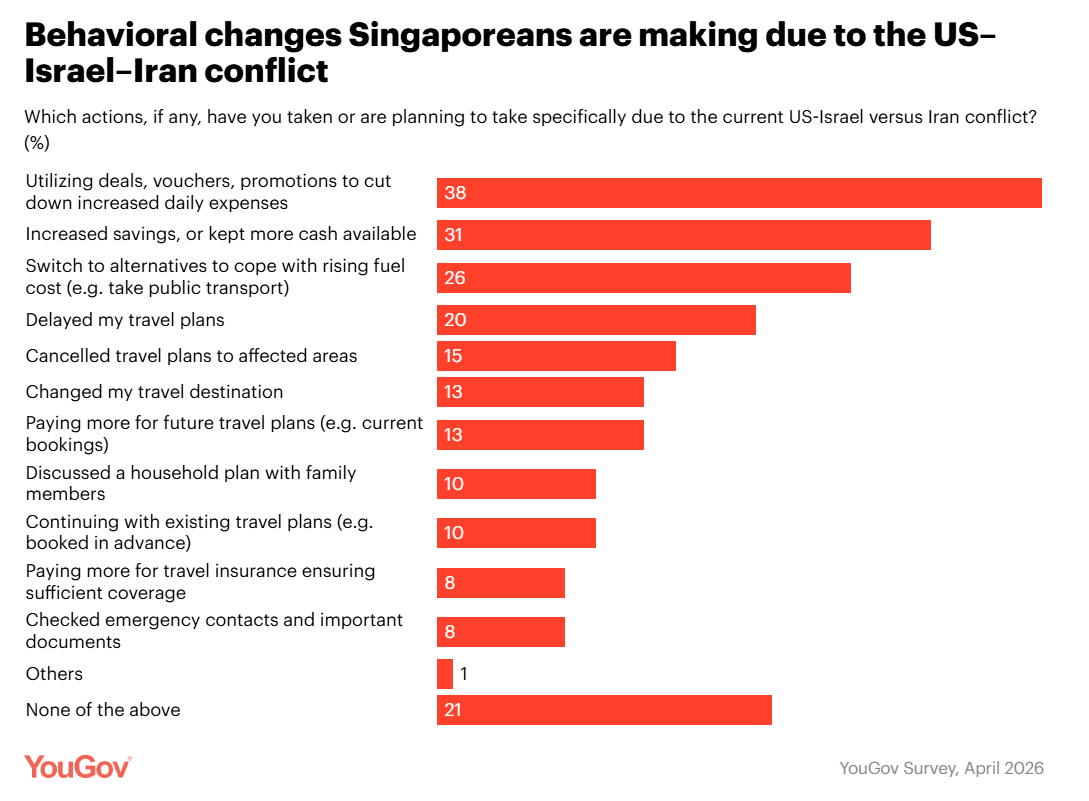
On adjusting to the Middle East conflict, nearly a quarter of Singaporeans polled — 38 per cent — said they are relying more on deals, vouchers and promotions to manage daily expenses.
Meanwhile, only 12 per cent of Singaporeans said they have stockpiled on supplies specifically due to the conflict. "Despite heightened global uncertainty, there is limited evidence of panic buying," said YouGov.
Among those who stockpiled, the most common items include long shelf-life foods (69 per cent), medication (38 per cent), hygiene products (36 per cent), and bottled water (26 per cent).
YouGov's findings come after the Monetary Authority of Singapore (MAS) previously said that inflation in Singapore is expected to "ease progressively" over 2027 in line with global energy prices.
In its latest quarterly macroeconomic review on April 14, MAS warned that a prolonged disruption to global energy supplies or "unexpected implementation" of export controls will lead to even higher import costs for Singapore and increasing the risks of inflation.
The central bank added that the Middle East conflict has also dampened Singapore's economic outlook, as it forecasted the country's GDP growth in 2026 to be a "step down" from the 5 per cent seen last year.
[[nid:733144]]
chingshijie@asiaone.com




