SINGAPORE – Big tech firms and global banks may be citing a shift to artificial intelligence to justify layoffs, but for workers who build these systems in Singapore, the technology is paying off: Salaries for AI roles here are rising up to five times faster than overall wages.
Within the past year, pay for AI roles has climbed by about 15 per cent to 25 per cent, with salaries for fresh hires typically starting at between $70,000 and $90,000 a year, according to recruitment firm Robert Walters. In comparison, nominal wages of full-time workers rose 4.9 per cent in 2025, down from 5.6 per cent in 2024, Ministry of Manpower figures show.
“AI and data-based roles remain among the most in-demand positions in Singapore this year,” said Kirsty Poltock, country manager at Robert Walters Singapore. “Companies are racing not just to experiment with AI, but to put it to work at scale in their businesses.”
While there are no definitive numbers, Poltock said AI-related hiring “has continued to grow strongly over the past 12 months, particularly in AI engineering, machine learning, data science, AI product management and AI governance roles”.
Chinese tech companies, for one thing, are intensifying efforts to recruit AI graduates from Singapore’s two flagship universities, offering sharply higher pay packages from $200,000 a year to entice PhD holders to work in China.
At the same time, Chinese and US tech companies are ramping up hiring for Singapore-based jobs.
On May 20, US-based ChatGPT creator OpenAI committed more than $300 million to build Singapore’s applied AI sector. This includes setting up an Applied AI Lab, which will launch a training programme to create more than 200 Singapore-based technical roles over the next few years.
Chinese tech giant Alibaba’s cloud computing arm also set up a global AI innovation hub in Singapore in 2025.
[[nid:736259]]
More demand than supply
AI is “clearly an outlier” in terms of high demand, talent shortages and premium salaries, even if it is not the only high-growth area, said Poltock.
AI jobs are aplenty online. A search on job portal MyCareersFuture.sg on June 5 revealed 181 listings for AI engineers, 50 for machine learning and 13 for data science. Over at the LinkedIn Jobs portal, there were 139 posts for AI engineers, 197 for machine learning roles and 76 for data science roles.
But fresh talents are limited. Poltock said AI roles often take longer to fill than many other professional positions because employers are competing for a limited pool of candidates.
At Nanyang Technological University, ranked No. 1 for AI courses in ShanghaiRanking’s Global Ranking of Academic Subjects, only 83 students graduated with a Bachelor of Science in Data Science and Artificial Intelligence in 2025.
But enrolment spiked in the 2025 to 2026 academic year, with 558 people taking up the four-year course. Another 340 enrolled in a master’s course in artificial intelligence.
The National University of Singapore introduced a new Bachelor of Computing in Artificial Intelligence in 2025.
Employers are particularly hungry for “deep tech” talents who can go beyond building AI prototypes to embedding systems into real-world operations, said Poltock.
“Chinese tech firms tend to have a much stronger emphasis on deep technical AI capabilities and infrastructure, including research,” she added. “In Singapore, employers are generally placing greater emphasis on commercialisation and enterprise integration – using AI to improve productivity, automate workflows and enhance customer experience.”
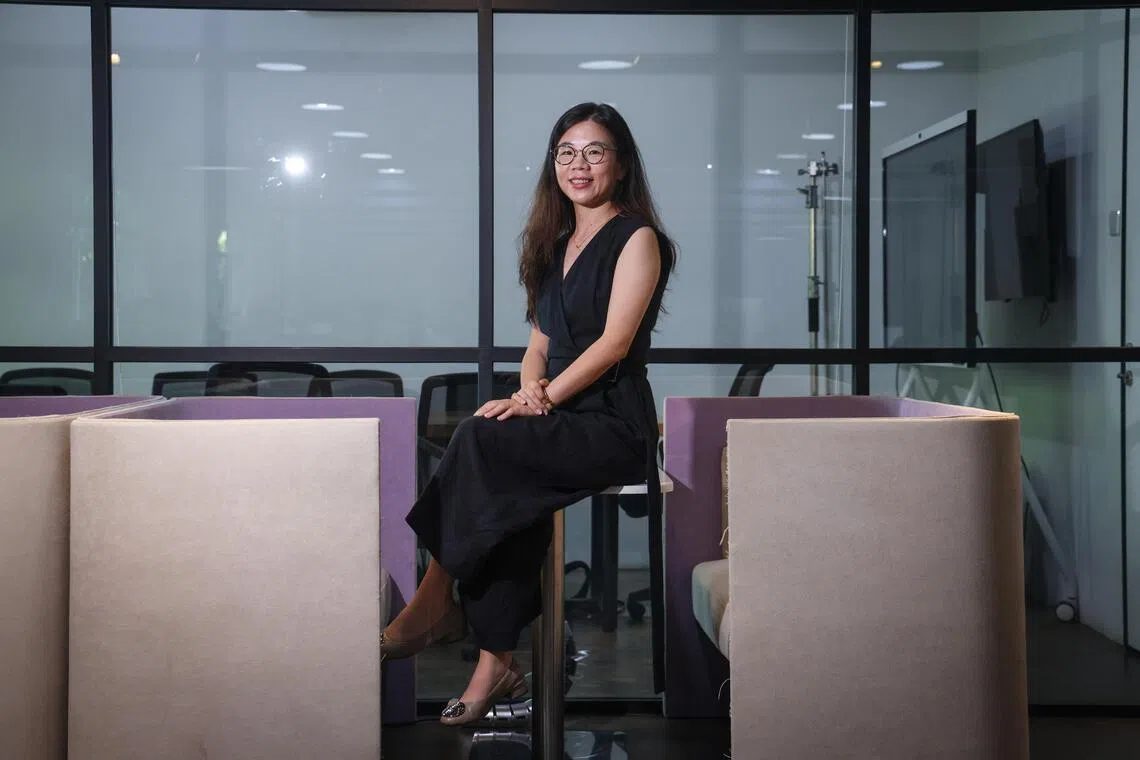
Kirsty Poltock, country manager at Robert Walters Singapore, said employers are particularly hungry for “deep tech” talents who can go beyond building AI prototypes to embedding systems into real‑world operations.
PhDs not always required
Typical entry routes include bachelor’s and master’s degrees in computer science, data science, mathematics or engineering, especially from local universities, combined with skills such as programming and hands-on project work or internships involving AI tools.
“For the vast majority of AI roles we see in Singapore, a good bachelor’s degree plus practical experience and the right skills are sufficient, but to earn the absolute top end of the spectrum, a PhD would be required,” Poltock said.
An “absolute expert in AI research or leading major AI initiatives in Singapore” could command close to $350,000 in total compensation, she added.
But the silver lining is that such AI leadership rarely operates alone, said Yuan Yijia, founder of Singapore-based AI recruitment agency Dada Consultants.
“They anchor an AI organisation here – then around them you start to see hiring for applied AI engineers, data analysts, platform and product roles. Those are exactly the kinds of positions that Singaporean graduates and mid-career professionals can qualify for if they build the right skills,” she told The Straits Times.
Dada Consultants founder Yuan Yijia said Singaporean graduates and mid‑career professionals can qualify for applied AI engineer, data analyst, platform and product roles if they build the right skills.
Poltock urged Singaporeans to regroup and consider how AI can complement their careers, whether by choosing AI-related degrees, adding technical skills mid-career or finding ways to apply AI in sectors they already know.
Some institutions offer courses that could be suitable for those in mid-career. For example, Singapore Polytechnic has a one-year Specialist Diploma in Data Science (Artificial Intelligence) that is conducted after office hours.
But those hoping to ride the AI wave cannot just tick a box.
“It will not be enough to just take a single course and say, ‘Okay, I am in AI now’,” Poltock said. At job interviews, candidates who stand out are “proactive, inquisitive and willing to get their hands dirty, whether through internships, internal pilot projects or even self-initiated work at home”.