

Bloomberg defamation case unprecedented for malice and aggravation: Ministers' lawyer

Senior Counsel Davinder Singh
PHOTO: AsiaOne/Danial Zahrin

SINGAPORE - The lawyer for two ministers suing Bloomberg and one of its reporters over an allegedly defamatory article said the case is unprecedented for the malice directed at Coordinating Minister for National Security K. Shanmugam and Manpower Minister Tan See Leng.
In closing submissions on May 22, Senior Counsel Davinder Singh said that ill-intent was illustrated in e-mails exchanged within the financial news organisation in the lead-up to the article, and in its decision to drop its paywall and provide access to the wider public, after it was issued with a correction direction under Singapore's fake news law.
In summarising the claimant's case, Mr Singh said it was important to note the context in which Mr Shanmugam and Dr Tan are mentioned in the article "Singapore mansion deals are increasingly shrouded in secrecy", which was written by Mr Low De Wei.
He said an ordinary and reasonable reader in Singapore would have taken these mentions to falsely mean that the ministers took advantage of there being no checks and balances or disclosure requirements for their transactions, and that they wanted to hide their transactions and avoid scrutiny.
"This case is unprecedented for the malice, the determination to hurt and the aggravation," said Mr Singh.
The article published on Dec 12, 2024 mentions the ministers' property deals which took place in 2023 - Mr Shanmugam's sale of his former home in the Queen Astrid Park area to UBS Trustees for $88 million, and Dr Tan's purchase of a bungalow in Brizay Park for nearly $27.3 million.
It also discussed alleged opacity in high-end property transactions.
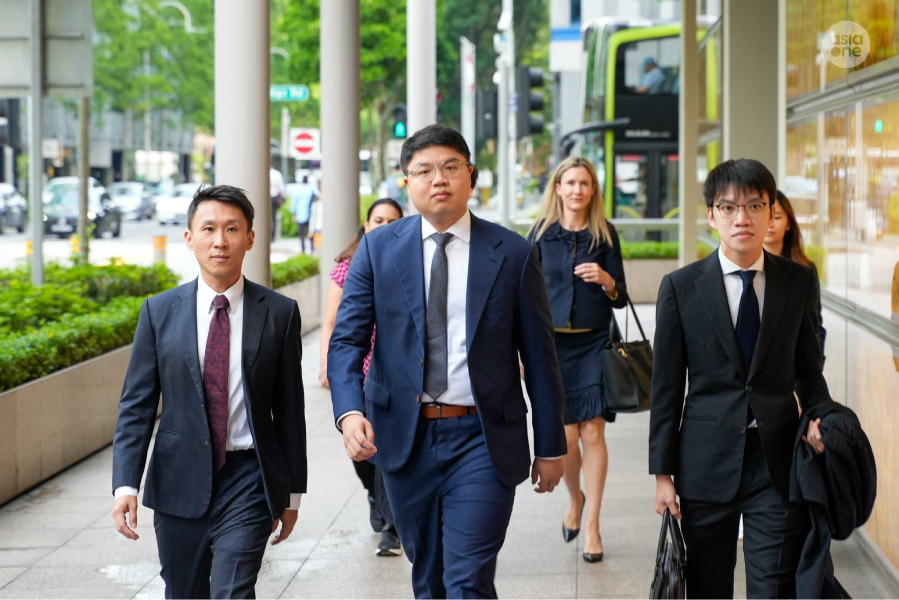
Bloomberg's lawyer, Senior Counsel N. Sreenivasan, said the news organisation has been consistent in its position and had employed the defence of responsible journalism to reflect the care it took in researching for the article.
He said understanding the meaning of the article, as taken by an ordinary and reasonable reader, would require ignoring the "strained meaning" asserted by the claimants as well as their sensitivity.
Mr Sreenivasan and Senior Counsel Chelva Rajah, who is representing Mr Low, said there was nothing defamatory of Mr Shanmugam and Dr Tan in the article, which they described as a report on trends relating to the purchase of good class bungalows (GCBs) in Singapore.
They said the article was extensively researched, and the information was verified through consultation with industry experts and communications with various government agencies. The lawyers added that the ministers were each given "multiple opportunities" to comment.
The lawyers said there was no suggestion in the article of any wrongdoing by the ministers, and it makes no allegation against them. They said Mr Shanmugam and Dr Tan were mentioned only briefly in the article.
In his submissions, Mr Singh challenged the defendants' claim that the article was about the increasing GCB prices and purchases by wealthy foreigners and naturalised citizens.
He said that if that were really the case, there would be no reason to feature Mr Shanmugam, who was a seller and not a buyer, in the article.
Yet, it devoted multiple paragraphs to Mr Shanmugam's transaction and even described it as having become "political fodder", said Mr Singh.
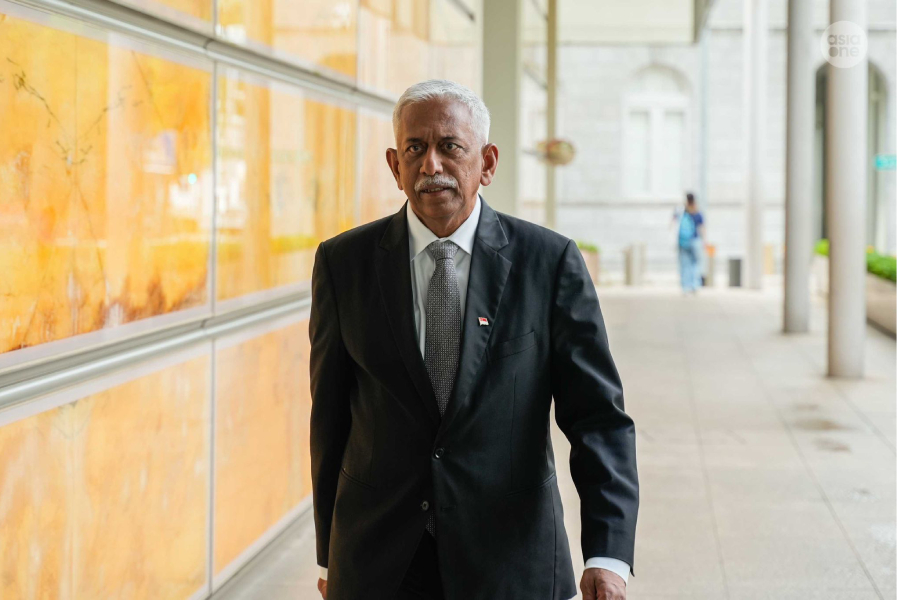
Mr Singh said he is leaving it to the court to decide on the quantum of damages it would ask from Bloomberg and Mr Low, but added that it should be higher than what was awarded in the defamation case against The Online Citizen (TOC) chief editor Terry Xu.
In that case, the High Court had on March 31 granted $160,000 in general damages each to Mr Shanmugam and Mr Tan, for a TOC article which referred to the Bloomberg piece on property transactions.
Mr Singh noted that Bloomberg has a wider viewership than TOC, and is "immeasurably far better known and established".
He said that in the case involving Mr Xu, the High Court had also granted $50,000 each in aggravated damages.
Mr Singh said that with the "unprecedented" aggravation in the present case, and the conduct of the defendants, this amount should be far higher.
He said the defence had "behaved reprehensibly" by "withholding material documents" from the court and claimants.
Mr Singh added that in the lead-up to trial, the defendants had withheld and then "drip fed" documents, despite orders from the court.
"It is also clear that (Bloomberg) is not at all concerned about the implications of aggravation. It has deep pockets.
"Based on the objective facts, it is clear that its aim is to maximise the publicity and further embarrass and damage (the claimants)," Mr Singh said.
Mr Sreenivasan and Mr Rajah said that if the judge rules the article as defamatory, damages to be awarded to the ministers should not exceed $80,000 each.
They said it takes into account the totality of the circumstances and, in particular, the nature and gravity of the allegedly offending words and the defendants' conduct.
During the hearing, Mr Singh called out Mr Sreenivasan's conduct during the trial, accusing the defence counsel of playing to the gallery on two occasions in highlighting "obviously irrelevant" issues.
Mr Singh said that Mr Sreenivasan had read out in open court the addressees of an internal e-mail from the Singapore Land Authority, which is a statutory board under the Ministry of Law, on how to respond to queries from Mr Low.
The addressees included senior figures within the ministry.
Said Mr Singh: "These facts and the fact that these addressees were so obviously irrelevant to the issues give rise to the compelling inference that they were directed at the gallery and the press and thereby aggravating the libel against (Mr Shanmugam)."
Mr Sreenivasan labelled the accusations as a "personal attack". He denied the allegations, saying the e-mail had been presented by the claimants just before he questioned Mr Low, who was on the stand at that time.
Mr Sreenivasan said that it was the only way he could communicate with him.
The hearing on May 22 followed a seven-day trial in April. Justice Audrey Lim, who heard the closing submissions, reserved her verdict.
[[nid:733593]]
This article was first published in The Straits Times. Permission required for reproduction.