

Critically endangered leopard cats in Changi to be relocated from second half of 2026
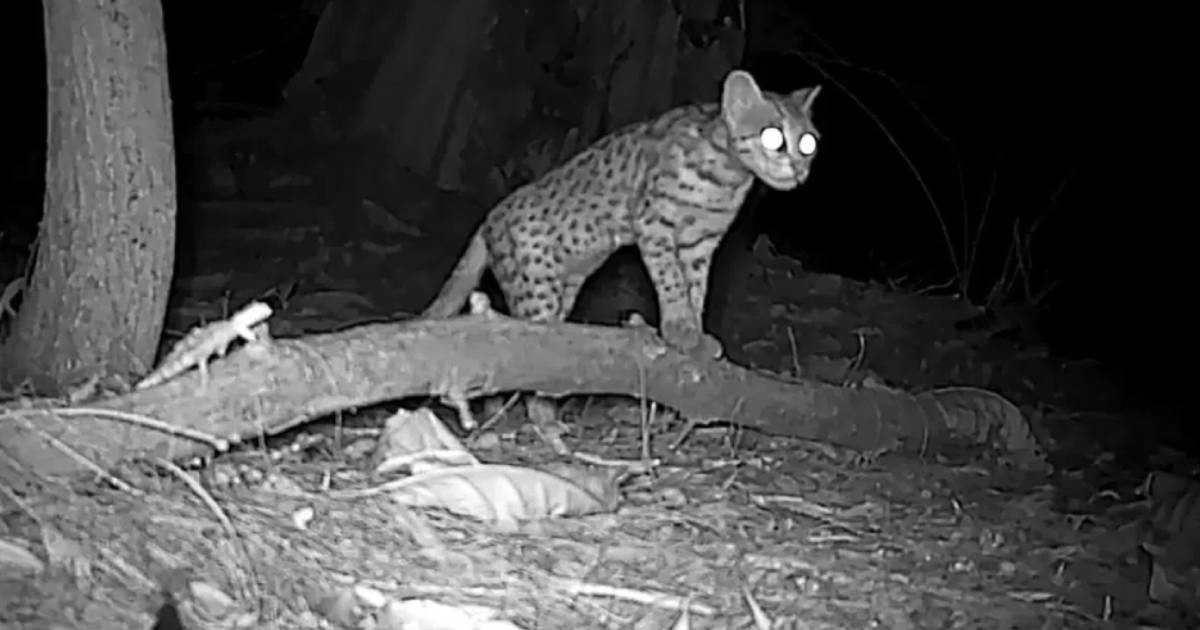
One of the five mainland leopard cats detected in Changi by volunteers between July 2025 and April 2026.
PHOTO: Singapore Wildcat Action Group

SINGAPORE – Five mainland leopard cats living in Changi’s coastal forest will be relocated from the second half of 2026 to protect them from development.
The National Parks Board (NParks) and the non-governmental Singapore Wildcat Action Group (Swag) said on Wednesday (June 3) that the relocation will ensure the animals' welfare and long-term survival as the Changi landscape is transformed.
They did not reveal the locations of the new habitats as this could attract unwanted visitors such as poachers.
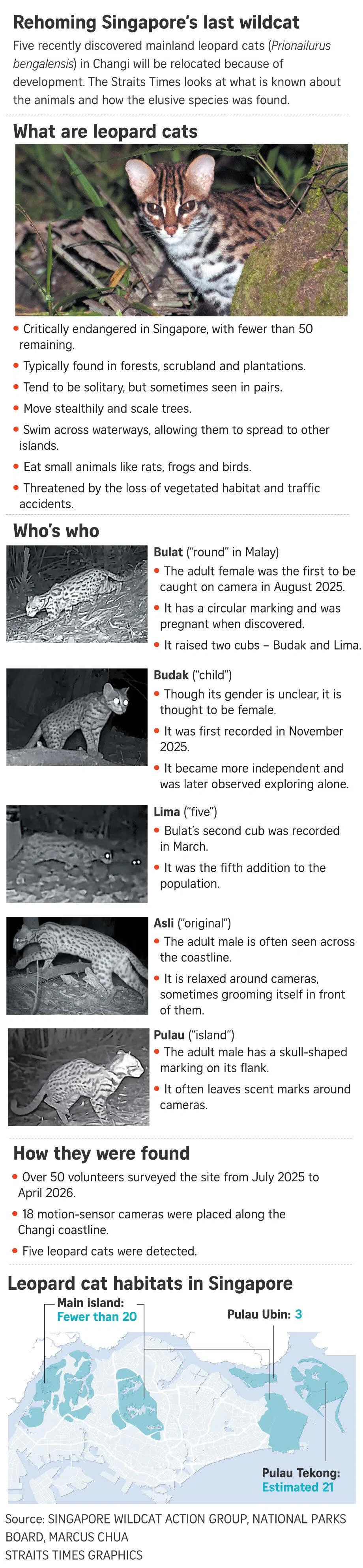
While leopard cats are one of the most widely distributed wild cats globally, they are critically endangered in Singapore. Fewer than 50 are estimated to reside here, with most of them in Pulau Tekong, Pulau Ubin and the Western Catchment Area.
The existence of the elusive species in Changi was first detected in January 2019 after one was killed in a traffic accident. It is believed that the Changi population hailed from leopard cats that swam across the strait from nearby Pulau Tekong.
Following sightings, Swag started a rapid survey in July 2025 to understand the population of leopard cats in Changi and their behaviour. Supported by NParks, the effort involved more than 50 volunteers, aged 10 to 83.
The volunteers set up and maintained 18 motion-sensor cameras along the coastline to track the nocturnal predators and collected their poop samples.
When the survey concluded in April, the group confirmed that five leopard cats lived in the area, which included the first cubs spotted in more than a decade, said Swag co-founder Vilma D'Rozario. A documentary was also made about the process.
Zhou Boyi, director of the terrestrial branch at NParks' National Biodiversity Centre, said the survey is a prime example of a community-initiated science project that laid a strong foundation for biodiversity management plans.
Mammal scientist Marcus Chua, who is advising the conservation effort, said the appearance of this small population is an encouraging sign that leopard cats can persist if their habitats are protected in Singapore.
However, leaving the Changi cats in their current location was ruled out.
"With the amount of forest remaining and knowledge that development in the area would continue, it was clear that the existing area would not be able to support a population of leopard cats," said Chua, who is also a mammal curator at NUS' Lee Kong Chian Natural History Museum.
He cited the high risk of traffic accidents and intense competition for shrinking resources, even with measures to mitigate the impact of development.
The construction of Changi Airport Terminal 5 is under way in the area, where land is also being reclaimed.
Zhou noted the species’ need for large foraging areas. "Considering the ongoing and upcoming developments within the Changi coastal area, we assessed that (relocation) is in the interest of the animals’ welfare and long-term survival," he said.
To ensure the safety of the Changi population, the leopard cats will be trapped in collaboration with trained professionals and based on research from other places such as Taiwan.
Before release, each leopard cat will be assessed by veterinarians from NParks and Mandai Wildlife Group.
The cats will then be moved to suitable habitats — identified in consultation with Swag and Chua — that offer forest cover, suitable prey, and the connectivity needed to find mates.
"Any relocation, if carried out, will be undertaken progressively and carefully, with ongoing monitoring," said NParks and Swag.
In Singapore, the main threat to leopard cats is roadkill, said D’Rozario. Traffic accidents have killed at least five of the animals in the last 25 years, a danger exacerbated by forest loss that forces wildlife to cross busy roads.
“NParks has the fencing, but we feel that the public needs to take responsibility to drive safely when they are near forested areas,” said D’Rozario. She advised that anyone who encounters a leopard cat should keep a safe distance and avoid approaching it.
She also expressed hope that the operation to relocate the cats will catalyse broader conservation efforts.
“It is our wish to contribute to a national species action plan (for leopard cats), which does not exist yet. We hope this will spur all stakeholders to begin one.”
Members of the public can learn more about the Changi leopard cats and local conservation efforts at the 15th edition of the Festival of Biodiversity, which takes place on June 6 and June 7 at the National Library of Singapore.
[[nid:736938]]
This article was first published in The Straits Times. Permission required for reproduction.