

Dialysis at home a better option for kidney patients, but take-up remains low

NKF renal nurse Shadirah Zaharum checking the clarity of the waste fluid belonging to peritoneal dialysis patient Norhyati Buang on Dec 3, 2025.
PHOTO: The Straits Times

Kidneys are vital for removing waste and toxins from our bodies. And when they fail, haemodialysis (HD), which is done at dialysis centres, has long been the option here.
There's another option, peritoneal dialysis (PD), which is done in the comfort of the home and also gives kidney failure patients a better quality of life. But among patients in Singapore suitable for it, the take-up rate remains low, despite efforts to encourage its adoption.
Both forms of dialysis remove waste and fluid from the body — a process that occurs naturally in healthy patients through urination. HD does it through the blood, while PD extracts them through the peritoneum, the membrane lining the abdominal wall.
In Singapore, three out of four new kidney failure patients still opt for HD, where patients go to a dialysis centre three times a week for three to four hours to have their blood removed from their body, cleansed and then put back.
Associate Professor Marjorie Foo, director of Singapore General Hospital's (SGH) PD programme, said the main reason patients avoid PD is a fear of harm by doing the dialysis themselves, and a lack of understanding of what PD and HD entail, in spite of extensive education by hospitals.
When a person's kidneys fail, the best choice is to get a transplant. But the number of kidney transplants here is extremely low. In 2024, more than 2,000 people were diagnosed with kidney failure, but only 103 received a transplant. The number for 2025 might be lower, since there were only 36 transplants in the first half of the year.
The other option is dialysis — either HD or PD.
Homemaker Norhyati Buang, 62, chose PD because of cost considerations. She had expected to undergo HD when her kidneys failed early in 2025 because that is what everyone does, she said.
But the National Kidney Foundation (NKF) had no available space at a centre near her home. Undergoing treatment at a private centre would have cost more than $3,000 a month. Even with MediShield Life footing $1,100 of the bill every month, the cost was far more than what her part-time taxi driver husband could afford.
So she chose continuous ambulatory peritoneal dialysis (CAPD) — one of the two forms of PD — where she changes the fluid in her abdomen four times a day. She was scared at first, but felt reassured by the support from both SGH and the NKF. This includes a 24/7 helpline and regular visits from an NKF nurse, under the NKF's National PD Home Support Programme.
Madam Norhyati said: "If I had known as much about CAPD then as I do now, I would definitely have chosen it, and not HD. I can stay home and do things instead of going to a centre, and it is easy to do."
Her treatment cost, after insurance, is fully subsidised by the NKF.
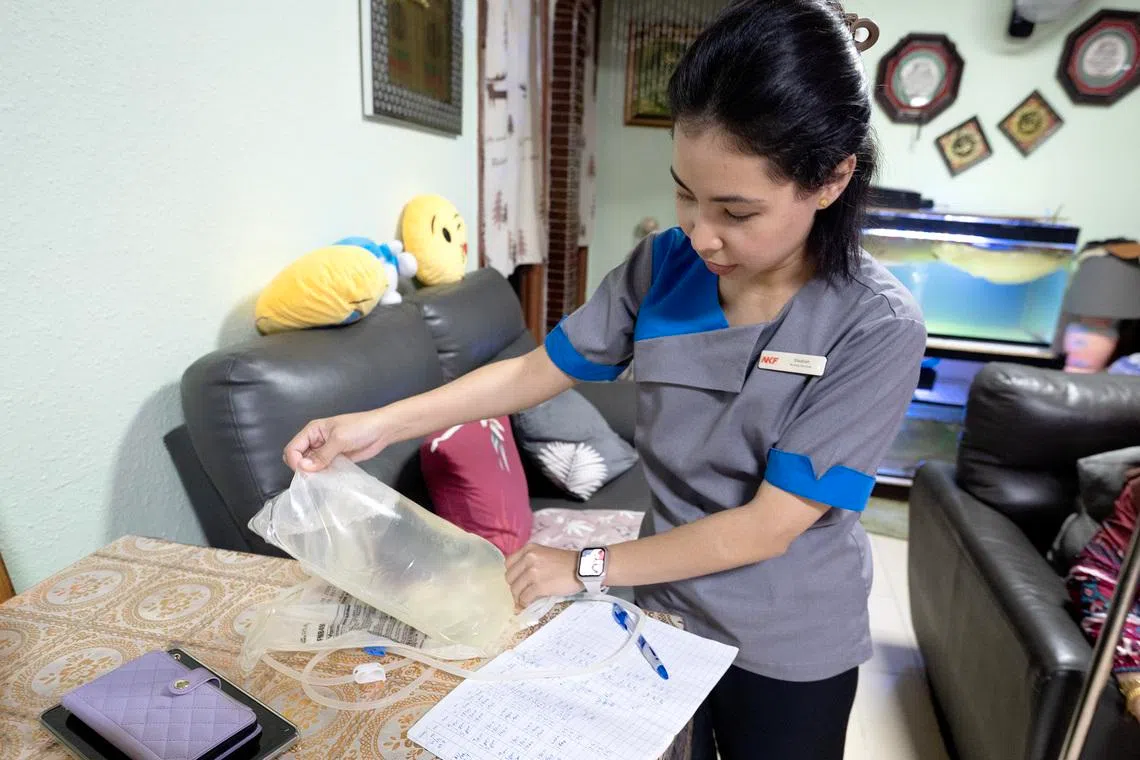
The procedure takes about 20 minutes, and she usually watches television while the exchange of fluid is going on. The solutions come ready mixed and are delivered to her home every month.
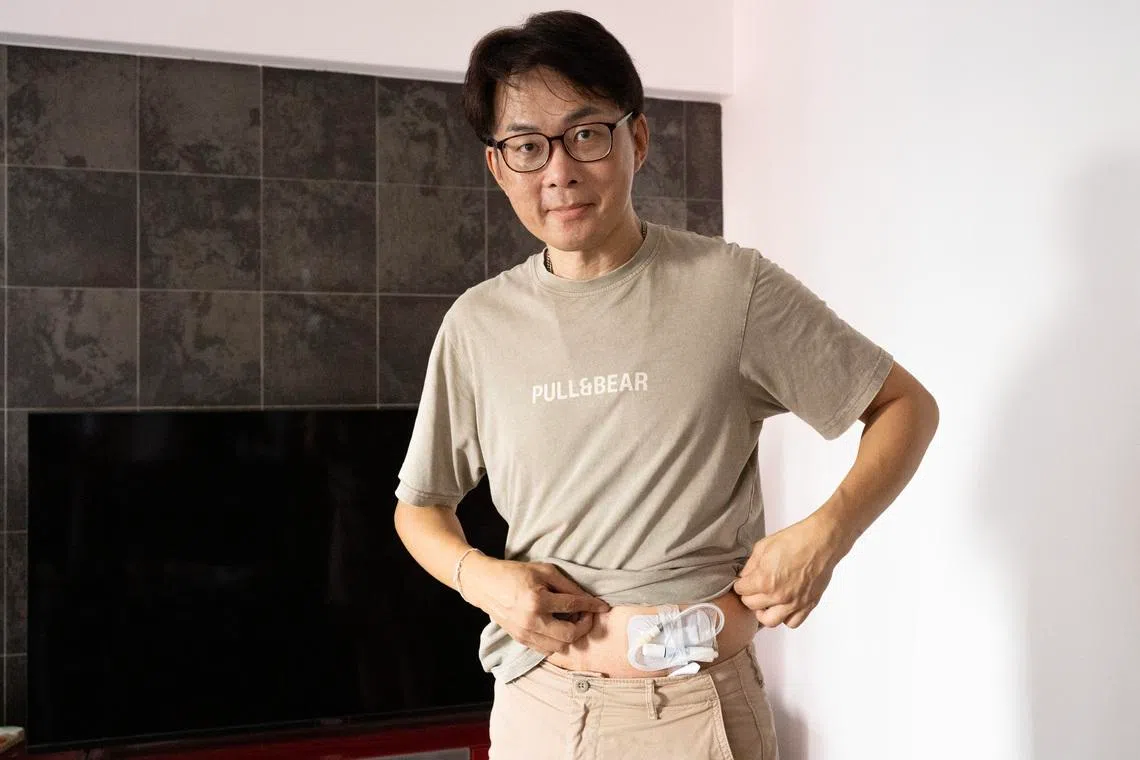
Prof Foo said that in PD, the solution is inserted through a catheter that is surgically implanted, after which "there is no pain. It is akin to turning on and off a tap". This is unlike HD, where two thick needles are inserted during each session — one for blood to flow out and the other, to return the clean blood.
Madam Norhyati is careful to sanitise the catheter before and after use, as she knows that lack of care could lead to infection. She said the timing of the PD exchange is flexible, so if she is out shopping, she can delay the PD by an hour or two. She can even carry a pack of the solution with her and do the treatment in the back seat of her husband's taxi.
Prof Foo said HD does not afford this flexibility. "There's no negotiation; you just come on time, you leave on time" since sessions are fixed and there are no spare slots at the dialysis centre.
Those on HD who skip a session — which means three to four days between dialysis sessions — will suffer from fluid overload, causing them to be breathless and their blood pressure to shoot up. Often, they end up in hospital.
However, patients, whether they are on HD or PD, may need to change to a different form of dialysis after 10 to 15 years.
In HD, repeated needling of the vein results in a narrowing and blockage of the veins over time, and new sites for needling need to be created in different parts of the arms and legs. After more than a decade, patients will run out of new sites for needling.
As for PD, a change is needed when the membranes become less effective in allowing waste and fluid to pass between the body and the abdominal cavity.
Prof Foo said that, ideally, patients should start with PD as it mimics the body's natural rhythm with continuous removal of waste from the body, unlike HD, which is done just three times a week. Clearing waste and excess fluid continually allows patients greater freedom in what they eat and drink.
She said PD patients are taught how to adjust the dialysis fluid if they indulge in a big meal, or conversely, if they have lost a lot of fluid due to diarrhoea or vomiting.
HD patients, however, have to follow a strict dietary regimen, especially in the amount of liquid consumed — generally between 500ml and one litre of fluid a day.
If patients can still urinate as normal, PD, which is gentler on the body, helps to retain residual kidney function for longer.
For Nelson Chew, 52, opting for PD was a no-brainer. The former physics teacher who later became a property agent suffers from a congenital kidney problem that led to early-stage kidney failure in his 30s.
Although he was on medication, was careful with his food and exercised regularly, his kidneys continued to deteriorate and by July 2024, his kidney function had fallen to about eight per cent.
Having done research on PD, Chew knew it would not interfere with his work and social life, and would allow him to continue travelling, something he enjoys doing several times a year. He had also seen the bulging veins of people who have undergone HD, and that scared him.
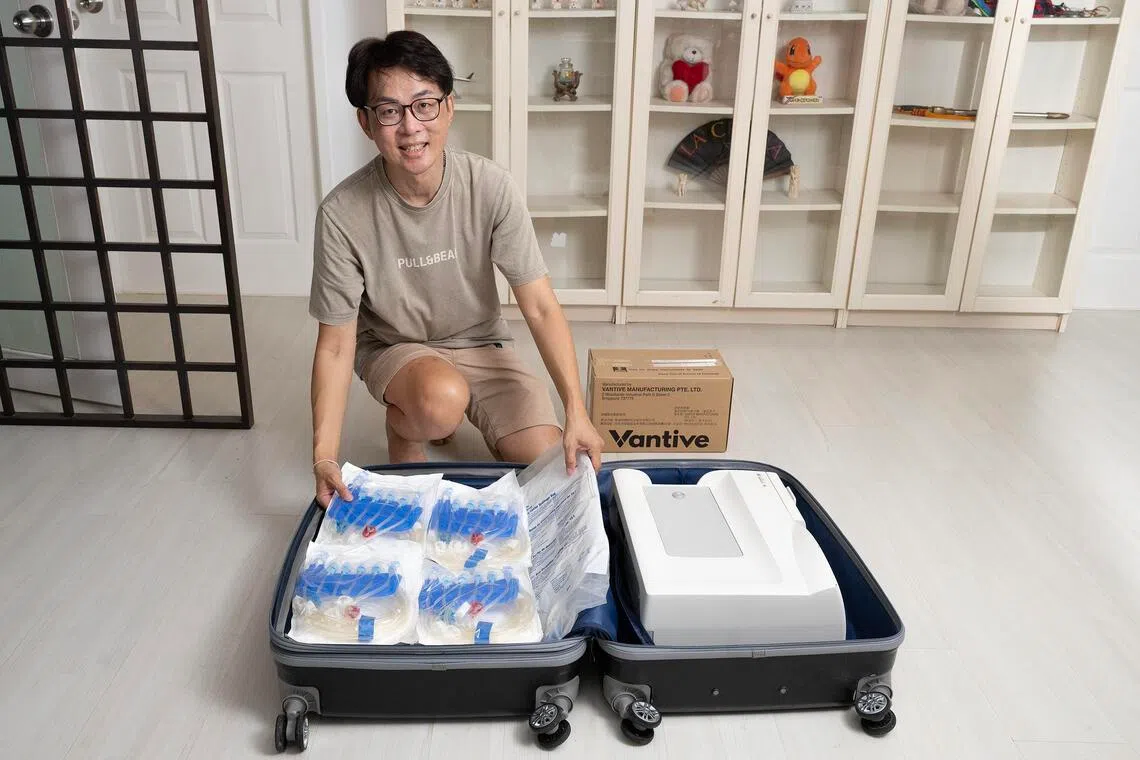
He opted for automated peritoneal dialysis (APD) where the dialysis is done overnight with a machine. He said he can sleep soundly during the eight hours he is hooked up to the machine, which changes the fluid in his abdomen four times a night.
Last December, Chew took a two-week trip to South Korea and China. He informed Vantive, the company that provides his dialysis fluid, of the five hotels he would be staying at so the dialysis solutions could be delivered there. Vantive is an international company with a presence in most countries so there was no extra charge for this service.
When Chew travels, he packs the 15kg dialysis machine, together with peripherals such as disposable tubes and disinfectants. Since going on dialysis, he has travelled to several countries.
Chew, who describes himself as a "happy and positive" person, said he was upset when told he had to go on dialysis. But he added: "Why waste time being upset? I still have to go on with life." And his choice of APD allows him to do just that.
In 2022, Health Minister Ong Ye Kung pushed for a PD-preferred approach as it "can be done at the patient's home, offers greater convenience, self-empowerment, normalcy in life, while maintaining good outcomes".
He challenged hospitals and social service organisations to increase PD rates for new patients from 20 per cent then, to 30 per cent by the end of 2025. In Hong Kong, which launched a PD-first approach in 1985, 70 per cent to 80 per cent of new dialysis patients are on PD.
Prof Foo said that while more new patients are opting for PD, the figures have not reached the 30 per cent target set by Ong. Today, about 24 per cent to 25 per cent of new patients opt for it.
She hopes that with the help of PD Warriors — a patient support group that was started during the Covid-19 pandemic, some of whom have opened their homes to share their experience with people who need to start undergoing dialysis — more new patients would opt for PD in future.
NKF's PD programme also ensures that patients are not left entirely to cope on their own, as help is just a phone call away. NKF chief executive officer Yen Tan said: "Our nurses journey alongside patients to give them confidence, even as PD empowers them to take charge of their lives."

[[nid:727451]]
This article was first published in The Straits Times. Permission required for reproduction.