Air quality in Singapore has improved, with 24-hour Pollutant Standards Index (PSI) readings in the northern and southern regions returning to the moderate range on Tuesday (Sept 15) afternoon.
Northern Singapore recorded unhealthy air quality for 10 hours, from 1am on Tuesday, before returning to the moderate range at 10am. The southern region spent 14 hours in the unhealthy range before improving to moderate levels at 11am.
At 3pm, data from the National Environment Agency (NEA) showed that PSI readings ranged from 92 to 135, placing air quality in the moderate to unhealthy bands. Central Singapore recorded the highest PSI reading at 135, followed by the western (118) and eastern (115) regions.
Meanwhile, the one-hour PM2.5 reading, an indicator of fine particulate matter in the air and a measure of current air quality, ranged from 48 to 101 at 3pm.
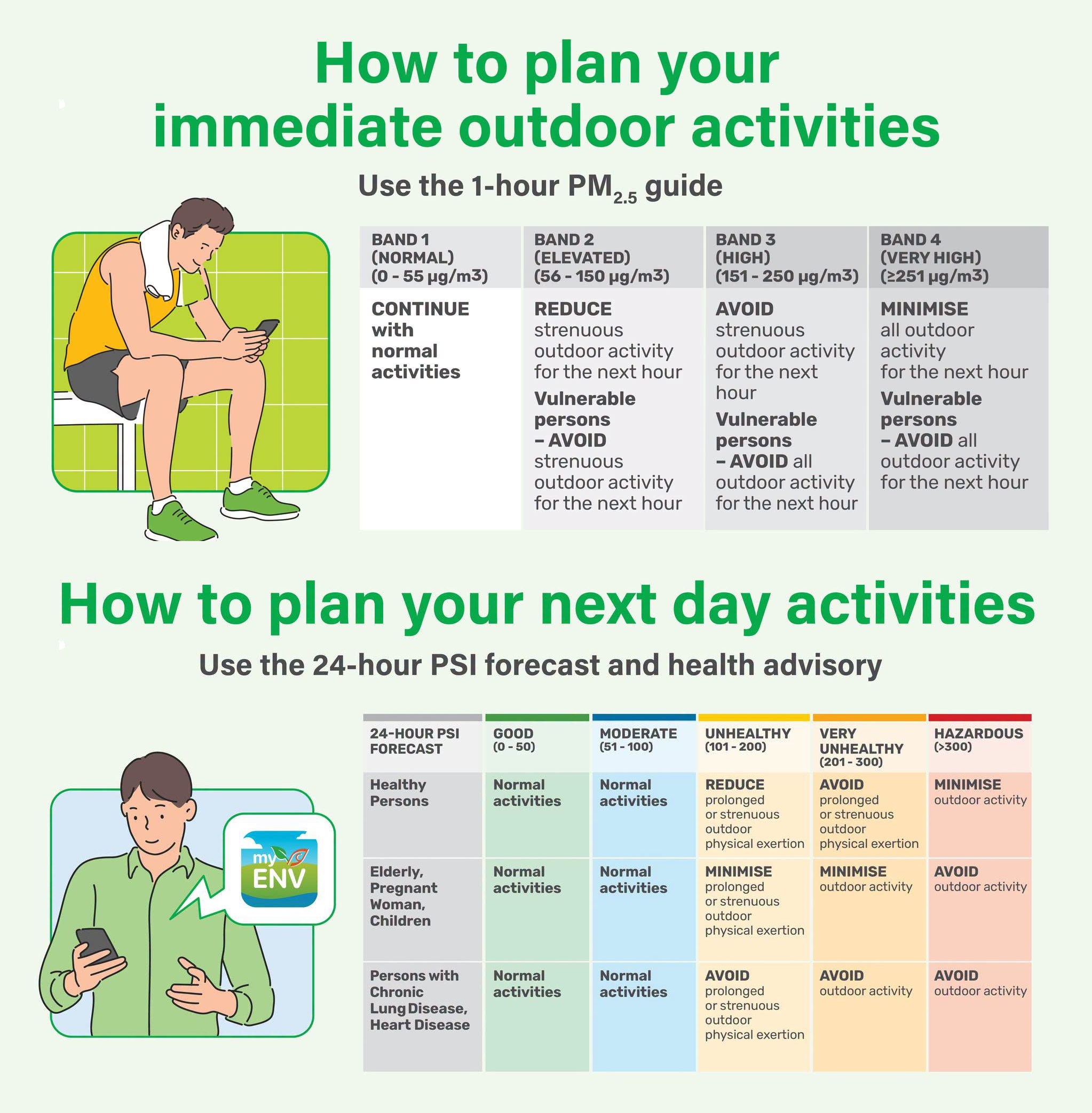
A reading of between 0 and 55 µg/m3 falls within the normal band, while readings ranging from 56 to 150 are classified as within the elevated band.
All three regions with moderate air quality — central (101), western (71) and eastern (70) Singapore — also recorded elevated PM2.5 readings.
NEA's historical data also shows that while PM2.5 concentration readings in the three regions fell back into the normal band on Tuesday morning, they began rising again from around 1pm.
Why PM2.5 is the number to watch
While scientific and epidemiological studies on the health effects of exposure to particulate matter have shown that the impact of short-term exposure is low, NEA provides hourly 1-hour PM2.5 readings.
These readings provide a real-time indication of the concentration of fine particles that can enter the lungs and bloodstream.
However, raw PM2.5 figures do not necessarily tell the average person what precautions to take. As such, NEA groups PM2.5 readings into four bands: normal (0-55 µg/m3), elevated (56 to 150), high (151 to 250), and very high (251 and above).
It also "translates" what this means into an outdoor activities planning guide for healthy and vulnerable groups planning to conduct or participate in such activities immediately.
Members of the public should note that the health impact of haze is dependent on one's health status, the PSI level, and the length and intensity of outdoor activity.
They may refer to the following guide when planning to take part in outdoor activities immediately:
[[nid:745156]]
editor@asiaone.com




