The co-location of the new Singapore Institute of Technology (SIT) within a business district means more opportunities for applied learning and industry collaboration, Prime Minister Lawrence Wong said on Tuesday (Sept 16).
He was speaking at the official opening of the new campus in the Punggol Digital District (PDD).
The PDD currently hosts companies like Panasonic, with organisations such as dConstruct, GovTech, UOB, OCBC, the Cyber Security Agency of Singapore, and the Association of Information Security Professionals set to move to the district.
Speaking at the opening ceremony, PM Wong highlighted that SIT is the only university in Singapore co-located within a business district.
SIT comprises two plots — the 42,000 sq m Campus Court facing the Coney Island waterfront and the 49,000 sq m Campus Heart featuring the Punggol Heritage Trail.
The campus has been fully operational since May, after about six years of development following its groundbreaking in 2019, with approximately 11,000 students and nearly 1,300 staff.
"This is a district designed for industries of the future, including fields like AI, cybersecurity and fintech," said PM Wong.
"PDD will be a natural extension of the SIT classroom, and SIT, in turn, can provide a steady pipeline of talent and ideas for PDD."
He revealed that two of Singapore's largest banks, UOB and OCBC, have committed over $1 billion to the district, and plan to move part of their operations to PDD by 2027.
PM Wong also noted that students will benefit from access to internships and project opportunities with companies in the district, as well as the possibility of traineeships or employment upon graduation.
For academic staff, the co-location offers the chance to conduct applied research in partnership with industry and the wider Northeast community.
At the same time, companies can tap into SIT's networks and expertise to co-develop real-world solutions.
PM Wong highlighted collaborations with A*STAR and the Home Team Science and Technology Agency (HTX) as examples of this approach.
"For example what SIT is doing with A*STAR and HTX — developing ways to improve detection of contraband items at Jurong Fishery Port, which if successful can be scaled up for larger-scale deployment."
'More than just a university campus'
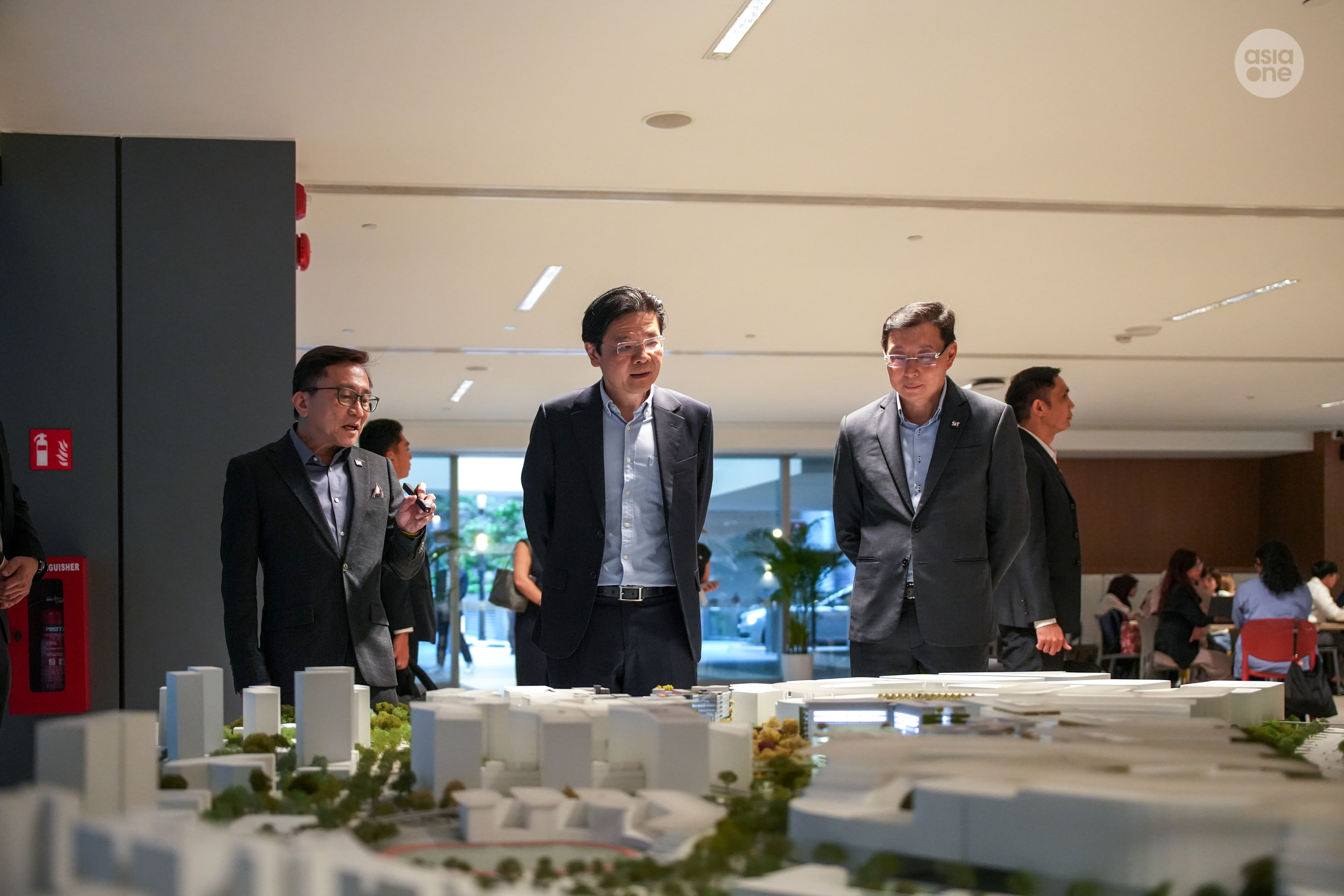
During the opening event, the prime minister toured the school's facilities and highlighted that SIT is more than just a traditional university.
"This can be much more than a university campus. It can be an ecosystem for closer partnerships where students, faculty, companies and government agencies come together," said PM Wong.
He added that the campus will push the boundaries of innovation, serving as a living lab — a space where new ideas and entrepreneurship can take root and flourish.
Beyond that, he said that these systems and data will also transform the campus into a testbed, where industry and government can trial innovative urban solutions and test them in a real-world setting.
PM Wong noted that while many of these innovations may start small within the campus, they have the potential to be scaled up and deployed more widely across Singapore.
One such example is SIT's collaboration with SP Group, which has led to the development of a multi-energy micro-grid on campus.
The micro-grid optimises energy use by integrating multiple power sources, including 10,000 sq m of photo-voltaic panels on the campus roof.
This initiative allows for research on integrating renewable energy and battery storage while maintaining grid stability.
He also noted that SIT will collaborate with JTC, IMDA, and industry partners to establish a testbed that extends beyond the campus — so that ideas can be trialled across the entire PDD, and eventually beyond the district.
A hub for lifelong learning
The prime minister added that the campus can be a vibrant centre for lifelong learning, and that the Government will be investing more in continuous training and education through SkillsFuture.
"In particular, SIT has pioneered competency-based, stackable micro-credential pathways (CSM)," he said, adding that this provides learners with flexibility based on the specific skill sets required for particular job functions.
Beyond CSMs, he said that SIT is also collaborating with SkillsFuture Singapore (SSG) to strengthen the skills assessment ecosystem.
"This can help more workers and employers to assess, recognise and validate their skills and map out concrete options for re-skilling and up-skilling," added PM Wong.
[[nid:722145]]
xingying.koh@asiaone.com




