Singapore's founding Prime Minister Lee Kuan Yew was willing to listen to the views of younger ministers, and would ask for alternatives to be put up should there be a disagreement on views, said former deputy prime minister S. Jayakumar on Wednesday (Aug 15) at the launch of his book.
Titled Creating Three Unique Singapore Laws: An Inside Story, Prof Jayakumar's book provides an insider's account of how the elected presidency (EP), Non-Constituency Members of Parliament (NCMP) and Group Representation Constituencies (GRC) were conceived, debated and established through constitutional amendment.
Addressing common misconceptions about decision-making in Lee Kuan Yew's Cabinet, Prof Jayakumar wrote in his book: "But, contrary to prevailing myths, especially in the mid-1980s, he was not a dictatorial prime minister who railroaded his proposals through a meek, compliant Cabinet.
"Instead, he took a collegial approach, consistent with the principle of collective responsibility in a Cabinet government.”
Prof Jayakumar also noted the "crucial role" played by younger ministers at that time, including former deputy prime minister Dr Tony Tan and Goh Chok Tong.
He said that Singapore's constitution might be "very different today" if the founding prime minister had been less willing to listen and change his position.
Referring to two parts in his book, Prof Jayakumar highlighted Lee's response to a differing view.
"Look, to those who have reservations and disagreements, I ask you to put up alternatives...
"...What is important is not that the solution I propose be accepted, but that there be a solution formulated which would be workable with a new guard in charge."
The 87-year-old, who had served in several Cabinet portfolios, including law, home affairs, and foreign affairs, before later becoming deputy prime minister, said his book also "lifts the veil of secrecy or mystique" about how the Singapore Government, especially the Cabinet, discusses important matters and come to a decision.
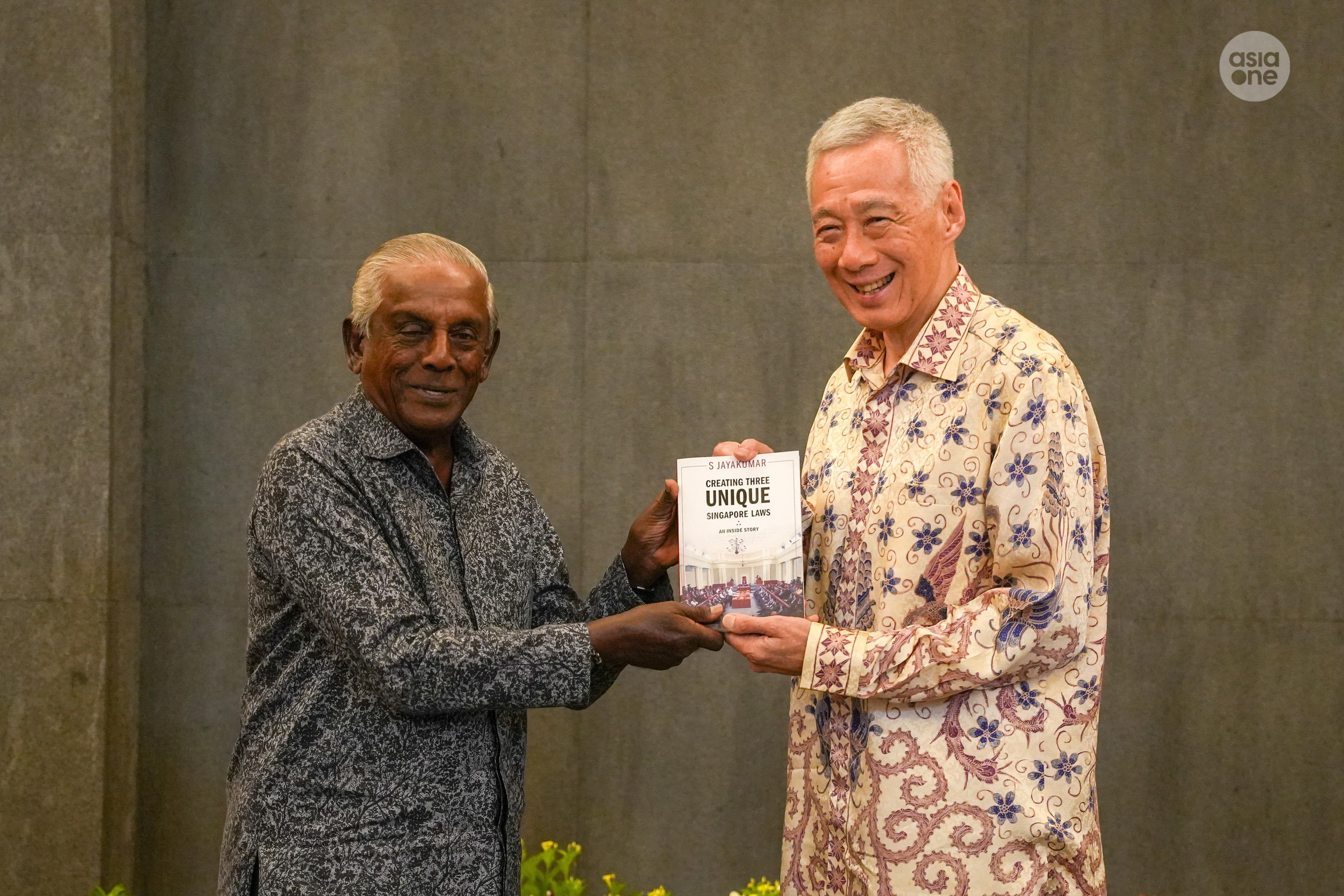
In his speech at the book launch, Senior Minister Lee Hsien Loong also spoke about this process, saying the leadership team would be open to radical, out-of-box ideas, including intensive but objective discourse.
"...Mr Lee Kuan Yew, as prime minister, put forth his views robustly, yet repeatedly and indeed obsessively sought alternative perspectives. He was always willing to be persuaded to change his mind, and sometimes settled on a conclusion only after years of reflection and debate.
"It shows what it means for the prime minister to be primus inter pares (first among equals) in the Cabinet, and how Cabinet collective responsibility is meant to work," SM Lee said.
Explaining the perceived secrecy, Prof Jayakumar said that for the principle of collective responsibility to work, the prime minister and his ministers must be able to discuss important matters in a frank and candid manner.
This allows all options to be weighed before a public announcement or statement is made, he said.
"It gives you a glimpse into the inside story of how deliberations took place on these issues, the arguments, the rebuttals, the point, the counterpoint, the dynamics of the personalities, and finally, how the process of compromise and consensus were reached, all with one thought uppermost in the minds of all the members of the Cabinet.
"That is, what would be in the interest of Singapore?"
Singapore must remain clear-eyed about its circumstances
The octogenarian quipped that the three legislations were the "most challenging" and "most interesting" during the 30 years he was in the Cabinet.
Having reflected on the city state's past and its progress today, he pointed out that what has not changed is that Singapore remains small, and will still have to operate under unusual and unique circumstances.
"How we got here is partly because the leadership in the past took important, innovative, unusual, and unique decisions, and pivotal decisions," he said.
And it is important for Singapore to be unafraid of taking, where necessary, unusual and innovative steps for its circumstances.
But he also cautioned that the country must remain clear-eyed that whatever approaches of other countries may not always work for Singapore due to its circumstances.
"(The book) is an illustration, in a small way, of how we had to figure out solutions for unusual situations, think out of the box, come out with the solutions.
"And as we face the future, we may need that ingenuity and the courage to take that approach," Prof Jayakumar said.
@asiaone Former Deputy Prime Minister S. Jayakumar was delivering a speech on Wednesday (Aug 12) at the launch of his book, which "lifts the veil of secrecy to an extent", giving readers a glimpse into the inside story of how deliberations took place, the dynamics of personalities, and how the process of compromise and consensus were reached. #sgnews #Singapore #GRC #NCMP #ElectedPresidency ♬ original sound - AsiaOne
[[nid:742498]]
editor@asiaone.com




