Malaysia Airlines jet entered Changi Airport runway in 2025 after approval to do so was cancelled

A Malaysia Airlines Boeing 737-8 taxiing on a runway.
PHOTO: Malaysia Airlines

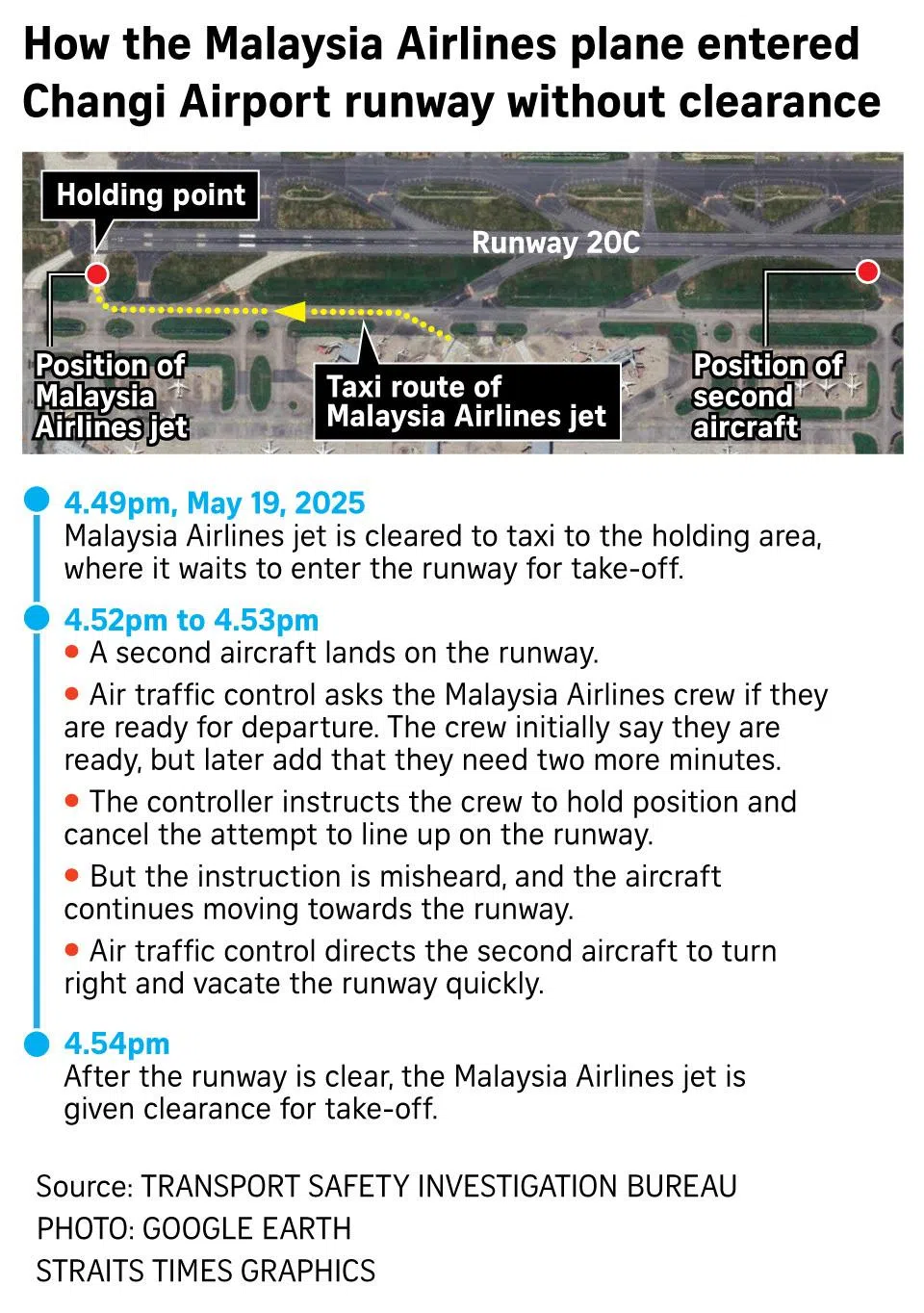
In May 2025, a Malaysia Airlines (MAS) jet entered a runway at Changi Airport after an air traffic controller cancelled its earlier clearance to line up for take-off.
At about 4.52pm on May 19, 2025, the controller told the pilots to stop taxiing the Boeing 737-800 onto the runway for departure after the MAS crew said they needed more time to prepare for take-off.
The incident came to light on April 1, 2026, when the Transport Safety Investigation Bureau (TSIB) published its investigation report.
At 4.53pm on the day of the incident, the MAS crew proceeded to line the aircraft up on the runway despite permission to do so being cancelled. TSIB found that the controller’s instructions were cut short due to simultaneous transmissions, and phrased in a way that the crew were less accustomed to.
No one was injured as a result of the incident. The MAS aircraft was cleared for take-off soon after, at 4.54pm, after another aircraft that landed on the same runway earlier had vacated the area.
TSIB, a department of the Ministry of Transport, classified the incident as a runway incursion, which is when an unauthorised aircraft, vehicle or person is on or near a runway that is in use.
The pilots of the MAS jet – bound for the Malaysian capital Kuala Lumpur – earlier received the go-ahead around 4.49pm to steer the aircraft to a holding point on a taxiway next to Runway 20C and wait for clearance to enter the runway.
At around 4.52pm, another aircraft landed on the runway.
The controller then asked the MAS pilots if they were ready for departure. They replied that they were, and the controller cleared the jet to line up on the runway.
Shortly after, the pilots realised their cabin crew had not reported to them that the cabin had been readied for departure, so they informed the controller that they needed two more minutes.
The controller then relayed these instructions to the pilots: “Line-up clearance cancelled and report when ready.”
But the crew read back incorrect instructions to the controller, saying “cleared line-up and wait”, while they continued to taxi the jet towards the runway.
The controller noticed the incorrect readback and asked the crew to stop at the holding point, but her instructions were cut short and only the words referring to the holding point were transmitted to the pilots.
TSIB said this was likely due to simultaneous transmissions taking place on the frequency.
The crew once again read back incorrect instructions, but the controller did not correct them immediately and the aircraft continued moving towards the runway and eventually entered it.
The crew had interpreted the controller’s instructions as approval to position the plane on the runway.
TSIB said the risk of an unauthorised take-off would have been eliminated if the controller had immediately corrected the crew’s misinterpretation and instructed them to stop.
The controller was alerted to the incursion via the airport’s surface movement control system.
TSIB found that the controller felt there was no need to ask the MAS aircraft to stop as it would “not remedy” the runway incursion situation.
The captain of the MAS flight later told TSIB investigators that he was more accustomed to instructions phrased in a “direct, imperative sentence structure” – such as “cancel line-up clearance” – though he understood what “line-up clearance cancelled and report when ready” meant.
Examples in International Civil Aviation Organization (ICAO) documents typically adopt a direct, imperative sentence structure for air traffic control clearances.
TSIB noted that the air traffic services provider, the Civil Aviation Authority of Singapore (CAAS), had published a handbook in July 2025 containing recommended standard phrases.
The handbook stated that the phrase for cancelling a clearance to line up on a runway was: “Hold position. Line-up clearance cancelled.”
According to the TSIB report, CAAS explained there was no need to align the phrase to a direct, imperative sentence structure as the emphasis was on “hold position”, which immediately conveys to pilots the action needed.
It added that there was no significant difference between its existing phrase and the direct form suggested.
CAAS director of air navigation services safety Victor Tan told The Straits Times that safety lessons from the investigation were communicated to all its air traffic controllers through safety briefings.
These briefings highlighted the importance of clear and concise phrasing, and the correct prioritisation of tasks – such as giving precedence to ensuring aircraft separation over others.
He added that these safety lessons were also reinforced and included in the training of current and trainee controllers.
Tan noted that the July 2025 handbook is aligned with ICAO standards, promoting clear and concise language while allowing flexibility based on operational contexts.
He said the authority reviews the handbook yearly to ensure it remains up to date and consistent with ICAO guidelines, and it will assess if an interim update is needed following the publication of TSIB’s report.
TSIB said MAS reminded all its flight crew to listen attentively to instructions from controllers and verify them if communication is interrupted. The airline also told its crew that they should plan, prioritise and schedule tasks effectively should they anticipate that several tasks need to be carried out simultaneously.
ST has contacted MAS for comment.
At least 12 runway incursions have been recorded at Changi Airport from 2010 to 2025, according to TSIB air safety investigation reports.
This article was first published in The Straits Times. Permission required for reproduction.
[[nid:733666]]