Singapore's MRT network reliability in April was the highest since November 2024, according to the Land Transport Authority's (LTA) monthly report released on Friday (May 15).
Rail reliability is mainly tracked using the mean kilometres between failure (MKBF) metric, which counts the average distance a train travels before it meets a delay lasting over five minutes.
The MKBF target for the MRT network is 1 million train-km.
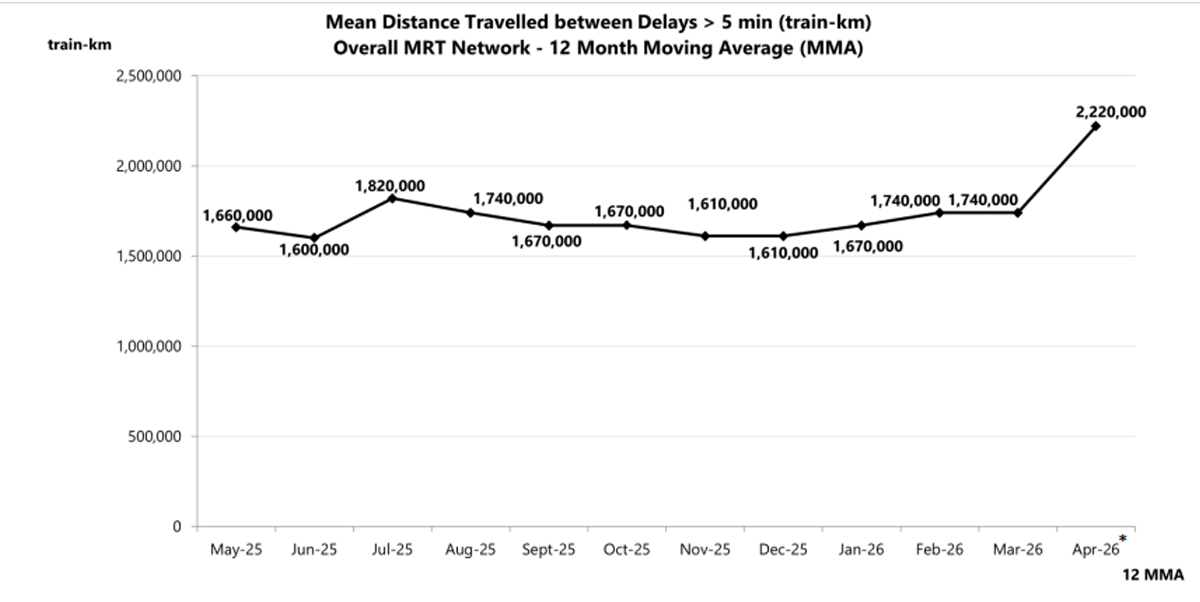
Over a 12-month moving average, MKBF for trains increased to 2,220,000 train-km in April, up from 1,740,000 train-km reported in March.
This is also the first time since November 2024 that the overall MRT network MKBF crossed 2 million train-km.
Across the five completed lines — North-South Line (NSL), East-West Line (EWL), North-East Line (NEL), Circle Line (CCL) and Downtown Line (DTL) — SBS Transit's DTL saw the biggest improvement, doubling its reliability from 2.1 million train-km to 4.2 million train-km.
Meanwhile, SMRT-operated NSL and EWL, which are also Singapore's oldest MRT lines, saw improvements in their respective MKBF. However, the CCL's MKBF fell slightly to 2.36 million train-km, from 2.37 million train-km.
SBS Transit-operated NEL held its MKBF steady at 4.45 million train-km.

The performance of the Thomson-East Coast Line — with a MKBF of 356,000 train-km — was excluded from the overall rail reliability results, as it is still in the process of being fully completed, with system integration works ongoing alongside regular operations and maintenance.
LTA said it is monitoring the line alongside rail operator SMRT to improve its performance.
In April, there were no major delays exceeding 30 minutes across the rail network. Train punctuality improved across all lines, except on the CCL, which saw a drop from 99.13 per cent to 98.93 per cent.
Train punctuality is measured as a percentage of train trips that complete their trips "on time" at the end of each line or a scheduled turnaround point within two minutes of the schedule.
Meanwhile, train service delivery, which measures the actual distance travelled by trains compared to the scheduled distance, saw mixed results in April.
While there were improvements on the EWL, NEL and DTL, the NSL and CCL saw slight drops.
Since October 2025, LTA has been issuing monthly updates as part of efforts to improve transparency and accountability.
"(This) provides the public with a clearer picture of how our rail network has been performing over time," said LTA in a statement then.
[[nid:725669]]
editor@asiaone.com



