

Nearly 3 in 4 Singaporeans likely to have 'victim-first lens' when determining severity of online harms: IPS study

The second phase of the study surveyed 600 people on their perceptions of the severity of online harms.
PHOTO: AsiaOne file

 PUBLISHED ONOctober 22, 2025 10:45 AMBYBhavya Rawat
Almost three quarters of Singaporeans are likely to find online harms more severe if they target vulnerable victims or have a considerable impact on them, according to a multi-phase online safety study conducted by the Institute of Policy Studies (IPS).
The study, titled "Online Harms in Singapore, from Evidence to Action", was conducted between June 2024 and May 2025.
Funded by the Ministry of Digital Development and Information, it comprised focus group discussions, in-depth interviews, as well as a survey of 600 Singapore citizens and permanent residents, conducted after the focus group discussions and in-depth interviews.
The demographic of survey respondents generally reflected the age and gender distribution of Singapore's resident population in 2024.
This study was released shortly after the Online Safety (Relief and Accountability) Bill (OSRA) was tabled in Parliament on Oct 15.
[[nid:723988]]
In the focus group discussions, respondents from all demographics consistently ranked child sexual exploitation, violent content, terrorism, and vice-related content the most severe online harms.
When it came to other pressing harms, non-consensual intimate images, the promotion of dangerous behaviour, and targeted harassment also emerged as major concerns.
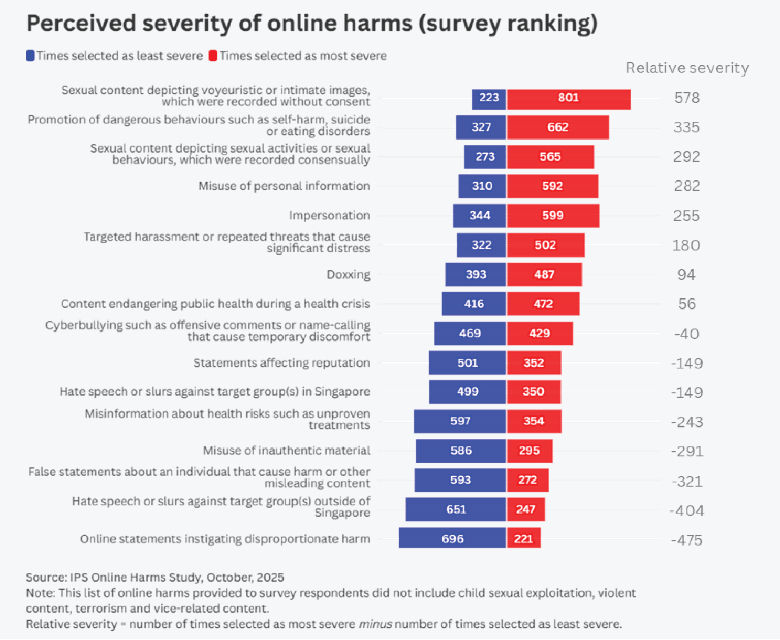
About three in four respondents rated harm to individuals (73.5 per cent) and the vulnerability of potential victims (74.3 per cent) as very or extremely important factors in judging how serious an online harm is.
These findings were reinforced by focus group participants, who ranked child sexual exploitation and abuse as the most severe harm because of the "extreme vulnerability" of its victims and the "lifelong consequences" it has.
While they agreed on the top few online harms, some demographic groups varied in their perceptions of others.
In the survey, male respondents ranked consensual sexual content fifth in severity, while female counterparts ranked it second.
Three in four respondents believed that improving online safety is a "shared responsibility" between Government, technology companies and individuals.
A total of 67.6 per cent of respondents wanted stronger action from social service agencies, despite expectations for them being lower.
Additionally, nearly eight in 10 respondents (79.3 per cent) said laws which hold perpetrators accountable would be "very" or "extremely" helpful, while 77 per cent wanted social media platforms to be faster in removing harmful content and accounts.
More than 70 per cent of respondents also supported other measures, including laws that can quickly address newer harms like deepfake pornography which would empower victims to seek financial damages and combine legal remedies with public education.
Addressing the findings of the study, Principal Investigator Dr Chew Han Ei said that victims have expressed wanting clarity, speed and support when harm occurs.
"At the same time, the public expects everyone - Government, industry, and society - to step up together," he said.
"This strong consensus provides a foundation for building a safer, more accountable digital ecosystem in Singapore."
Dr Carol Soon, Co-Principal Investigator, said: "Singapore has taken important steps in online safety. Our recommendations build on this foundation by calling for clearer victim support, stronger digital literacy, and laws that keep pace with fast-changing harms like deepfake pornography."
"To be effective, our approach must be both preventive and responsive," she added.
[[nid:721974]]
bhavya.rawat@asiaone.com