

'New normal': DPM Gan Kim Yong on how US tariffs on pharmaceuticals signal larger investment trends that affect Singapore
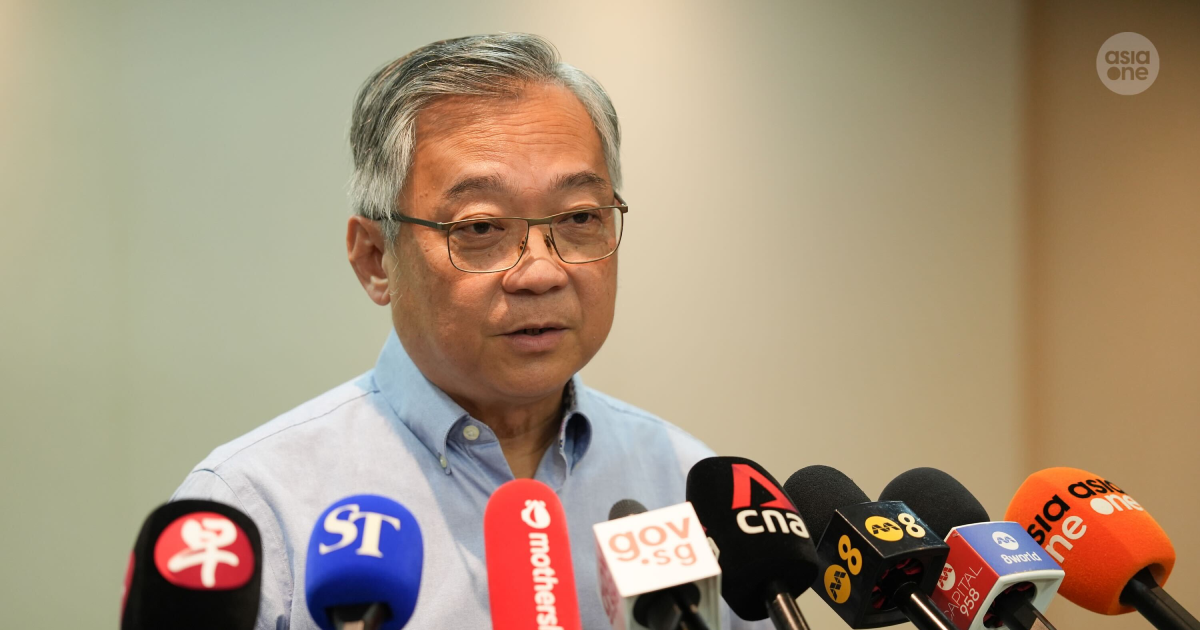
DPM Gan Kim Yong speaks to the press on Sept 27, 2025.
PHOTO: AsiaOne

 PUBLISHED ONSeptember 27, 2025 9:16 AMBYDrima Chakraborty
Pharmaceutical companies in Singapore aim to build manufacturing plants in the US to gain an exemption to the recently-announced 100 per cent tariff on branded drugs.
Deputy Prime Minister Gan Kim Yong told local reporters on Saturday (Sept 27) that Singapore had already been in talks with the companies "to better understand their concerns and the situation with regard to their exports to the US" previously and subsequently learnt about their plans following the new tariffs.
"In the meantime, they are also continuing to clarify with the US administration, to better understand the conditions and the criteria, and to confirm that whether there are plans for the [new] plants in place, whether they will be eligible for tariff exemption," he said.
DPM Gan, who's also the Minister for Trade and Industry, added that pharmaceuticals make up 13 per cent of Singapore's exports to the US, amounting to $4 billion.
"SERT (Singapore Economic Resilience Taskforce) has announced several initiatives to help companies adjust to this new environment," he continued. "One of them is the Business Adaptation Grant.
"More details will be announced over the next couple of weeks, and this scheme will be able to help many of the companies that are affected by the new tariffs to adjust the supply chain, to reconfigure their production base in order to be able to manage the impact of the tariff. And we are prepared to do more if necessary, to help companies weather this transition."
DPM Gan also pointed to Singapore's new graduate internship and traineeship programme, which aims to "provide more opportunities for our fresh graduates in view of the uncertainty and volatility going forward".
Singapore is also continuing its bilateral discussions with the US regarding pharmaceuticals and semiconductors.
While it was not clarified by the US whether the 100 per cent is standalone or on top of base tariffs, DPM Gan shared that he believes it is the former as branded pharmaceutical products have previously been exempted from the baseline tariffs.
"We will need to clarify with the US," he added.
[[nid:721725]]
Pharmaceutical companies building new plants in the US are not in direct competition with Singapore's interests, as many of them continue with their plans to build capacity in Singapore.
However, DPM Gan shared that the US tariffs may point to larger investment trends around the world.
He said: "I think, in time to come, other countries will also begin to have to introduce tariffs to protect their own industries, so I think this is going to be a new normal. It's not going to be a passing storm, it's going to be here to stay.
"So I think we have to understand the new world that we are facing, and therefore we have to reorganise ourselves, strengthen our resilience and the competitiveness so that we can be relevant to the global economy in the long term."
DPM Gan also pointed to Japan, South Korea and the EU which "have made significant commitment to new investments are going to flow into US", some of which could have been targeted at investing in Singapore and the region but have now been diverted.
"So I think this, in the longer term, will shift the investment pattern, and the investment environment will become even more competitive," he added.
He pointed to the Economic Strategy Review which has been set up to look at Singapore's long-term outlook, to ensure we stay competitive.
In response to AsiaOne's question on companies that do not meet the criteria for tariff exemption, DPM Gan said that Singapore will just "have to continue to focus on areas that we can be competitive".
"We will help some of these companies reorganise themselves, and there will still be products that we are competitive in, and we'll try to attract them to Singapore, even pharmaceutical companies," he said. "US is not the only market."
He added that Singapore also exports to "a lot of other countries" and can work with pharmaceutical companies to move to these new markets and attract new investments beyond the US.
"At the same time, if we are able to be competitive, even despite the tariff, we might still be able to have a piece of the market for our pharmaceutical companies here," DPM Gan said.
He said that the companies will have to optimise their global supply chain to "see whether part of it can be able to serve the US" while the rest of it serves the rest of the world.
"So pharmaceutical companies will have to make their calculations, redesign the supply chain, and reorganise their production base so that they can remain competitive," DPM Gan said.
[[nid:722729]]