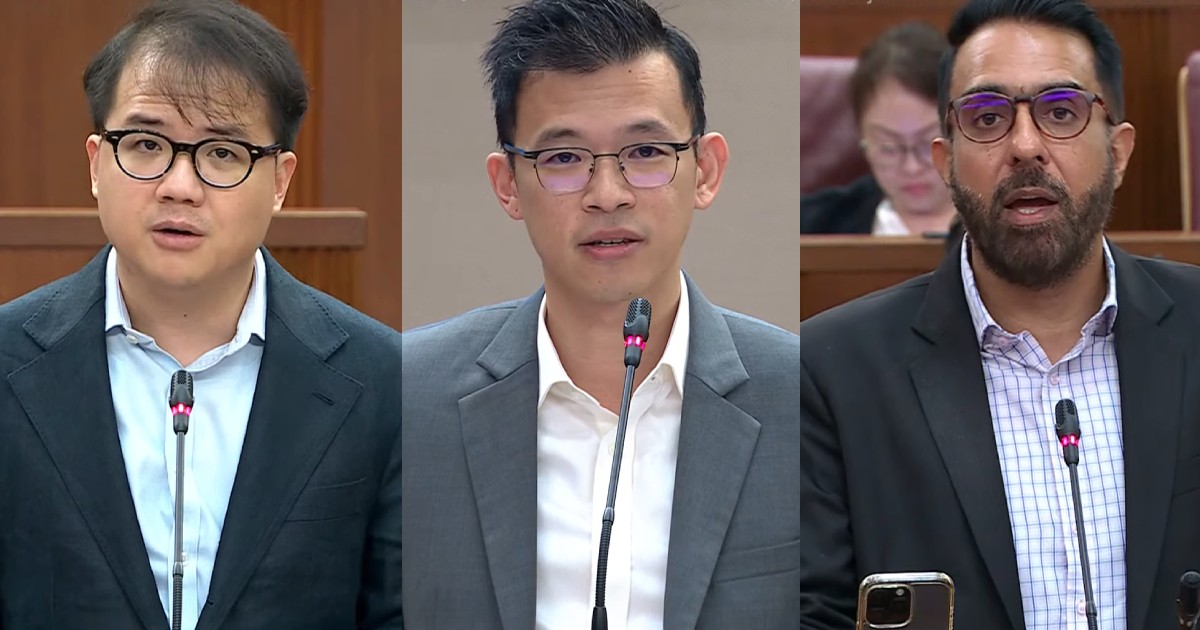
Workers' Party MPs on Wednesday (Aug 5) put forward a range of proposals in Parliament aimed at addressing challenges facing Singaporean workers, young people and local businesses.
A motion titled "an economy of the future that works for all" was moved by Aljunied GRC MP Kenneth Tiong, who said in his opening speech that Singapore needs an updated growth model.
Speaking on the challenge of innovation and entrepreneurship, he submitted the creation of a "special" zone consisting of residential and commercial space, including local enterprise and R&D, around Nanyang Technological University (NTU).
Tiong said the State land in this district should not be priced at market scarcity value. Instead, it "takes its return in the companies that grow there instead of in rent".
Tiong argued that high land costs have become a barrier to research, entrepreneurship and innovation, particularly for younger Singaporeans.
He described the proposal as an "experiment" that could create a district that is both "pro-worker and pro-business".
"Once in, the rent stays low while you are part of the zone — studying, working, building or serving it," Tiong stated.
"Leaving is built in: a firm gets a fixed term and option to renew, then graduates out on success; a person who loses a job, or whose startup dies, gets a year's grace before the rent resets.
"And the housing is rented, never sold. It never becomes an asset to be traded."
A zone authority that will have stake in the enterprises within could further develop the zone, he added.
"If there is a Singaporean secret sauce that inheres beyond the cost pressures of land and wages, then a zone here, alongside the one in Johor, will tell us.
"It is a test we should run for our younger generation. We have spent thirty years making this country a good place for other people's companies to succeed. I am asking that we spend the next thirty making it a place where our own can."
Supporting young Singaporeans entering the workforce
NCMP Andre Low spoke about giving a "fair start" to young Singaporeans, citing increasing difficulties faced by fresh graduates and youths seeking employment.
"The Economic Strategy Review (ESR) is organised around workers adapting again and again," he stated.
"It gives far less attention to the all-important first transition from education or National Service into stable work, and to whether young people get a fair start."
Low said that while the Government has provided various career exposure opportunities, "exposure is not employment".
He proposed a national commitment called a "Fair Start Promise", which supports individuals transitioning into working life with stable employment or a proper paid, career-building pathway.
This would include opening more entry-level positions to "capable beginners", expanding paid apprenticeships and creating what he described as "genuinely additional job opportunities".
"Young people must prepare, search earnestly, and engage with suitable opportunities. Employers must provide real work and invest in beginners. The government must build the conditions in which sustained effort can lead somewhere."
'Every worker deserves protection'
Meanwhile, WP chief Pritam Singh renewed his call for legislating minimum retrenchment benefits.
"To receive retrenchment benefits, workers in Singapore are dependent on the goodwill of employers, the terms of their employment contracts, or the strength of their bargaining position after they have already lost their jobs," he said of the current situation.
Singh also pointed out several Asian economies that have legislated severance or retrenchment protections.
"They have all reached a common conclusion: business flexibility for employers and worker protection are not mutually exclusive," he said.
It is important for all retrenched workers to be afforded benefits, he said, citing financial pressures and mental health concerns experienced by such workers and their families.
"A resilient society requires workers who know they will not be left to bear the burdens of economic change alone.
"Because in line with the call of the labour movement and NTUC no less, while not every job can be protected, every worker deserves protection."
[[nid:738813]]
lim.kewei@asiaone.com