Singapore and Changi cannot afford to be complacent, and we must "continue to work hard", said Prime Minister Lawrence Wong during the groundbreaking ceremony of the mega Terminal 5 (T5) on Wednesday (May 14).
The terminal will also house Changi's first transport hub, with the potential for land, air and sea transportation options.
Speaking at the event, PM Wong, who is also the Finance Minister said: "Like Singapore, this improbable nation we have, Changi, too, has defied the odds to thrive and succeed beyond all expectations.
"We must make a connection to the world, and we must make sure our air hub stays competitive. That's why, today, we are making another bold move in Changi with this groundbreaking."
He shared that an estimated 50 million passengers are expected to travel through T5 each year.
With the completion of T5, Changi Airport will be able to handle 140 million passengers yearly, boosting its current capacity of 90 million by more than 55 per cent.
The current 170 city links that Changi has is expected to increase to more than 200 with the completion of the new terminal, PM Wong stated.
The terminal will occupy 1,080ha of the Changi East industrial area, which is similar in size to the current Changi Airport which consists 1,240ha.
A total of 71 contact stands will be available in T5, which can be individually used as boarding gates for large planes or split into two for smaller aircraft.
Within T5 will be two sets of trains that will ply the terminal — similar to the existing Skytrain — allowing ease of access to these boarding gates. A 2.5km underground link will also connect T5 with Terminal 2.
Once complete, T5 will be home to both Singapore Airlines and its budget arm, Scoot.
T5's transport hub
T5's ground transportation centre will also feature interconnectivity with rest of Singapore through public and private transportation.
In particular, the Thomson-East Coast Line will be extended to connect T5 with the city centre and the Johor Bahru-Singapore Rapid Transit System (RTS) Link terminal at Woodlands North.
The Cross Island Line, Singapore's eighth MRT line which will be completed in 2030, will also connect T5 to the Punggol Digital District and Jurong Lake District.
New roads along Changi Southern Corridor also links T5 to Tanah Merah Coast Road, East Coast Parkway and Pan Island Expressway.
Tanah Merah Ferry Terminal's proximity to T5 also highlights the possibility of air-sea transfers, Changi Airport Group (CAG) managing director for Changi East Ong Chee Chiau said, adding that the transport hub in T5 will also consist a series of drop-off points, taxi stands, car parks, and bus stations.

Passengers departing from T5 are expected to be able to get from plane to a transport of their choice within 30 minutes, while those transiting to a different flight will be able to get to their next gate within an hour.
"We want to give you the best possible choices that you would like to take for your own specific uses," Ong said, emphasising the importance of ease of transfer for travellers.
CAG chief executive officer Yam Kum Weng took the opportunity to highlight how T5 "marks a new chapter" for Changi Airport.
"Changi Airport has a special place in our hearts," he said. "Many of us have a memorable story that relates to Changi. With Jewel, we reimagined what an airport can be. As a new gateway to Singapore, T5 offers new possibilities and will bring new surprises."
Yam added: "The success of T5 isn't measured by just how good it is on day one, but how much better it becomes over time. The vision for T5 is a bold one... T5 will be an icon that all Singaporeans will be proud of."
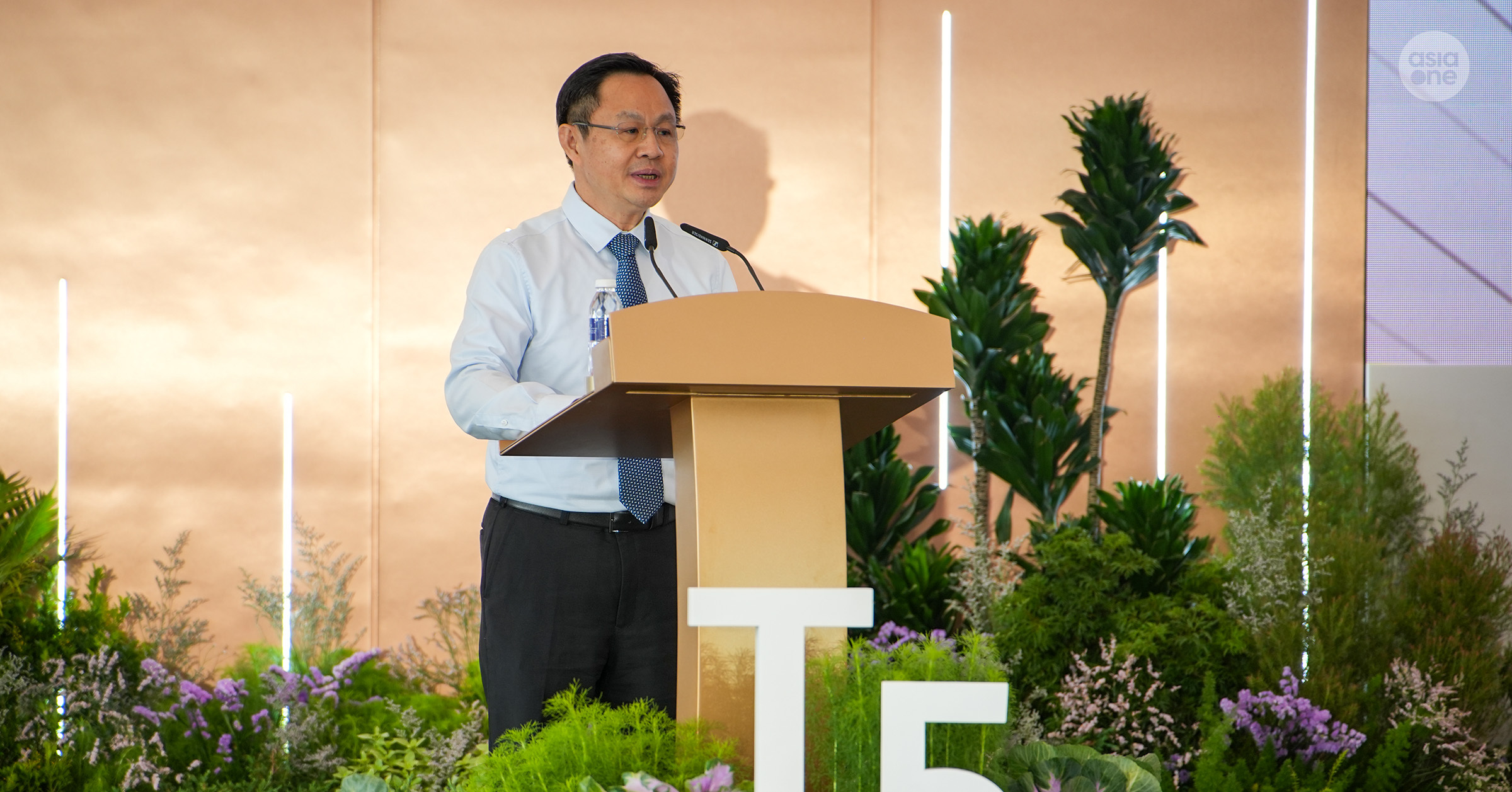
Also present at the ceremony was Transport Minister Chee Hong Tat.
Powered by automation
T5 has also been designed to utilise technology to automate and digitalise airport operations, improving efficiency and passenger experience.
This will be put into action via the Integrated Operations Centre, which will allow operators to have better situational awareness and make decisions based on data given.
Ground handlers who would have improved understanding of aircraft activities and potential delays would then be able to better utilise resources to mitigate these delays.
Autonomous vehicles will also be used to shuttle passengers and staff, potentially improving road traffic and safety, while automated baggage transfers and baggage handling could improve delivery efficiency even amid bad weather.
Additionally, aerobridge docking would also see automation in T5, improving productivity and operational efficiency.
Designed to weather storms
The new terminal will feature curved roofs of different heights instead of a singular roof covering the whole terminal.
Natural light and landscaping will also add to the "familiar cosy yet uplifting feel" that the airport is known for, CAG said.
T5 will also feature one of Singapore's largest rooftop solar systems, which could potentially generate enough energy to power up to 20,000 four-room HDB flats for an year.
Global warming and adverse weather conditions have always been a concern for CAG, the group also said.
Because of this, T5 is elevated 5.5m above sea level and aircraft taxiways will be sloped for better draining of rainwater.
This would allow for stormwater to be effectively managed in situations where high tides may arise, or amid extreme storm and rainfall.
$4.75b in contracts awarded
This groundbreaking ceremony comes after contracts worth $4.75 billion were awarded for various projects to different companies.
The joint venture between the Singapore branch of China Communications Construction Company and Obayashi Singapore received a contract valued at $3.8 billion while Hwa Seng Builder was awarded a $950 million contract.
The construction of T5 is expected to complete in the mid-2030s.
[[nid:716592]]
khooyihang@asiaone.com