

Singapore must become more cohesive as global outlook remains uncertain: PM Wong

Prime Minister Lawrence Wong said that as the world becomes more fractured, Singapore must become more cohesive.
PHOTO: ST

Singapore's first-quarter growth was solid and reflects the diversity and strength of its economy, but the global outlook remains uncertain, said Prime Minister Lawrence Wong on Monday (June 8).
The country is making broad adjustments in areas like economic planning to deal with the uncertainty and technological change, but what is most important is its ability to maintain solidarity and unity, he said.
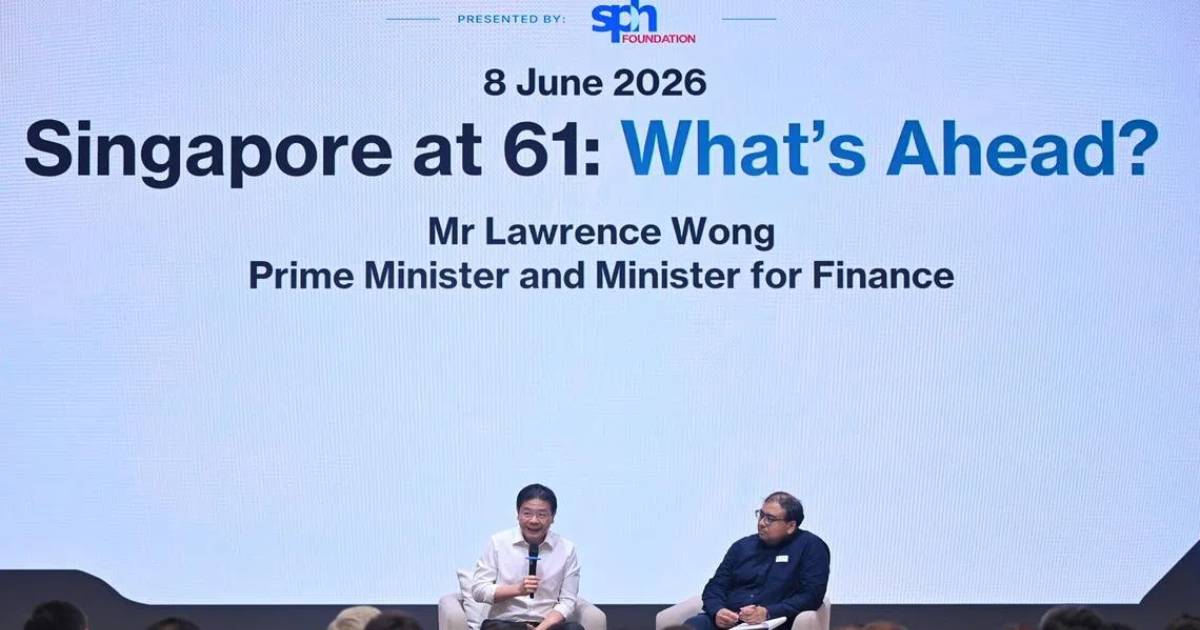
"We cannot fully control how the world changes, but we can choose how we respond, and that response must come from Singaporeans ourselves," he said at a dialogue with the Singapore Press Club held at the SPH Media auditorium in Toa Payoh.
Singapore is more diverse than ever before, with people from different backgrounds, different aspirations and perspectives. That diversity is a tremendous source of strength, PM Wong said.
"Our greatest strength remains the same - and that's our ability to stay united and move forward together as one people," he said.
And as the world becomes more fractured, Singapore must become more cohesive, he added.
"That's how we continue to thrive and flourish in this next phase," said PM Wong at the dialogue titled "Singapore at 61: What's ahead?"
While Singapore beat the initial first-quarter estimate of 4.6 per cent to grow 6 per cent year on year, the full effects of the Middle East conflict have yet to be felt here, he noted.
He was speaking as the guest of honour at the dialogue, which was part of the Singapore Press Club's Eminent Speaker Series, presented by the SPH Foundation.
The Government still expects inflationary pressures to rise, and there is also uncertainty about how artificial intelligence will impact the job market, said PM Wong, who is also Finance Minister.
He raised the example of electricity prices, and said that current tariffs do not yet reflect the full increase in oil prices due to the crisis, which began in February 2026.
The global economy has also been able to adapt better than most people expected, he noted.
This is because of alternative supplies, rerouting and drawing-down of inventories. "These buffers have helped to cushion the impact up to now."
But it is still an open question on how long the disruption and these buffers will last, he said at the session moderated by The Straits Times associate editor Zakir Hussain.
If the disruption continues and buffers start to dwindle, at some point, the impact on the global economy will be more severe, and there may be more shortages, PM Wong said.
This will result in more impact on demand and Singapore's growth. Rising costs in areas like food and fertilisers are also not yet fully accounted for, he added.
Singapore will also have to navigate a world that is in the midst of "the most important transition to the global order since the end of the Cold War", he said. This transition will take time and be marked by more distributed centres of power.
The US remains the dominant power for the foreseeable future, while China has risen to be its "peer competitor".
Europe remains a major force, while India is rising rapidly, he said. There are also rising middle powers, including regional groupings like ASEAN, he added.
Fortunately, Singapore is moving from a position of strength because the country has built trusted institutions, deep capabilities and a strong reputation, he noted.
But the Government is aware that it cannot stand still and must adapt and change to stay relevant.
That is why it recently undertook a major review of its economic strategies, PM Wong said.
Recommendations from this include sharpening Singapore's value proposition to the world, and building more resilience in the public and private sectors.
[[nid:734039]]
This article was first published in The Straits Times. Permission required for reproduction.