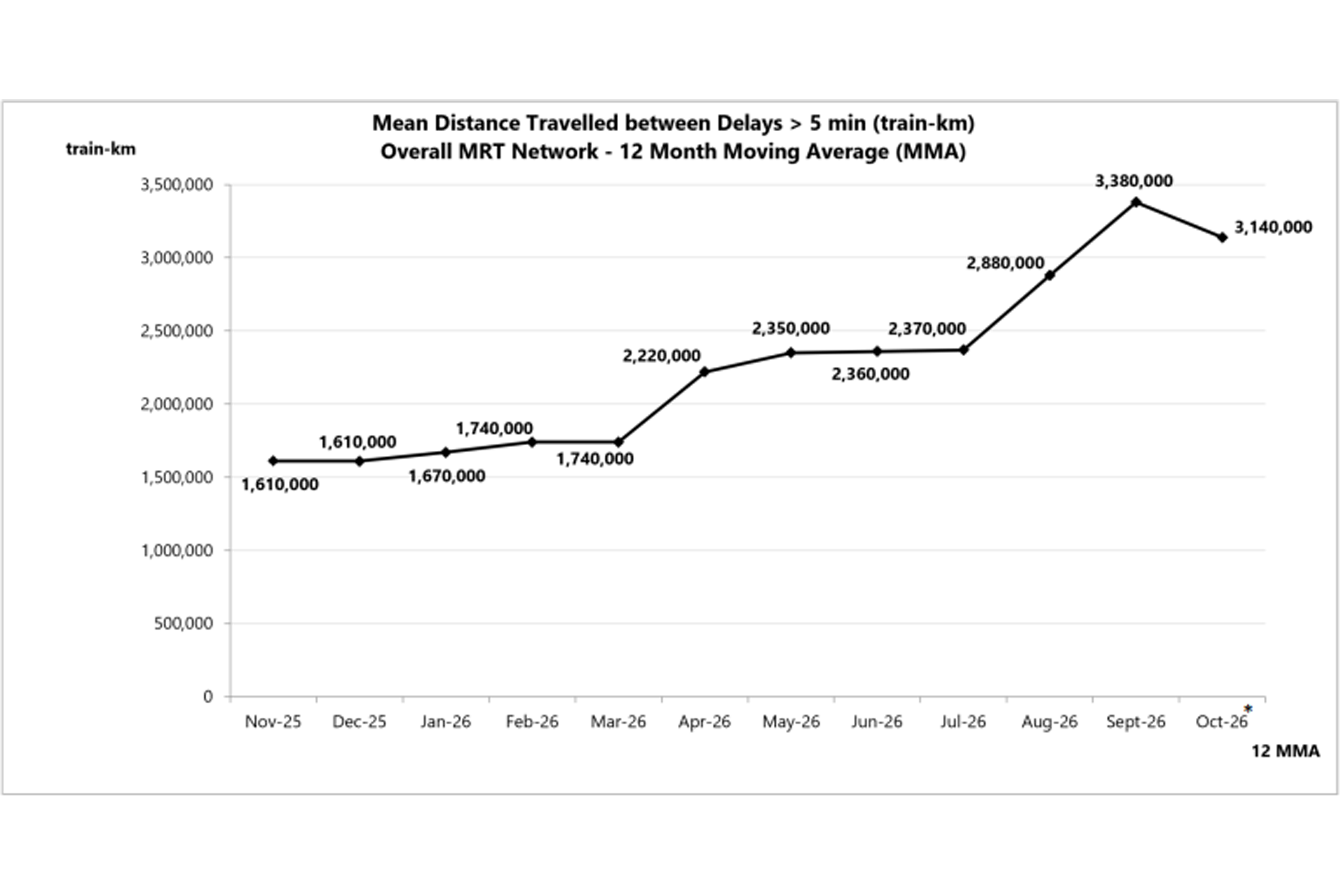
Singapore's MRT network, excluding the Thomson-East Coast Line (TEL), saw its Mean Kilometres Between Failure (MKBF) dip slightly in October — falling from the record 3.38 million train-km set in September to 3.14 million train-km.
But it remains well above the 1 million train-km MKBF target, while exceeding 2 million train-km for the seventh consecutive month, according to data from the Land Transport Authority (LTA)'s monthly rail reliability report.
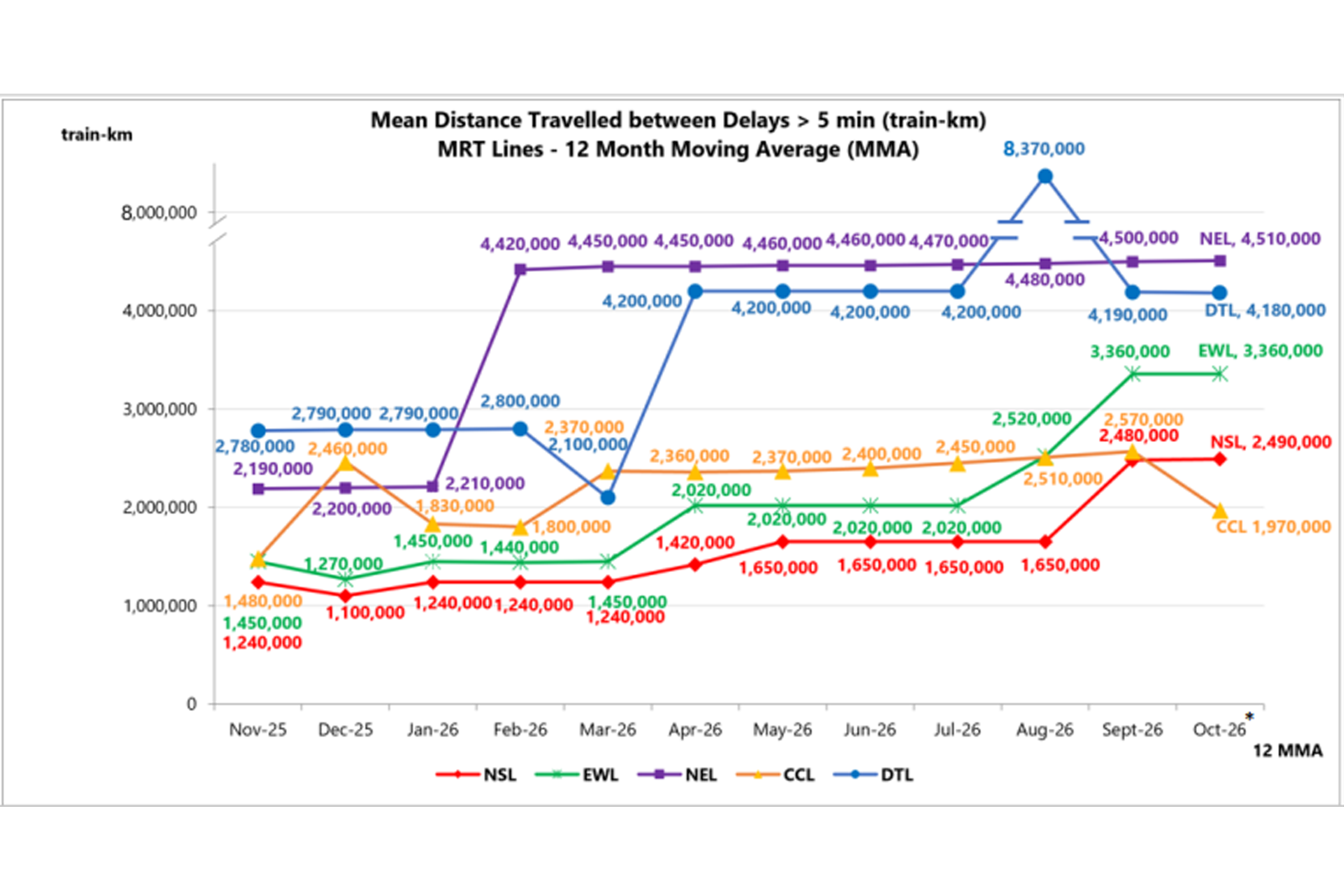
All MRT lines’ MKBF remain above one million train-km, including the oldest North-South (NSL) and East-West Line (EWL), LTA said on Thursday (Nov 19).
Rail reliability is mainly tracked using a 12-month moving average of the MKBF metric, which counts the average distance a train travels before it has a delay of over five minutes.
It also shows that three mature MRT lines — North-East Line (NSL), EWL and NSL — either maintained or improved their 12-month MKBF moving average.
Reliability on the Downtown Line (DTL) dipped slightly from 4.19 million train-km to 4.18 million train-km.
The biggest drop in reliability was recorded on the Circle Line (CCL), which saw reliability fall by about 23 per cent — from 2.57 million train-km in September to 1.97 million train-km last month.
LTA said the seventh consecutive month of high performance in rail reliability was made possible by the dedication and commitment of transport workers and rail operators.
"Our high MKBF levels over the last seven months reflect their sustained effort and dedication to uplift reliability and improve their response to faults and incidents, as well as the constant upgrading and maintenance work on our rail systems."
Bukit Panjang LRT sees continued improvement
The substantial completion of renewal works on the Bukit Panjang LRT (BPLRT), set for completion by February next year, has also led to continued improvement in its reliability.
"(This) has significantly improved the reliability of the system, and allowed us to deliver smoother and more reliable journeys for commuters."
This improved reliability follows the introduction of the full fleet of third-generation LRVs and the migration to the new CBTC signalling system from the legacy system.
BPLRT's MKBF, which reached a record 443,000 car-km in September, has risen by over 50 per cent, to 667,000 in October.
Train service delivery and train punctuality
Two other metrices used by LTA to track rail reliability — train service delivery and train punctuality — also remain high at above 99 per cent in October.
Train service delivery measures the actual distance travelled by trains compared to the scheduled distance, while train punctuality measures the extent to which trips are completed on time.
Only the EWL recorded a slight drop in its train service delivery — from 99.96 per cent to 99.95 per cent.
All other lines recorded improvements.
Overall, the MRT network recorded train service delivery of 99.96 per cent in October, up from the 99.84 per cent in September.

Meanwhile, train punctuality on the overall network climbed from 99.36 per cent in September, to 99.63 per cent in October.
LTA data showed that the EWL recorded a dip from 99.90 per cent to 99.65 per cent, while train punctuality on the CCL remained constant.
Improvements were also recorded for NSL, NEL and DTL.
[[nid:751730]]
editor@asiaone.com


