

We take a look at how LTA tests autonomous vehicles before deployment on Singapore's roads

The Land Transport Authority (LTA) will be rolling out the first autonomous shuttle service in Punggol starting from next year.
PHOTO: AsiaOne/Danial Zahrin

The Land Transport Authority (LTA) will be rolling out its autonomous shuttle service in Punggol next year, and it will be the first time that autonomous vehicles (AVs) will be deployed as fixed shuttle services in Singapore.
But before these AVs can be put into service, what is being done to ensure that they are completely safe to operate on our roads, and will be able to co-exist peacefully with other road users here?
To find out, the LTA invited AsiaOne to see how these AVs are being tested, as well as offer some insights as to what the testing parameters are for AVs and the standards they have to follow before being officially allowed on our roads.
We also got to experience riding in one of the new autonomous shuttles that will be deployed in Punggol, to see what it is like being driven around in these driverless vehicles.
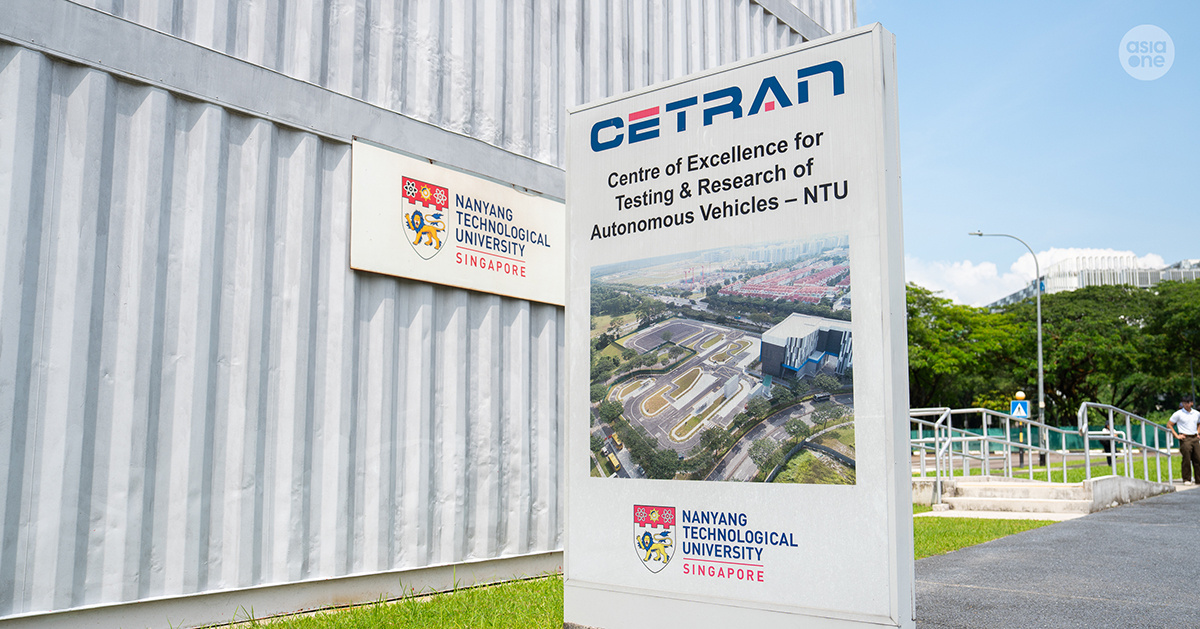
The Centre of Excellence for Testing & Research of Autonomous Vehicles (Cetran) at Nanyang Technological University (NTU) was established to support the AV community in Singapore.
Its key roles include helping to develop standards for AVs to follow while on the roads, doing collaborative research on AVs with relevant industry partners, and assisting the LTA with the assessment and testing of AVs before they are approved for use in public.

To facilitate the testing process, Cetran has a dedicated AV test centre located at Cleantech Park, near NTU's main campus. It is here that AV operators can test their vehicles and equipment, and ensure that they are in compliance with the standards set by the LTA.
Before we got to ride on the shuttles though and see them in action, LTA gave us a briefing on what are some of the requirements that AVs are supposed to fulfil before they can be approved for use here.
It's all quite technical in nature, but the main one is that they have to pass the Milestone 1 (M1) test, which verifies that the AV platform can meet basic safety requirements, and performs as intended in a closed-circuit environment.
Some of the areas of assessment in the M1 test include checking whether the AVs can execute basic manoeuvres like negotiating bends and keeping to its lane, stopping for dynamic and static obstacles, making emergency stops, and alerting users once a fault is detected.
LTA will also assess the AV operators' remote operations, or how effective they can intervene remotely in the event of an incident, as well as their risk management processes.

Once the AV operator has passed the M1 test, they will move onto the Deployment Readiness Assessment (DRA) stage, where the AVs will be tested on public roads on authorised designated routes and areas.
This test will determine how well the AVs can handle real world situations, such as manoeuvring around on our local roads, interacting with other road users and coping with varying traffic and weather conditions.
We got a chance to take a look at part of the M1 testing procedure at the Cetran test circuit, where one of the autonomous shuttles that will be deployed in Punggol was used in a demonstration exercise to the media.
The circuit is set up like what you would see inside a driving centre, complete with real world road elements like traffic lights, bus stops and zebra crossings.
The test would involve the AV going round the circuit, and seeing how it reacts to obstacles emerging along the way, like the sudden appearance of a jaywalker, or a pedestrian crossing the road.
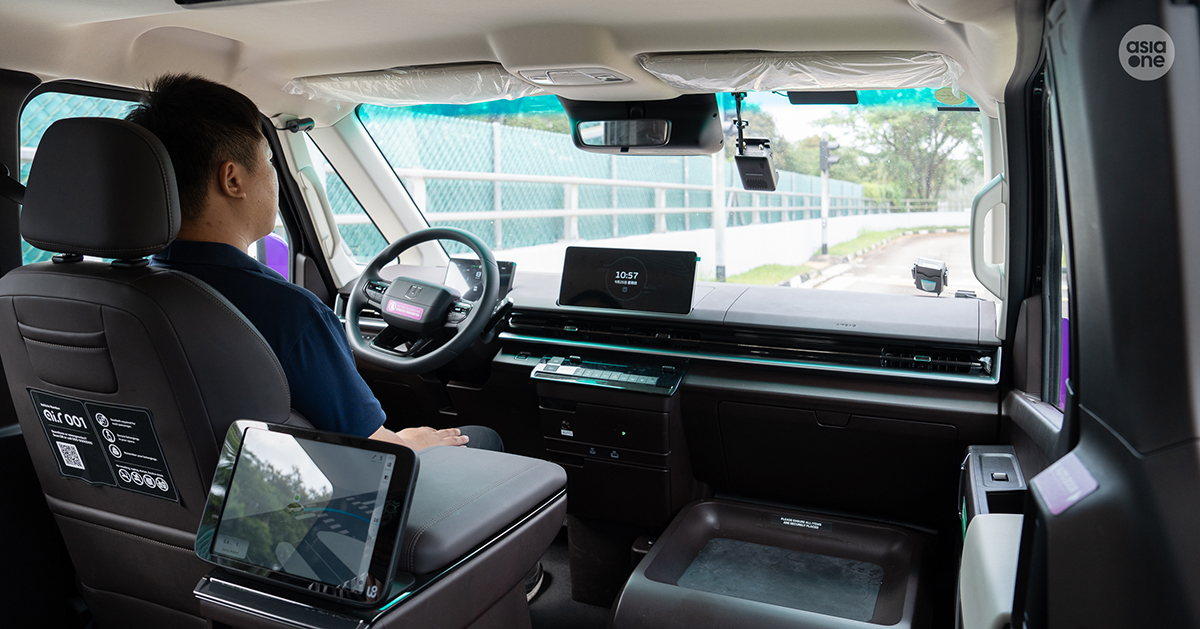
The experience from riding inside the AV was relatively uneventful for the most part, aside from the novelty of seeing the car driving around the circuit without any input from the driver.
What was most impressive though, was how it reacted to potential hazards, such as a dummy pedestrian in the middle of the road.
The vehicle that we rode in was developed by AV technology company WeRide, and features 11 sensors and cameras that can detect traffic light signals, obstacles and potential hazards all around the vehicle within a 200-metre range.
Upon detecting the impending appearance of a dummy pedestrian about to dash across the road, the vehicle slowed itself down and stopped in time on its own, doing so without any abrupt movements.
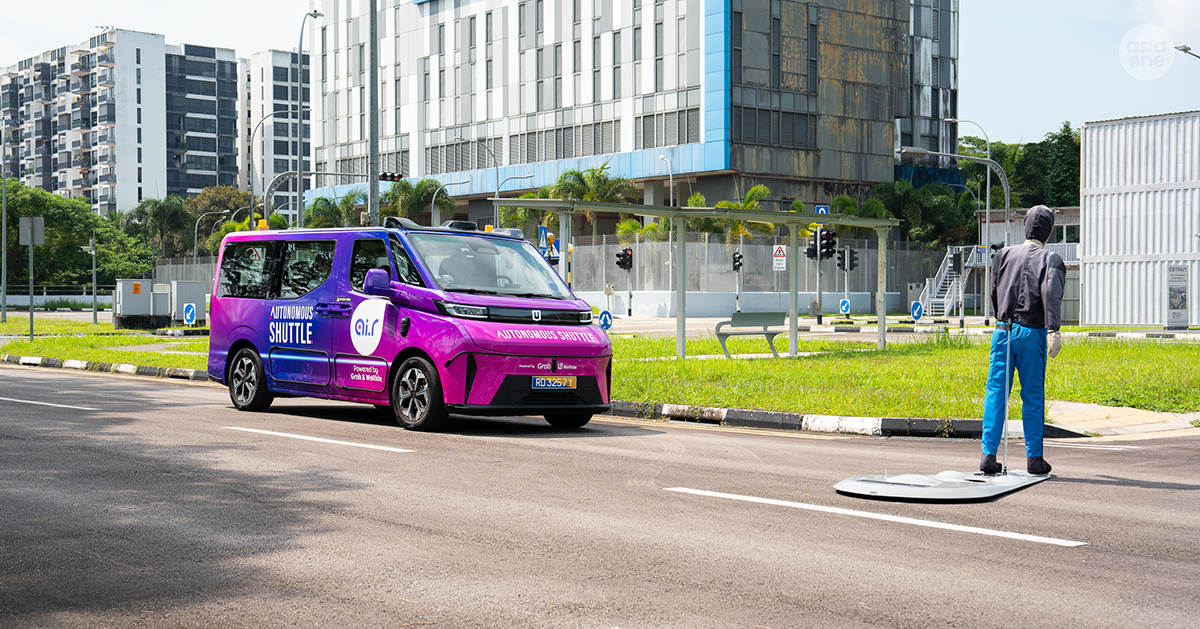
When faced with a stationary dummy in the middle of the road, the AV took a decision to cross into the next lane to go around it. A WeRide representative later explained that the AV will be able to detect oncoming traffic if there is any in such situations before deciding its next course of action.
@asiaone Take a look at how the future of transport - autonomous vehicles (AVs) - is shaping up at the Centre of Excellence for Testing & Research of Autonomous Vehicles - NTU (CETRAN) as tests get underway. #sgnews #Singapore #Transport #Car #AutonomousVehicles ♬ original sound - AsiaOne
It's clear that the LTA has set extremely rigorous test standards that AVs have to pass before being approved for use on Singapore's public roads. After all, safety is the number one priority, and AV operators have a huge responsibility to ensure that their vehicles are able to operate safely as they interact with other road users.
Judging from what we saw at the demonstration, it's clear that the AVs that will be deployed on our roads soon will be able to handle our road conditions and traffic situations safely and effectively.
[[nid:722916]]
ben.chia@asiaone.com
No part of this article can be reproduced without permission from AsiaOne.