

Fatherhood, full-time: Why more Singapore men are staying home to care for their children

Stay-at-home dad Abraham Yeo together with his wife, Ms Peng Cheng Yu, and their three children aged five, three and one.
PHOTO: Abraham Yeo

SINGAPORE - More fathers are stepping out of full-time work to look after their children amid a gradual rise in paternal involvement at home.
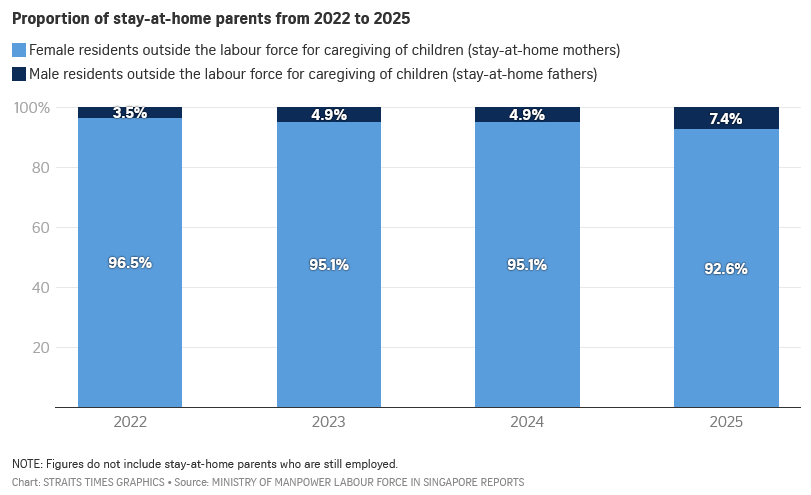
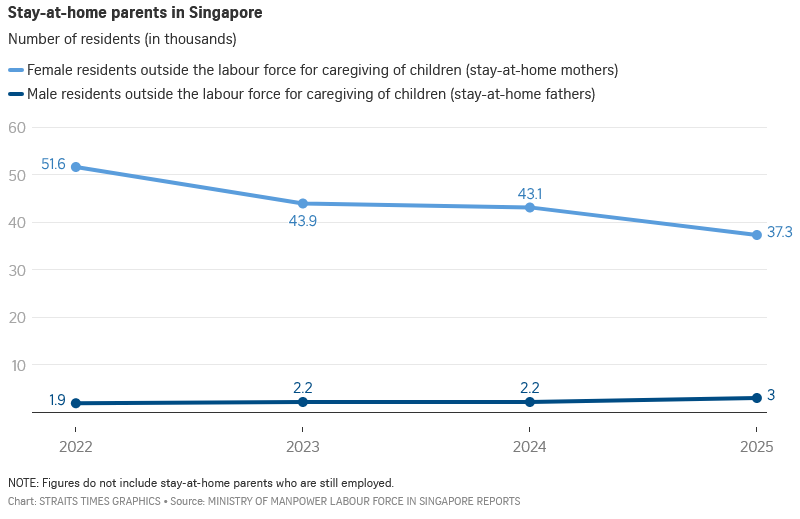
The number of stay-at-home dads outside the labour force has risen from about 1,900 in 2022 to 3,000 in 2025, based on data from the Ministry of Manpower’s annual Labour Force in Singapore reports.
They now make up 7.4 per cent of residents outside the labour force for childcare in 2025, up from 3.5 per cent in 2022.
Over the same period, the number of stay-at-home mums fell from about 51,600 to 37,300.
While these figures exclude stay-at-home parents who combine part-time work with caregiving, experts say they reflect a broader rise in hands-on fatherhood in Singapore, driven partly by the normalisation of flexible and hybrid work during the Covid-19 pandemic.
But they cautioned against overstating the shift, noting that workplace norms remain less supportive of fathers taking up larger caregiving roles, and that mothers are still the primary caregivers in most families.
More fundamental changes are needed to move towards a more egalitarian society, they said, with research showing the benefits of higher paternal involvement.
Besides those who leave work for full-time caregiving, stay-at-home dads also include those who continue working in different capacities, said Centre for Fathering’s chief executive Xander Ong.
While the non-profit organisation does not track the number of fathers who stay home, it has observed that more are opting for work arrangements that allow them to be more present for their families, he said.
They include those on part-time, freelance, or flexible arrangements, as well as a growing number running home-based businesses.
Surveys conducted by the Centre for Fathering among 669 fathers in 2024 and 801 in 2025 showed a higher share of dads engaged in part-time work, self-employment or entrepreneurship. The figure rose from 14.5 per cent to 16.4 per cent over the two years.
The proportion of fathers who were not currently working – including those in between jobs – also rose to 5.4 per cent in 2025, up from 4.8 per cent in 2024.
What is common among these men is the desire to be present for their children in both the amount and quality of time, said Dr Ong.
A local study published in June 2025 showed that children had fewer behavioural problems and better test scores when their fathers took at least two weeks of paternity leave.
The pandemic briefly made parents’ childcare roles more visible, helping to make male caregiving more acceptable both socially and in workplace settings, said Institute of Policy Studies’ (IPS) senior research fellow, Dr Tan Poh Lin.
It also lowered psychological and practical barriers for fathers to take on primary caregiving – even if temporarily – as flexible and hybrid work became more common, said IPS senior research fellow, Dr Kalpana Vignehsa.
Pragmatism is another factor, she said.
“Dual-income couples are making decisions based on who earns more, whose job is more flexible and who can step back with less long-term penalty.”
At the same time, more individualistic norms mean couples are less likely to be driven by societal expectations and more likely to choose arrangements that suit their household, Dr Tan noted.
Many stay-at-home dad arrangements are also transitional, said Dr Vignehsa, with fathers stepping into primary care at specific life stages – early childhood, job transitions, or periods of labour market disruption – before returning to paid work.
With more women pursuing education and earning more, alongside the expansion of flexible work, Dr Vignehsa expects the trend of more involved fathers to continue, though gradually and unevenly.
Singapore society is open to moving away from stereotypical gender roles, with surveys showing strong agreement that fathers and mothers are equally important as caregivers, she said.But practice still lags.
Mothers continue to form the vast majority of stay-at-home parents, Dr Vignehsa said, and many working mothers remain the “default parent”.
“For a comprehensive shift to more egalitarian norms, we would need to see more men taking sustained responsibility for care across the board,” she added.
And while more men stepping into primary care signals greater flexibility, the fact that some must leave work entirely rather than adjust within it suggests that workplaces are still limited in accommodating caregiving responsibilities, said Dr Vignehsa.
Fathers may face challenges re-entering the workforce and slower career progression, like mothers who have stepped out.
Centre for Fathering’s Dr Ong said better support for families starts with work culture – whether fathers feel genuinely supported to take leave, adjust schedules and be present at home without fear of judgment or career penalties.
Being a stay-at-home dad had never been part of Mr Abraham Yeo’s plans.
But when his first daughter was born in 2020, and his family unexpectedly had to let go of their helper, the responsibility of caregiving fell to him.
He had left his career in software engineering a year before to focus on running Homeless Hearts, a charity he had co-founded in 2014, from which he does not draw a salary.
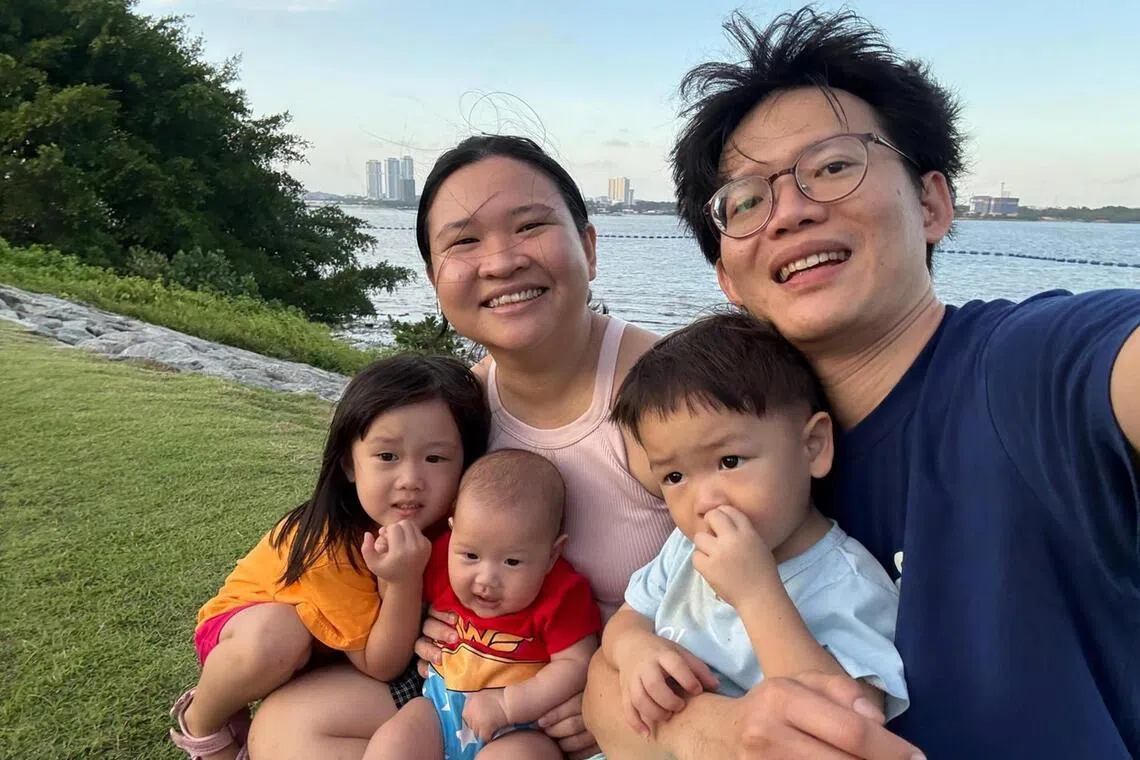
The couple decided it made more sense for him to become the primary caregiver, as his wife was drawing a regular income as a nurse.
Besides criticism from both his parents and in-laws, Mr Yeo himself initially doubted his caregiving abilities.
“It’s quite an intimidating feeling when you realise that the survival of the infant is dependent on you practically 24 hours,” the 44-year-old said.
But over time, he has gained confidence, said the father of two daughters aged five and one, and a three-year-old son.
While caregiving takes up most of his time, Mr Yeo said continuing some form of productive work is important to him.
He spends up to four hours daily remotely overseeing the charity’s operations.
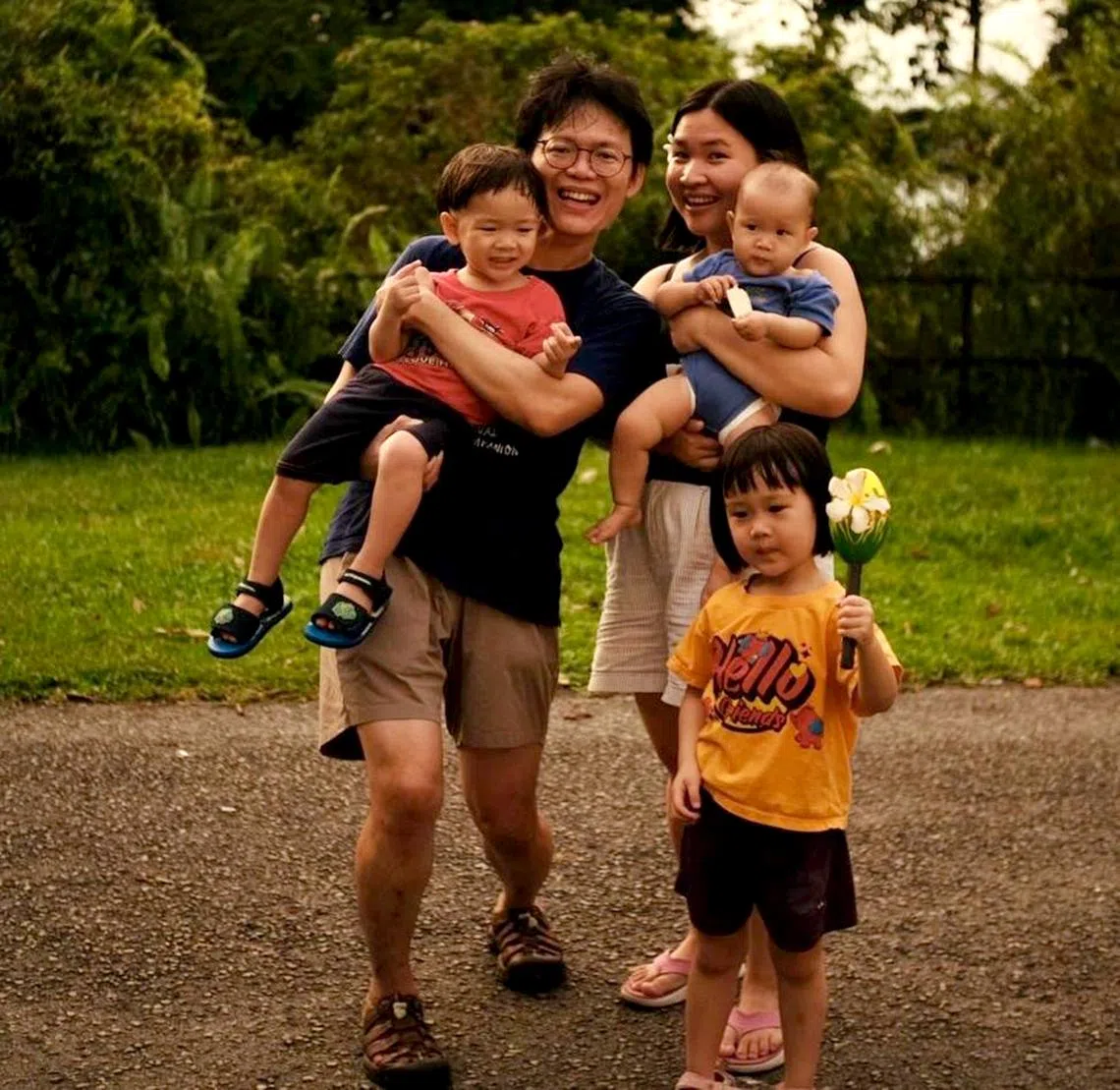
Joining The Ordinary Dad, a ground-up community for stay-at-home fathers to forge friendships, also helped him find support from other men.
“The modern world often (leads us to) think that masculinity is all about muscular strength, competence and the ability to make money,” he said. “It’s about endurance, perseverance, joy, courage, and learning to be humble and to serve out of your weakness.”
Mr Yeo’s family has also made lifestyle choices to live on a single income.
They rely on public transport, avoid unnecessary debt and have only the mortgage of their five-room HDB flat to pay off.
In 2024, Mr Jionghan Ng quit his job as a country manager at an IT company to spend more time with his children.
“To give (the regular income) up, especially when you have two kids, and you’re not sure how much is needed for them, there was uncertainty,” he said. His wife, who works in marketing, cannot work from home.
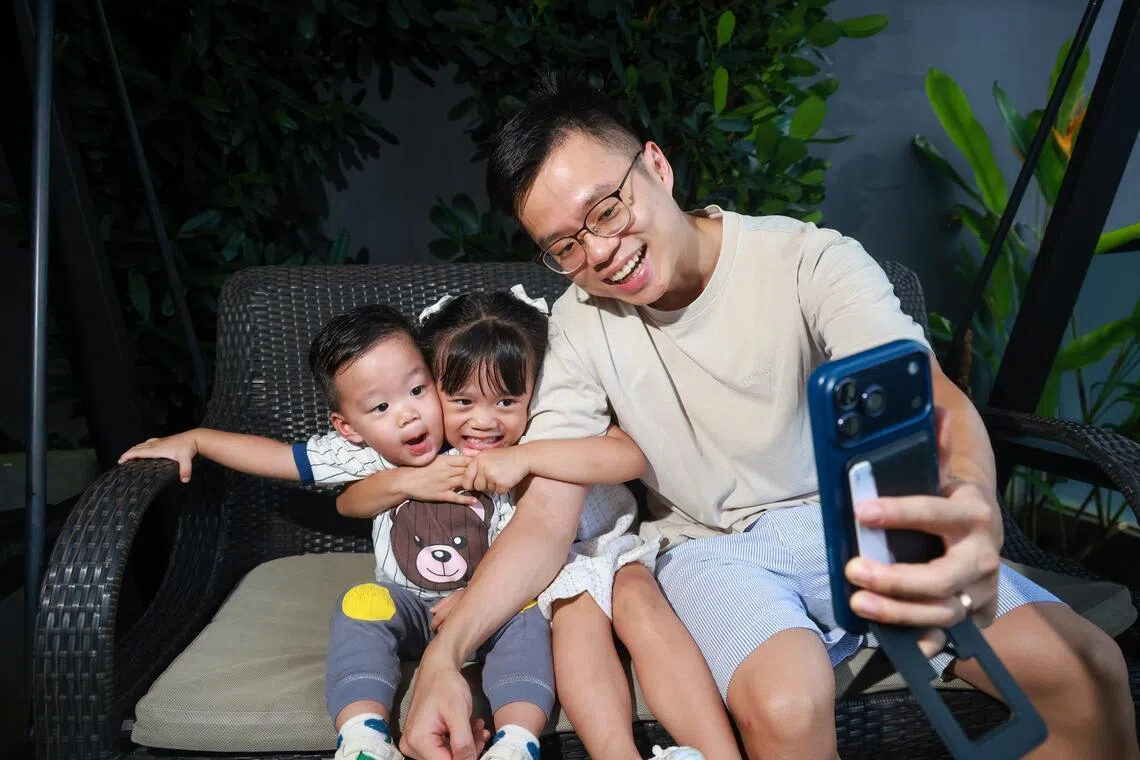
To maintain a certain quality of life for his family, Mr Ng, 33, decided to set up a tea business and work remotely, while drawing on income from personal investments.
The father of a five-year-old girl and a two-year-old boy has encountered unpleasant remarks online, where he shares snippets of his life.
Brushing such remarks off, Mr Ng said he feels secure in his role as his children’s main caregiver.
“If you don’t want to look down on stay-at-home moms, why would you want to look down on stay-at-home dads?”
Mr Andrew Fam became the primary caregiver almost instinctively once his wife’s maternity leave for their first child ended in 2019.
Having worked remotely for a few software engineering start-ups over the past decade, the 39-year-old said he wanted his wife to fulfil her career aspirations as a school teacher.
He looks after their seven-year-old son and a three-year-old daughter during the day until his wife comes home, after which he starts work.
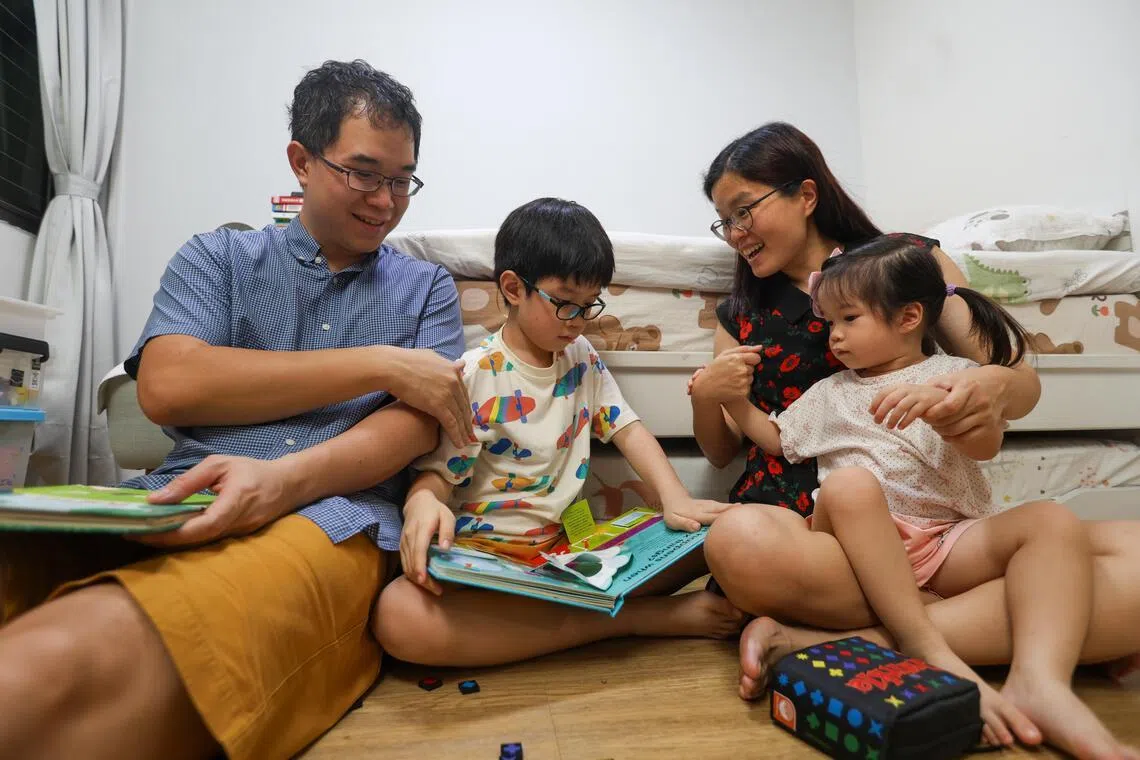
Sustaining this arrangement is not easy.
“It takes an inordinate amount of effort to find and negotiate jobs that are willing to support this kind of stay-at-home work,” he said, noting that he turned down about four job offers in 2025 after unsuccessful negotiations over work arrangements.
Despite the challenges of juggling work and caregiving, Mr Fam describes the past seven years as some of the best: “The highlight really is being able to spend time with the kids and watch them grow up.”
Mr Ang Siang Shen started staying home full-time when he decided to homeschool his daughter in September 2025.
The 40-year-old, who used to work in IT, studied early childhood development in order to teach his three-year-old.
Each weekday begins with a self-designed curriculum that attempts to replicate that taught at pre-schools, including sensory and cognitive exercises. This is followed by activities such as visits to the library, swimming pool, or parks.
Being a stay-home dad has allowed him to witness his daughter’s many firsts.
“Her first potty on her own, the first time she feeds herself properly… Every little achievement the child makes feels like your own,” he said.
Going from dual to single income also meant cutting back on luxuries for Mr Ang, who used to enjoy regularly eating out and joining sporting events. His wife works in the tourism industry.
Caregiving requires immense emotional regulation and a willingness to learn how to do better each day, he said.
“It’s the 10 per cent joy that makes me continue with that 90 per cent grind.”
[[nid:735736]]
This article was first published in The Straits Times. Permission required for reproduction.