Campaign to normalise request for less salt and sauces to roll out in last quarter of 2026
Consumers are encouraged to request for less salt and sauces when dining out, and to go for lower-sodium options which are indicated by the Health Promotion Board decal.
SINGAPORE — After inroads were made in reducing Singaporeans’ sugar and saturated fat intake, a drive to reduce sodium consumption here is also gaining momentum.
Efforts include an upcoming campaign by the Health Promotion Board (HPB) in the last quarter of 2026 that seeks to normalise the behaviour of consumers asking for less salt and sauces.
The campaign also seeks to encourage consumers to choose lower-sodium options.
“We need to have this ‘normalising ask’, and when more people ask for it, maybe (at) some point in future, we can do low sodium by default,” said HPB chief executive Tay Choon Hong in an interview with The Straits Times.
Coupled with the Nutri-Grade labelling scheme introduced in end-2022 for pre-packaged beverages, and subsequently expanded to include freshly prepared beverages a year later, more consumers have shifted towards healthier drinks.
Under the scheme, drinks with less sugar content and/or lower saturated fat are graded A and B, and may voluntarily carry the Healthier Choice Symbol.
Drinks that exceed a specific threshold are graded C and D, with an advertising ban for those graded D.
Data on pre-packaged beverage sales showed that 37 per cent of those sold in 2017 would have received an A or B grading, much lower than the 63 per cent for beverages with higher sugar and/or saturated fat content.
The tables turned by 2024, when the proportion of healthier drinks sold nearly doubled to 73 per cent.
The World Health Organization (WHO) has also recognised the scheme as an example of “how actions from cities can help to shape food environments in ways that improve public health”, through its conferment of the 2024 WHO Healthy Cities Recognition Awards to Singapore.
With the evident impact of the Nutri-Grade scheme on sugar and saturated fat intake – an achievement that Tay described as something he is “very proud of” – it will be extended to tackle sodium consumption too.
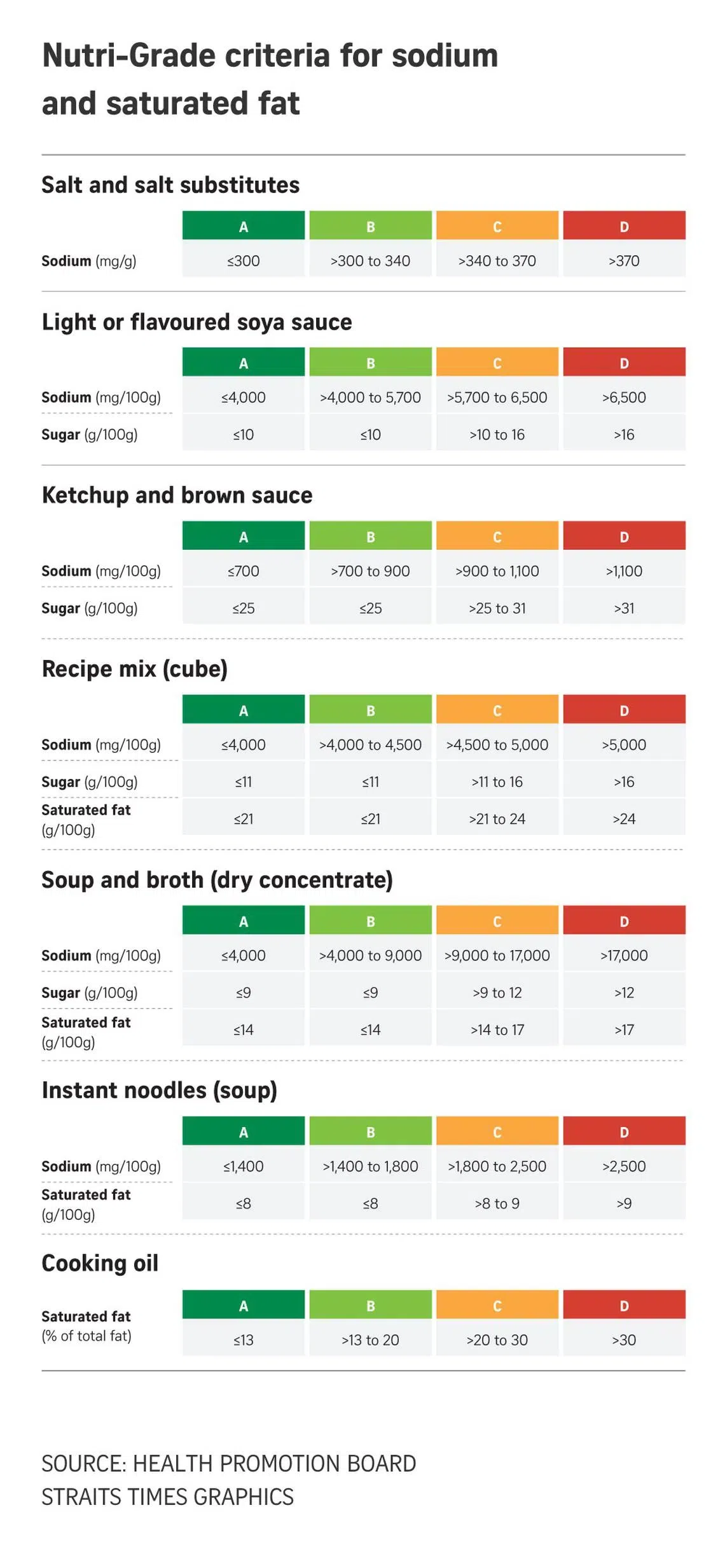
From mid-2027, Nutri-Grade will be implemented for pre-packed salt, sauces and seasoning, instant noodles, and cooking oil, which are key contributors of sodium and saturated fat intake.
However, Tay was cautious in forecasting if the success could be replicated for sodium consumption, considering industry feedback on difficulties in product reformulation and the need to ensure commercial viability.
For one thing, the sodium thresholds for various food items are different.
“The thresholds need to make sense.... essentially, we want it to be possible for manufacturers to reformulate within each category to a healthier version,” said Tay.
However, reformulation is not as straightforward as simply cutting down on the amount of salt used, he said.
Taking light soya sauce as an example, HPB has received feedback from manufacturers that if the sodium threshold is set too low, there will not be enough salt to support the fermentation process, as the sauce contains a high amount of soya beans.
“They are fearful that they might be forced to reduce the amount of soy, which then leads to a poorer quality soy sauce,” said Tay.
Manufacturers also pointed out that as sauces and seasonings are careful blends of different tastes and flavour profiles, any reduction in salt amounts will need a rebalancing to ensure the flavour profile.
Taking the feedback into consideration, HPB subsequently adjusted the threshold for soya sauce to help manufacturers reformulate with a meaningful reduction in sodium content, and yet have good quality soya sauce.
Tay said that HPB will intensify its engagement with the industry again in the second half of 2026, to check in on the reformulation progress and if manufacturers may require further support from HPB.
High sodium intake can result in high blood pressure or hypertension — one of the key risk factors for cardiovascular diseases such as heart attack, stroke and heart failure — and other diseases like kidney failure.
Latest data released in 2025 showed that more than one-third of Singapore residents have hypertension.
HPB’s 2022 National Nutrition Survey also showed that nine in 10 people here take in 3,620mg of sodium a day, much higher than the recommended daily limit of 2,000mg, or one teaspoon of salt.
HPB had earlier set a goal to shave 15 per cent off sodium consumption by 2026, or cutting a quarter teaspoon of salt each day.
It has worked with retailers to make lower-sodium alternatives – which are considered healthier — more affordable, and ensure the availability of a greater variety of lower-sodium sauces and seasonings.
It also stepped up efforts at supermarkets, restaurants and hawker stalls since 2024 to help people choose lower-sodium options.
For instance, in the first quarter of 2026, healthier choices were put up at designated shelves of FairPrice and Sheng Siong supermarkets, to raise consumer awareness of existing products.
In 2022, ST reported that salt substitutes, such as potassium chloride, which tastes like regular salt but could have over 30 per cent less sodium content, were about 10 times more expensive than regular salt or sodium chloride.
Today, consumers can get 1kg of lower-sodium salt at the price of around $5, which is more than double the $2 or so price for 1kg of regular salt.
Tay said a typical household consumes about 1kg of salt in an entire year.
“In this context, paying $3 more for a whole year’s worth of health assurance is not bad. Also, prices of lower-sodium sauces and seasonings are actually quite comparable to the regular versions,” he said.
[[nid:737647]]
HPB closely monitoring international discussion on ultra-processed foods
When asked about further expansion plans for the Nutri-Grade scheme, Tay highlighted that it now targets the three main ingredients – sugar, saturated fat and sodium – that directly correlate with the three main chronic conditions.
Nevertheless, HPB is constantly looking at developments around the world as part of its responsibility, including discussions on ultra-processed foods (UPFs).
UPFs are a class of foods or drinks made using processing techniques, additives and industrial ingredients, and mostly containing little whole food. Examples include carbonated soft drinks and instant noodles.
Tay said HPB is looking at what other countries might be doing for UPFs, and “at some point, when there is sufficient evidence and also more consensus among the scientific community about how to approach this issue, then we may come up with further guidance to consumers about it”.
In 2025, a series of papers published by 43 global experts in medical journal The Lancet highlighted that UPFs are a major public health threat that must be urgently addressed.
Experts said UPFs are linked to a number of diseases, from obesity to cancer, though they also acknowledged criticisms and noted that more evidence is needed, particularly on why and how UPFs cause ill health, as most studies were designed to only show links but not direct causality.
Tay also noted that the current Nova classification system may be confusing to consumers as it accounts for only the level of processing, but not the nutrient contents.
This resulted in bread and calcium-fortified soya milk being grouped in the same class of UPFs as more discretionary snacks such as potato chips.
“So, if there is a way for us to help consumers make better choices which takes into account both dimensions, it might then be a much more relevant and nuanced way of approaching this,” said Tay.