There is "good progress" across the six areas of collaboration — sustainability, digitalisation, skills development, healthcare and medicine, advanced manufacturing, and connectivity — under the India-Singapore Ministerial Roundtable (ISMR) said Deputy Prime Minister Gan Kim Yong.
"It's not just across a negotiating table, but that we develop trust and relationship with one another that will help to strengthen bilateral collaboration between the two countries," he said after the 4th ISMR held at Shangri-La Hotel on Thursday (Aug 20)
Held annually, the ISMR is a ministerial-level platform between Singapore and India to drive cooperation in new and emerging areas.
In an earlier statement on Wednesday, the Ministry of Foreign Affairs (MFA) and Ministry of Trade and Industry (MTI) said leaders from both countries will review progress from the third ISMR, held in New Delhi in August 2025, at the Aug 20 meeting.
They will also identify new opportunities to advance the implementation of the Singapore-India comprehensive strategic partnership roadmap, the ministries said.

Giving an update on the meeting on Thursday, DPM Gan said that ministers from both countries agreed there was good progress made on the six areas of collaboration.
For example, following the signing of a memorandum of understanding (MOU) on semiconductor ecosystem partnership in 2024, a number of semiconductor manufacturers have since invested in India.
This, in turn, has led to such manufacturers bringing along with them their suppliers and ecosystem, providing opportunities for Singapore's small and medium enterprises (SMEs).
On Thursday, DPM Gan said ministers from both countries discussed how such relocation or entry into India can be better facilitated.
With the increased investment in India, along with increased trade between the two countries, they also discussed the need to increase air connectivity, given the expected increase in traffic.
This will be followed-up by aviation authorities from both countries.
Other areas discussed include:
- Project Nexus, which aims to enable cross-border payments by connecting multiple domestic instant payment systems globally
- Facilitating the use of green fuel under the Singapore-India Green and Digital Shipping Corridor
- Skills training and upgrading programmes
- Resilience of food supply
- Technology collaboration in areas such as space and nuclear
To support these endeavours, two memorandums of understanding — covering food safety and maritime heritage — were also inked at the 4th ISMR.
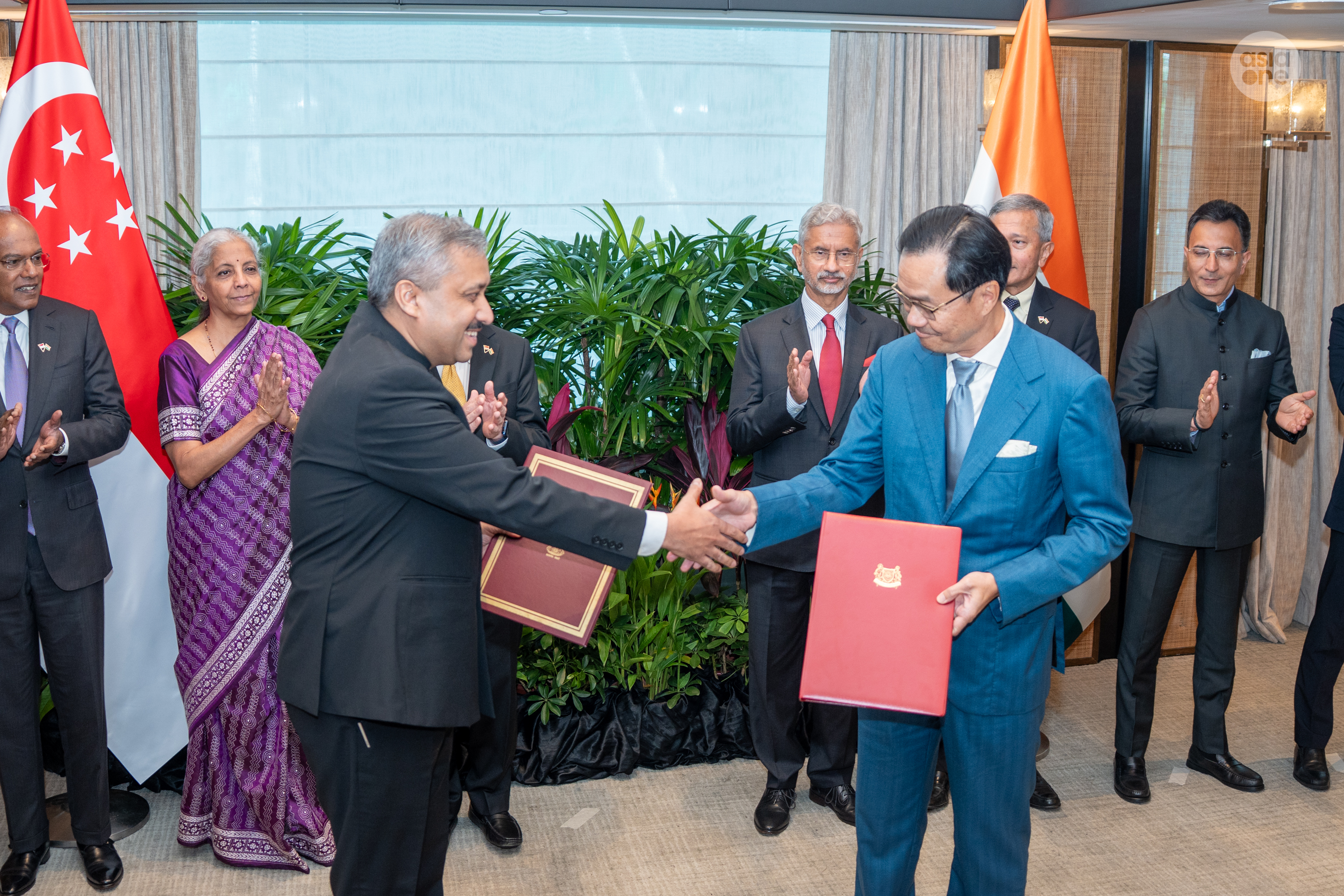

A letter of intent between the Telecom Regulatory Authority of India and the Info-Communications Media Development Authority of Singapore was also exchanged, covering cooperation in the fields of telecommunications and broadcasting.
Members of the Singapore delegation included Senior Minister, Coordinating Minister for National Security and Minister for Home Affairs K. Shanmugam, Minister for Foreign Affairs Dr Vivian Balakrishnan, Minister for Digital Development and Information Josephine Teo, and Minister for Transport Jeffrey Siow.
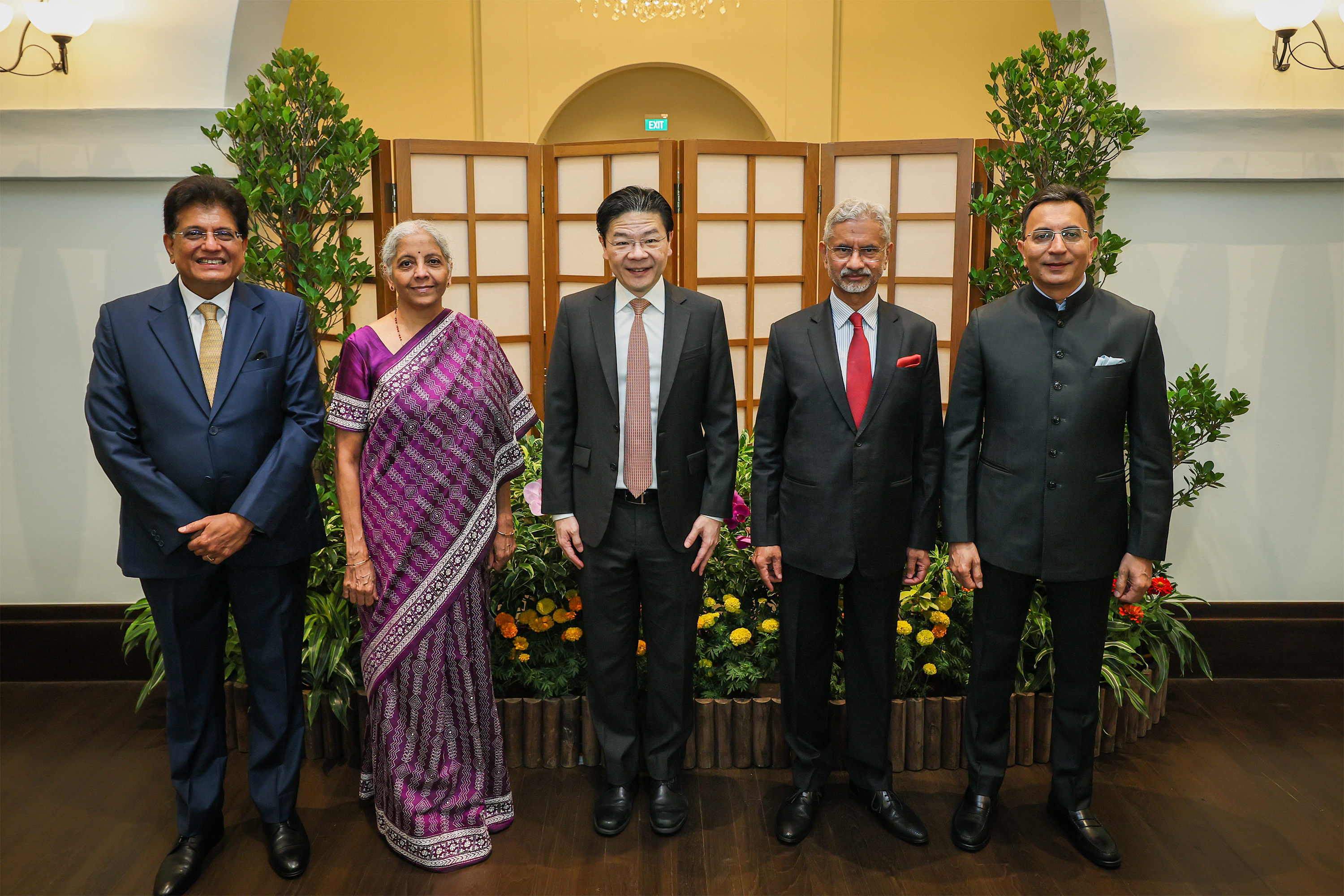
The India delegation comprised Minister of Finance and Corporate Affairs Nirmala Sitharaman, Minister of External Affairs Dr S Jaishankar, Minister of Commerce and Industry Piyush Goyal, and Minister of State for Ministry of Commerce & Industry and Ministry of Electronics & Information Technology Jitin Prasada.
The Indian delegation also called on Prime Minister Lawrence Wong and was hosted to lunch by DPM Gan.
Singapore-India relations
The two countries marked the 60th anniversary of bilateral relations last year.
At a joint press conference by the two prime ministers in September that year, India PM Narendra Modi emphasised that cooperation between India and Singapore will not be limited to traditional areas, but aligned with the changing times, including in areas such as advanced manufacturing, civil nuclear, green shipping, skills development and urban water management.
Echoing this point, PM Lawrence Wong said this would include cooperation in the areas of skills development; manufacturing and industrial development; strengthened connectivity across the air, sea and digital domains; and cooperation in frontier areas such as space.
During the India-Singapore Ministerial Roundtable in August 2025, DPM Gan had also said that Singaporean companies and MNCs are interested in exploring how they can integrate their processes and invest in India to create a semiconductor ecosystem between the two nations.
According to the Singapore Economic Development Board, Singapore now produces one in 10 chips and one in five semiconductor equipment units globally.
Annual bilateral trade reached nearly $60 billion in 2025.
Singapore is India’s top investor accounting for about 24.7 per cent of India’s foreign direct investment (FDI) equity inflows since 2000.
Meanwhile, Indian investment in Singapore has also grown significantly, with India's stock of FDI in Singapore reaching $32.7 billion in 2024.
[[nid:722185]]
editor@asiaone.com




