In the first ever indoor drone show staged at a National Day Parade, some 300 drones will take flight inside the National Stadium next Sunday (Aug 9).
These drones, together with the team behind them, will embody the spirit of the segment of the show they appear in: pushing beyond what is thought possible.
Electronic music artist Jasmine Sokko will be descending onto the stage in Chapter 5: Go Beyond Our Limits, performing her NDP single "You'll Be Okay".
Alongside two aerialists, they will be suspended 30m above the floor, all while 300 drones move in formation around them.
Teaching 300 drones where to go
Drones typically find their way using GPS, the same satellite signal your phone uses for maps.
In a crowded indoor setting full of performers and audience, that signal is unreliable and not precise enough for everyone's safety.
So the team from the Defence Science and Technology Agency (DSTA) worked on an alternative in their first two weeks in the stadium, which is a network of transmitters fixed around the venue that allows every drone to know where they are.

Each drone is programmed with its own route before take-off, so it knows where it should be at every second of the routine.
"It's not about flying 300 drones. It's about getting all 300 drones to function together as one body," said Kwek Qing Wei, 40, DSTA's senior programme manager for unmanned systems.
"What makes this even more special is that this year, we also have performers who will land from the air," said Kwek.
"This adds to the difficulty. We need to ensure that the drones can perform in a safe environment."
The drones fly inside an invisible boundary they are not allowed to cross, keeping them well clear of the performers and the crowd.

Each drone maintains at least a 3m buffer from performers, and they can fly as high as 24m.
Before each show, every propeller, light and battery is checked by hand, and no drone takes off until it has confirmed it can hear the positioning system.
Once airborne, the team can bring down any drone that loses contact, or call the whole fleet back on command.
Another 12 drones will be on standby. This means that if a drone falls during mid-show, the team can see on its controls exactly which drone has lost signal and where it will land.
The team will then send another drone up to take its place in the formation.
2,600 performers, on the same beat
The drones are only one moving part among thousands.
"My main responsibility is to execute the show smoothly and accurately from start to finish," said Lieutenant-Colonel Koh Jun Kiat, 34, chairman of the NDP 2026 show management committee.

He works with a team of show and technical callers to integrate drones, aerial elements, fireworks and special effects with everything happening on the ground.
That means controlling every gate, stage lift and trapdoor in the venue, making sure more than 2,600 performers enter and exit off the stage accurately, down to the last second.
His committee also operates the large props: the floats, the pedal-powered mousedeer and tapir puppets, the inflatable dugongs and the mascots.
Many of the people operating them had never been part of a production this size, and needed weeks of rehearsal to hit their cues.
Spotters watch the floor throughout, with response teams waiting at the sides and underneath, ready to handle anything from a dropped prop to a float that stops moving, with LTC Koh comparing the job to conducting an orchestra.
"For everything on the ground and in the air that the audience sees on stage, the show management committee is working steadily behind the scenes to operationalise the creative vision," he said.
No toilet break
For the 42,000 Singaporeans watching the show live in the stadium, what they see on the big screens is decided live, shot by shot, while it is happening.
That is the job of camera director Roger Ng, 37, and his assistant director, who work through about 1,200 cues, by his last count, across the two and a half hours of the show.
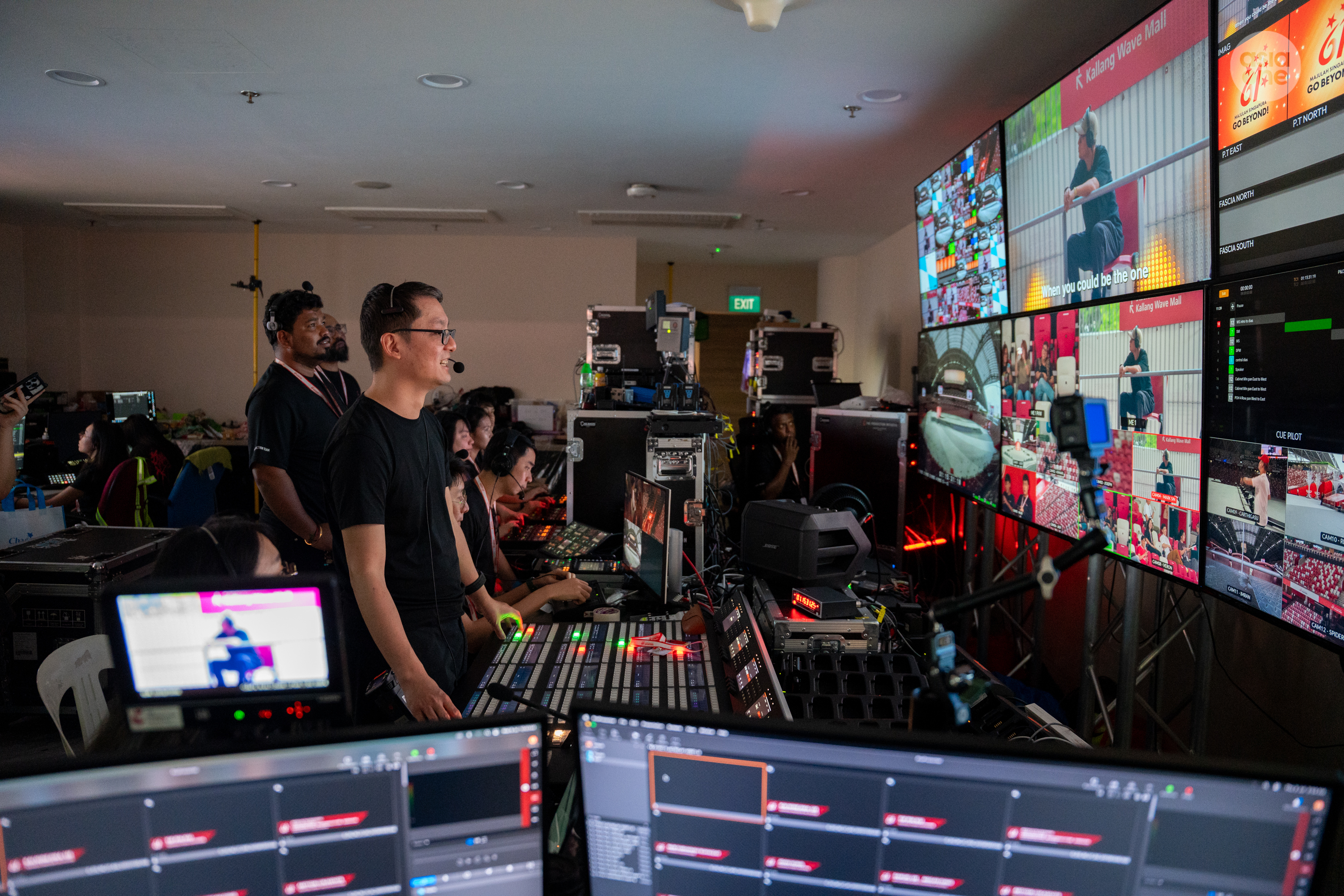
"We're calling every single camera, making sure they have the framing they're supposed to have, with the right person at the right time," he said.
"We don't get a toilet break. We don't get a break at all."
Among the 36 cameras in play is the SpiderCam, which runs on cables above the field and was last used at NDP in 2016.
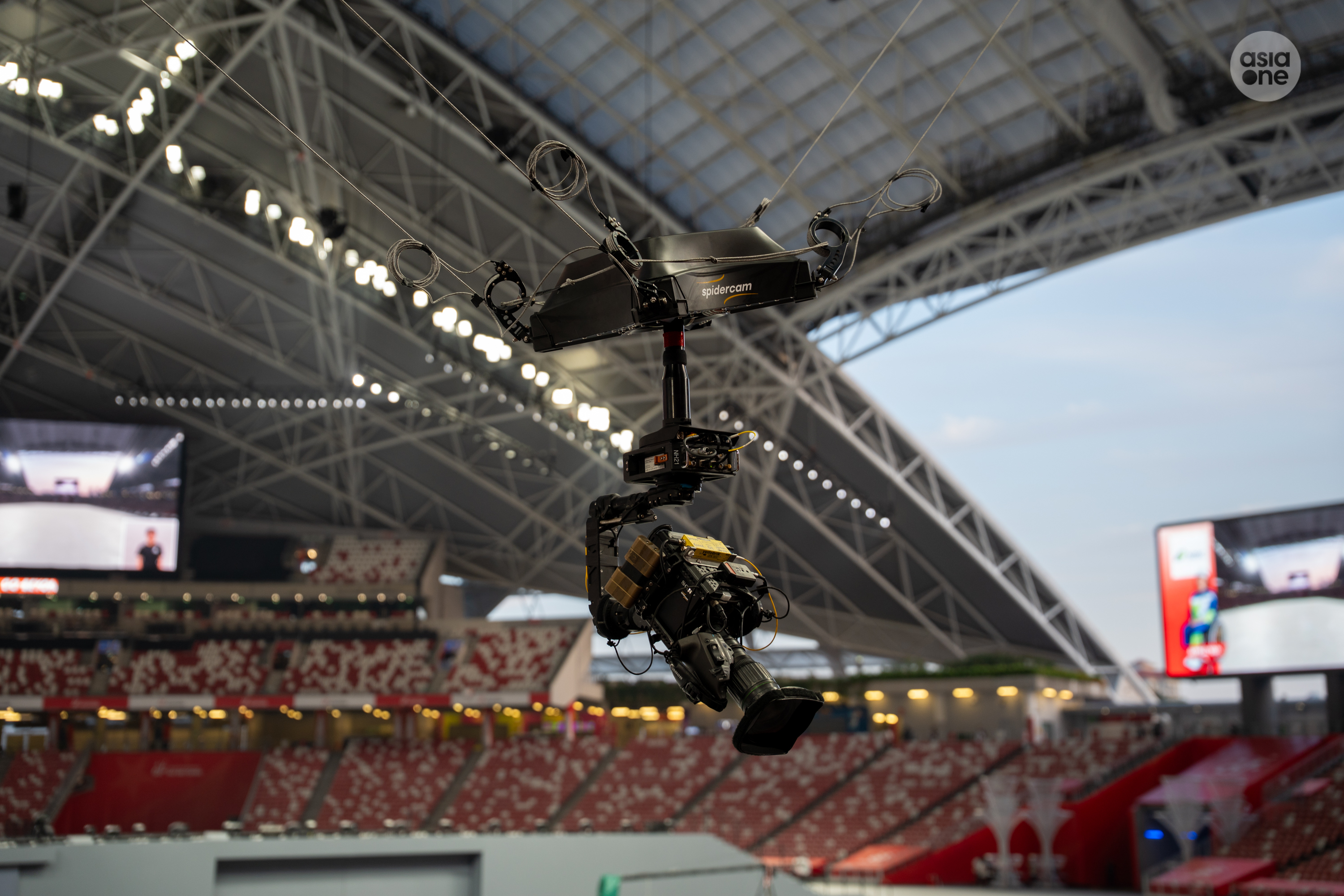
Ng points to Chapter 5 as the clearest example of what the new venue allows.
"When you have Jasmine Sokko and the aerialists in the air, plus the aerial cubes, and then we have the SpiderCam this year to capture it from an elevated angle. That presents a really new visual for audiences, both at the stadium and at home," he said.
He has been involved in NDP since 2010, when he was serving national service.
His heart rate, he said, runs higher during those two and a half hours than at any other point in his day.
The cost to look effortless
Before all the execution, someone has to imagine it, then stitch them together.
"The stadium is like a huge canvas for us to see its needs, its possibilities afresh," said creative producer Noorlinah Mohamed, 58.
"It gives us a chance to transform something as huge as what you've experienced to something intimate, beautiful and immersive for Singapore."
Her job is to take the creative director's vision and turn it into reality, working across a team of about 34 creatives.
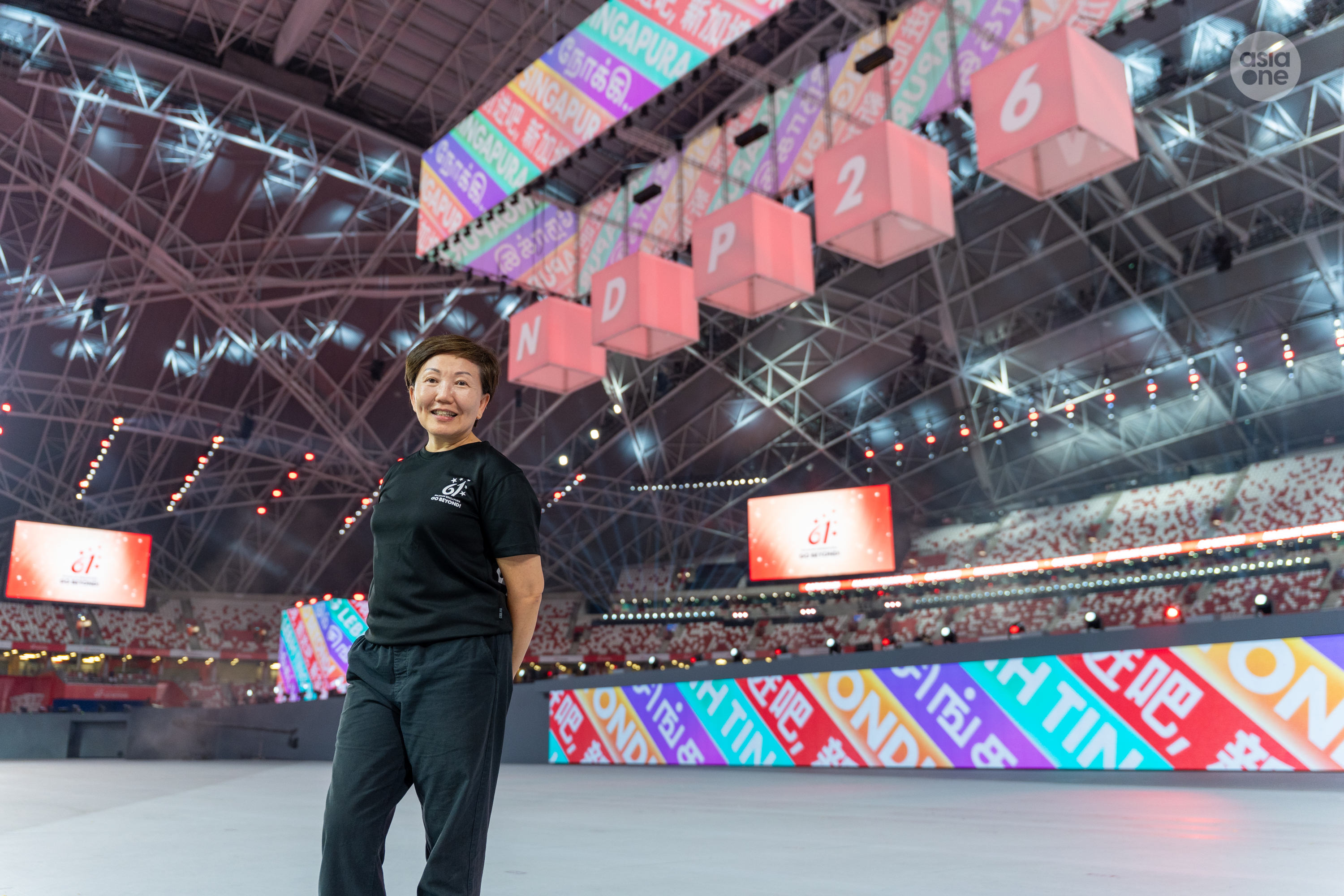
Designers, musicians, lighting and multimedia artists each arrive with their own ideas about what the parade should be. However, most of those ideas "have to be shifted", she said.
Not everything fits together, and not everything can actually be done.
One that did: the mascots.
In past years they were built rigid and sturdy, she said, and this time the team deliberately went the other way and enabled them to dance. Those are the same mascots that have since gone viral for their bouncing and hyperactive turns at rehearsals.
Most of her own work, though, happens long after everyone else has gone home.
"I'm staying up till 3am making sure the time codes are aligned, making sure the callers are getting the information right, passing one information to another, making sure everything is squared off," she said.
She has lost count of how many departments she has to coordinate with.
"All you see is this beautiful, magnificent thing," she said.
"But that beautiful, magnificent outcome is the labour of every single one, coordinating with each other, working with each other."
@asiaone You’ve probably seen this year’s National Day Parade (NDP) mascots making the rounds online. But this year’s National Day Parade is so much more than that! Featuring its most complex stage setup in recent years, and an immersive multimedia experience, preparations are well underway to make sure Singapore’s 61st birthday celebrations go off without a hitch. AsiaOne caught up with the creatives behind the Parade! #sgnews #Singapore #SG61 #NDP2026 ♬ original sound - AsiaOne
She spent the early weeks quietly worried they would not finish in time.
One of the biggest sets in NDP history had to go up in about three and a half weeks, with pieces hanging as high as 30m.
Then the school children arrived on July 18 for one of the National Education shows.
"The kids' voices filled the auditorium," she said. "I burst into tears."
[[nid:741404]]




