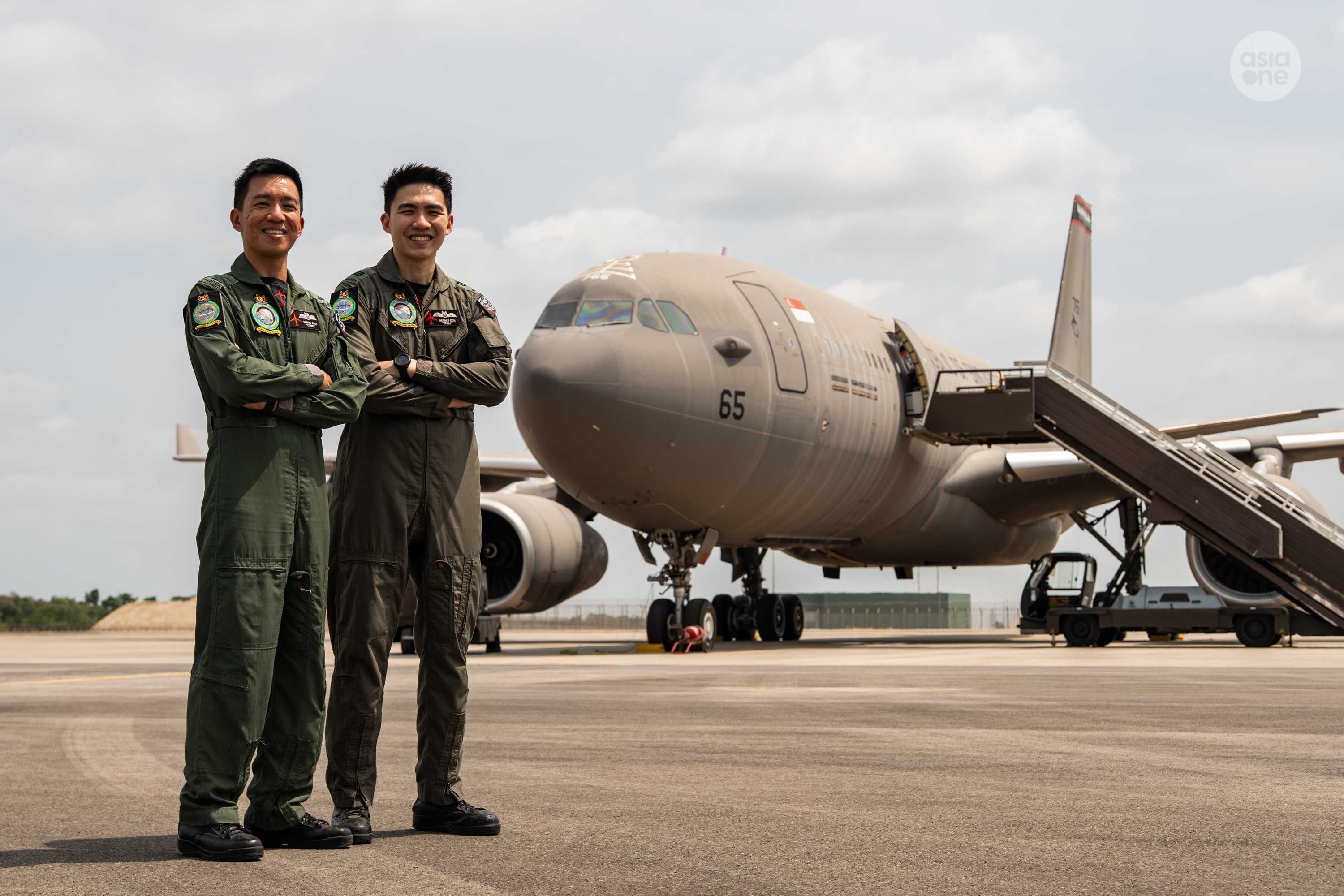
Three hours into the night flight, air force transport pilot Gerald Goh saw a single projectile in the distance.
"The initial reaction was a sense of shock," the 31-year-old pilot told AsiaOne in an interview on Friday (March 27).
"But we assessed, as a crew, that it was from a distance… and we determined it was safe to continue with the mission."
The mission — on March 10 — was to bring home 218 stranded Singaporeans and their dependents on board the Republic of Singapore Air Force's (RSAF) first military evacuation flight from Saudi Arabia.
While the projectile — fired within Middle Eastern airspace during an ongoing war — was assessed not to have targetted his A330 Multi-Role Tanker Transport (MRTT), Captain Goh said the incident underscored the real risks faced by the flight crew.
A second RSAF repatriation flight arrived back in Singapore on March 13 with another 81 Singaporeans and their dependents.
"To be honest, during the two missions, I didn't think too much about it… I was very focused on getting the mission done," said Cpt Goh.
"It was only two days after I landed that I realised, 'wow, we've done something like this'."
In all, the two missions spanned over 35 flight hours and 16,000 nautical miles, with RSAF personnel working beyond 24 hours on each flight.
Cpt Goh was among the personnel who spoke to reporters at Changi Air Base (East) — where the MRTT is based under the 112 Squadron — offering a behind-the-scenes look at how the flights were put together in less than a week.
Major Fong Wei Shen from the RSAF's Air Defence and Operations Command, which is in charge of RSAF's peacetime operations, said his team had been monitoring the "situation" since the United States and Israel attacked Iran on Feb 28.
The "button" was pressed on March 6, a day after the Ministry of Foreign Affairs announced repatriation flights to bring Singaporeans home from Muscat, Oman. The repatriation flights from Oman were undertaken by Singapore Airlines.
Major Fong, who was the RSAF missions' chief planner, said the trigger for the RSAF evacuation flights was a lack of direct commercial flights between Saudi Arabia and Singapore.
The MRTT, which had been used previously for international humanitarian and disaster relief efforts, apart from refuelling RSAF planes mid-air, would land in Changi Airport with civilian passengers for the first time.
Planning for the operation included assessing the situation in the Middle East by gathering information from various sources, which Maj Fong described as "constantly changing".
Diplomatic clearance was also sought through the Singapore embassy in Saudi Arabia for the military aircraft to land there.
RSAF personnel were also selected to ensure that all areas of responsibility were covered, from the flight crew to the medical team on stand-by throughout the flight.
The Ministry of Defence declined to reveal the total number of personnel involved in the evacuation flights, citing operational sensitivities.
Besides coordinating with various agencies such as the Ministry of Transport and the Immigration and Checkpoints Authority, Maj Fong said his team worked with the Ministry of Foreign Affairs to address passengers' concerns about boarding a military flight for the first time.
"There was limited in-flight service and amenities on board… so they asked, 'Are there toilets available?' Or 'Is there hot water for milk formula?' We needed to manage expectations and let them know what amenities are available and what are our limitations."
Ensuring that the MRTT was ready for deployment within 48 hours fell under the responsibility of Military Expert 5 Tamilselvan Palanisamy, who explained that planning the flight's logistics involved looking at what he himself, as a passenger, would need for a flight.
"For example, bassinets — we don't have this in our inventory — so we need to coordinate with Sats to loan some for infants, and also cater food for kids and vegetarians," he said, referring to the ground handling company.
@asiaone
You may remember 1st Warrant Officer Chin Yew Wen from photographs showing encik doing meal service on board the RSAF A330 MRTT. Well, here's encik in person. Hear what encik has to say - listen, or drop 20. Just joking 🌚 #sgnews #Singapore #AirForce #Homecoming #MiddleEast #War
♬ original sound - AsiaOne
For mission commander Major Simeon Chen, the RSAF 112 Squadron's "rigorous and realistic training" ensured they were able to execute the mission when called upon.
The deputy commanding officer of the squadron, who was also a pilot for the evacuation flights, said the mission brief to personnel involved included contingency planning in case of airspace closures.
Other risks that were considered were projectiles and missiles in the conflict zone, as well as the possibility of the aircraft's GPS system being jammed, which could affect its navigation.
On addressing fatigue concerns, the medical team also analysed crews' circadian rhythms, or their internal biological clocks that regulate body functions based on the wake/sleep cycle, to ensure they have sufficient rest during the operation.
Despite the extensive preparations, Maj Chen admitted that he would be lying if there were no "lingering" concerns from the personnel involved.
"They did a phenomenal job," he said. "If they were scared, they didn't show it.
"They had concerns, families had concerns, but we did our mission professionally."
In videos that have since gone viral, an encik asking passengers on evacuation flights whether they preferred "fish or chicken" delighted social media users.
Speaking to AsiaOne on Friday, First Warrant Officer Chin Yew Wen said that all he wanted was to give the Singaporeans on board a "good experience" after what they had gone through in the Middle East.
The 51-year-old air refueling officer had played a similar role when the MRTT was deployed to evacuate refugees from Afghanistan in August 2021 after the country fell to the Taliban.
Unlike the mission five years ago, 1WO Chin said that the flight crew were tasked to provide cabin services to the passengers, like serving water and in-flight meals. They also arranged for cargo and luggage to be loaded into the plane.
"There was a moment when I saw parents using still water at [room] temperature to mix the milk formula for their babies," he said. "So I went over to offer them hot water.
"They were pretty calm. I think it's probably when they see a military plane with soldiers all wearing uniforms coming to bring them home, so they feel a sense of safety."
First Sergeant Pang Jingwen, who was one of the first personnel who volunteered for the operation, said, "It was a really fulfilling, noble mission."
Unlike the humanitarian trips he had joined in the past, which mainly involved handling cargo, the 26-year-old said this experience marked the first time he had "real humanitarian interactions".
"Seeing the passengers boarding the plane [and] bringing back Singaporeans. It felt real… that is really meaningful for the RSAF and the families to receive their loved ones."
Meanwhile, Captain (Dr) Chia Hui Yi, a medical officer on board the first flight who attended to unwell passengers, shared the same sentiment.
"Many passengers were cheering and clapping when the plane landed. All of us felt the same way," she said.
[[nid:731389]]
chingshijie@asiaone.com




