A prolonged crisis in the Middle East could have a significant impact on supply chains and energy markets, which will in turn have a "huge impact" for the global economy and on Singapore, said Prime Minister Lawrence Wong.
Speaking to the media on Saturday (March 28) as he wrapped up his visit to Hong Kong, PM Wong was asked if the government is planning to roll out measures to cushion the impact of rising prices amidst energy shortages.
Acknowledging public concerns, PM Wong assured Singaporeans that the Government is monitoring the situation closely and planning ahead.
"A lot of concerns are about the price impact, and I can fully understand the concerns, but we are also concerned about what might happen if the situation in the Middle East continues for a prolonged period of time, or even escalates, and the Strait of Hormuz continues to be blocked for prolonged stretch because then the impact of such a prolonged crisis is not just going to be about higher and elevated prices," he said.
PM Wong went on to explain that the consequential impact on supply chains and energy markets will have a "huge impact" for the global economy and on Singapore.
"So we are monitoring all these very closely, and meanwhile, our officials are also working very hard to prepare for all possible contingencies and to look at ways to strengthen our energy and supply chain resilience," said PM Wong.

In the meantime, Singapore, along with regional partners such as Australia, Malaysia and New Zealand, have held discussions on a range of related concerns, including energy security, with a focus on diversifying supply sources and strengthening supply chain resilience amidst growing uncertainties
Further updates will be provided when Parliament sits again on April 7, he added.
Narrative about zero-sum competition between Singapore, HK outdated
The prime minister was also asked about how Singapore and Hong Kong, as gateways to different hinterlands, can collaborate given their the two countries' respective status as financial hubs.
In response, PM Wong explained why the narrative of a zero-sum rivalry is outdated and less relevant.
"Our two cities have developed in different directions, and we should focus more on collaboration and not so much on competition. The competition will continue, and I think it is healthy competition which should spur us to keep on doing better and to sharpen our respective value propositions.
"But both Hong Kong and Singapore, in a way, are gateways to different hinterlands. For Hong Kong, it is to the wider Chinese domestic market. For Singapore, it is to Southeast Asia. So, we also have complementary roles, and if we combine our strengths together, I think we can both be complementary hubs for the entire region and add to the resilience and vibrancy of this entire region," he said.
At his meeting with Hong Kong Chief Executive John Lee on Friday, the two leaders discussed collaboration in some potential areas such as research and innovation, tourism, as well as civil service exchanges.
PM Wong also indicated that Singapore can participate in some of the new projects that Hong Kong is embarking on, such as the Northern Metropolis.
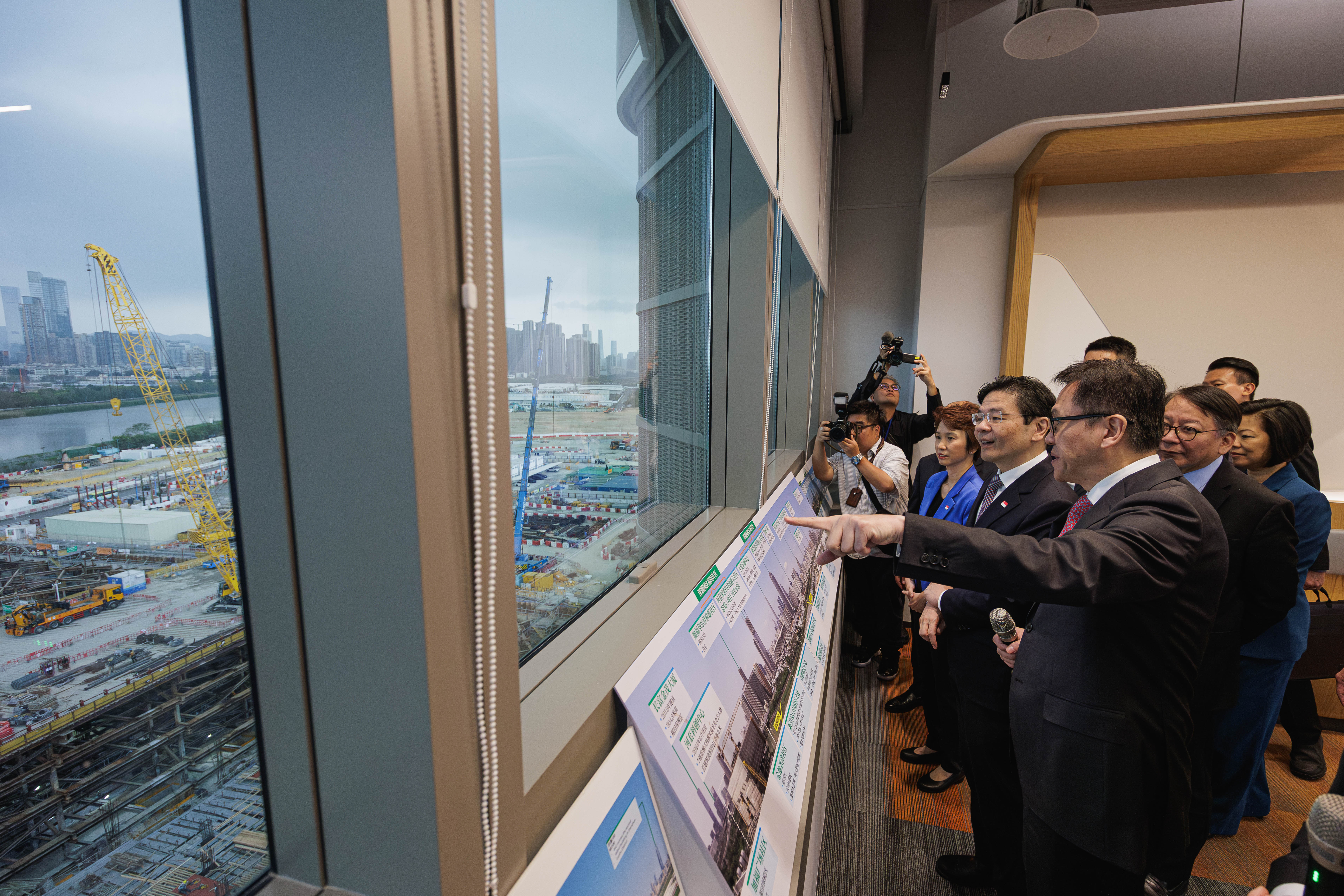
Hong Kong's Northern Metropolis, located in the New Territories, covers the Yuen Long and North districts, and includes new towns in Tin Shui Wai, Yuen Long and Fanling/Sheung Shui.
Given its proximity to Shenzhen's metropolitan core, the Northern Metropolis is envisioned to host the innovation and technology (I&T) industry to support Hong Kong to become an international I&T centre.
It is expected to eventually accommodate some 2.5 million residents and provide about 650,000 jobs.
Singapore confident about China's longer-term prospects
Turning to bilateral ties between Singapore and China, which he described as "excellent", PM Wong said that Singapore will remain a long-term investor in China.
He pointed to the various projects in China, such as the China-Singapore Suzhou Industrial Park, the Sino-Singapore Tianjin Eco-City, and the China-Singapore (Chongqing) Demonstration Initiative on Strategic Connectivity, as examples of the multiple touchpoints that already exist between the two countries.
"All of these different projects allow us to engage China in multiple ways, to participate in China's development and to contribute to China's success.
"So we will remain a long-term investor in China, because we are confident about China's longer-term prospects," PM Wong said.
In his speech at the annual Boao Forum for Asia on Thursday (March 26), PM Wong also spoke about the critical role China could play in global and regional development.
He added that the two countries will look at exploring further collaboration in new areas such as artificial intelligence, science and technology, and the green economy.
[[nid:732347]]
editor@asiaone.com




