LONDON — The leaders of the UK, Ukraine, France and Germany discussed the "urgent need" to ramp up production of weapons to combat Russia's powerful hypersonic Oreshnik ballistic missiles in a meeting in London on Sunday (June 7).
British Prime Minister Keir Starmer hosted Ukrainian leader Volodymyr Zelenskiy, French President Emmanuel Macron and German Chancellor Friedrich Merz at 10 Downing Street.
In a statement released by Starmer's office following their evening meeting, the leaders condemned Russia's "large-scale missile and drone attacks — including the repeated use of the Oreshnik missiles — on Ukrainian cities with a tragic toll on civilians".
They also condemned Russia's "irresponsible and dangerous Russian drone incursions" into Nato territory, including last month's in Romania.
Russia has stepped up its aerial campaign against Ukraine recently, most notably with the launch of the Oreshnik missiles.
"The leaders underlined the urgent need to scale up the production of interceptors and co-develop anti-ballistic missile and deep strike capabilities," the leaders said.
No details, financial or otherwise, on how this would be done were provided.
Ukraine's shortage of air defence systems, in part because of the depletion of US stocks during the Iran war, has left civilians especially vulnerable to ballistic missiles, even as Kyiv's defences stop most of Moscow's drones and its forces have made advances elsewhere on the battlefield.
The worry for Ukrainians is that the Iran war, which has been in abeyance for weeks, may now reignite after Iran launched missiles on Sunday at Israel in the first such bombardment since a fragile ceasefire took effect in early April, complicating mediation efforts for a deal to end the war.
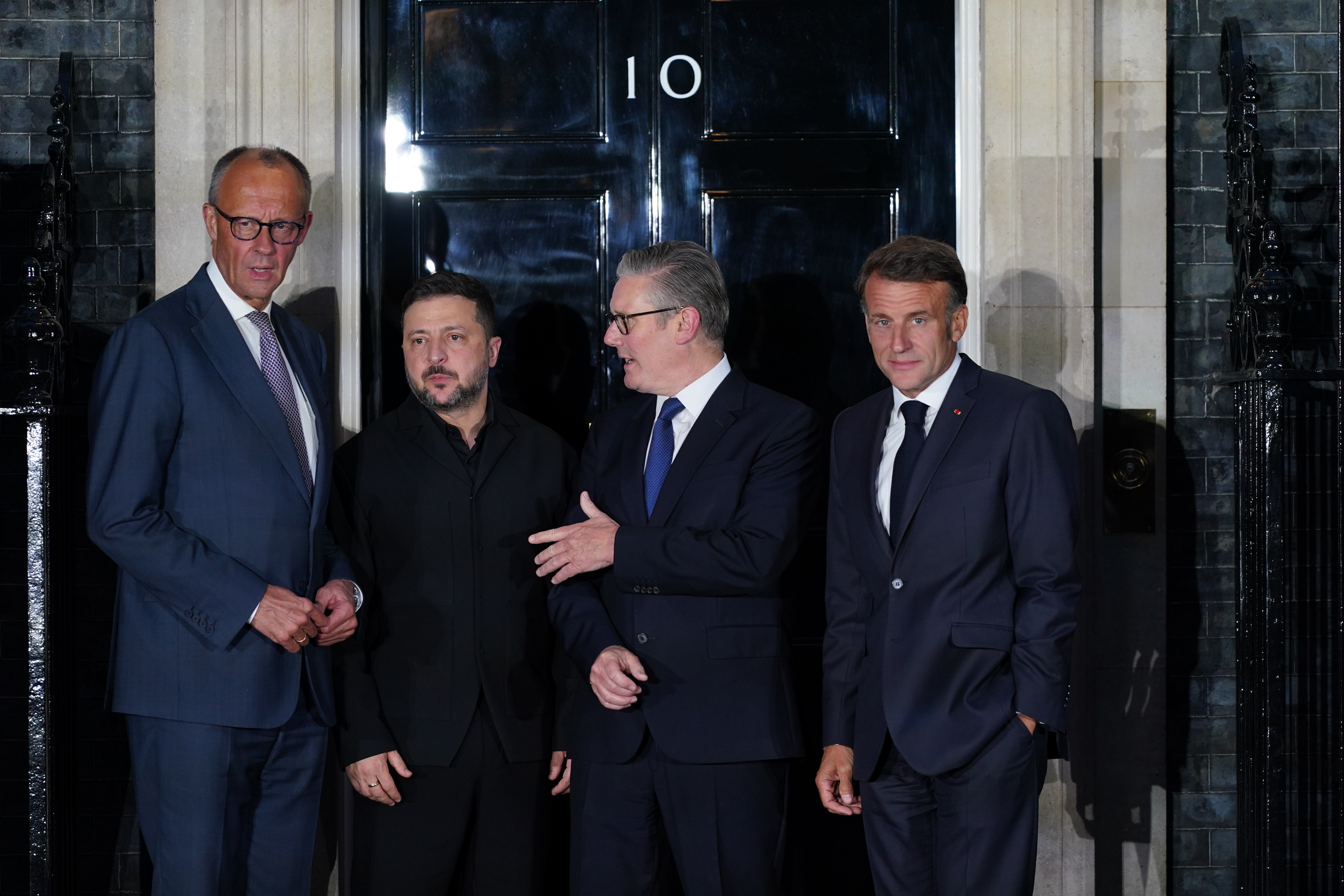
Following their meeting in London, the European leaders called on Russian President Vladimir Putin to agree "an immediate and complete ceasefire" with the current line of contact as a starting point for any negotiations.
The UK, France and Germany, the so-called E3 group of European nations, have been prominent backers of Ukraine following Russia's full-scale invasion in February 2022.
The UK and France lead the "coalition of the willing" initiative to provide security guarantees for Ukraine as part of a peace process.
The meeting comes in the wake of a Russian drone strike that killed three people waiting at a bus stop in southeastern Ukraine.
A separate drone strike damaged a storage centre for spent nuclear fuel in the Kyiv region, just 15 kilometres from the Chernobyl nuclear power plant, Ukraine's General Staff said.
The attack sparked a fire that was extinguished within an hour. Radiation remains within safe levels, officials said.
The International Atomic Energy Agency chief Rafael Grossi said the incident was "deeply concerning" due to the large amounts of nuclear material held at the facility.
He said in a statement that the agency would visit the site of the attack soon.
The Russian attacks follow a large-scale Ukrainian drone attack on Saturday that targeted Saint Petersburg, Russia's second-largest city, underscoring Kyiv's growing ability to hit deep inside Russia.
With the front line barely moving as swarms of drones hinder advances, both sides have sought an edge by launching long-range strikes.
[[nid:737496]]



