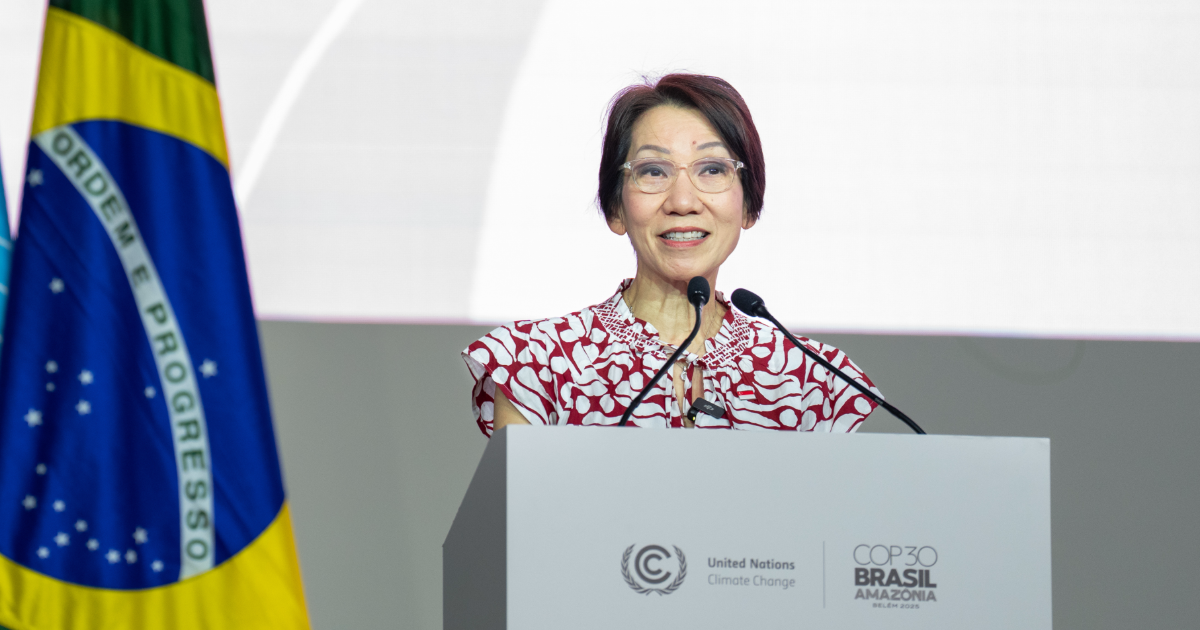
Singapore is diversifying its energy mix through alternative sources of energy such as biomethane and solar. It is also studying the potential deployment of nuclear energy, said Minister for Sustainability and the Environment Grace Fu on Monday (Nov 17).
Fu, who is also Singapore's Minister-in-charge of Trade Relations, was delivering Singapore's national statement at the high-level segment of the United Nations Framework Convention on Climate Change in Belem, Brazil on Nov 17.
Singapore was 13th among the list of first 31 countries and regional groupings to deliver their national statements in the first session.
The two-day segment will see countries delivering their national statements.
Intergovernmental organisations and groups of non-governmental organisations admitted by the Conference of the Parties (COP) will also deliver their statements.
In her statement on behalf of Singapore, the minister reaffirmed Singapore's commitment to work with the global community to progress towards climate goals.
"Climate change continues to outpace the collective response of the global community," Fu said, adding that the multilateral cooperation is being put to the test amid intensifying geopolitical tensions and economic uncertainty.
Singapore is one of 13 countries who submitted the 2035 Nationally Determined Contribution (NDC) before the Feb 10, 2025, deadline.
In its NDC, Singapore committed to reducing emissions to between 45 and 50 million tonnes of carbon dioxide (CO2) by 2035.
The National Climate Change Secretariat said in a Feb 10 statement accompanying its NDC submission that as a low-lying island state, climate change is an existential challenge for Singapore.
Diversification of energy mix, focusing on adaptation and resilience
Fu said that Singapore's pledge to reduce its emissions is a linear trajectory to net zero in 2050, adding that Singapore has quadrupled its solar deployment since 2020.
The city state is also diversifying its low-carbon energy mix by exploring biomethane as a low-carbon fuel and energy imports.
“We are also studying the potential deployment of nuclear energy," she stated.
Singapore is currently in the exploratory phase of its studies — focused on the safety and viability aspects of nuclear energy deployment
In a parliamentary reply on Nov 6, Minister-in-Charge of Energy, Science and Technology Dr Tan See Leng said that the Government "has not made a decision" on whether to deploy nuclear energy, adding that there will be regular public engagements on the latest developments in nuclear energy.
During a one-day visit to Singapore in July, director-general of the International Atomic Energy Agency (IAE) Rafael Mariano Grossi indicated that Singapore would not face any insurmountable challenge should it decide to adopt nuclear energy as a source of power.
On the adaptation and resilience fronts, Fu said that Singaporehas also developed its inaugural National Adaptation Plan to address climate impacts, including rising sea levels, urban heat, and food and water supply resilience.
She added that Singapore is also working with its Asean partners to advance the Asean Power Grid — an interconnected grid that will allow Asean member states to trade electricity freely with one another.
Calling it a "key pathway" of Asean's energy transition, Fu said that Asean will also work on developing carbon capture and storage technologies.
Financing green initiatives implementation
Fu also noted in her statement that implementation of green initiatives requires adequate financing.
"As a global financial hub, Singapore is doing its part voluntarily to help fill this gap.
“Our contributions focus on three pillars: capacity building, mobilising blended finance, and strengthening carbon markets,” Fu said.
She added that the Singapore government has pledged up to US$500 million concession capital - matching dollar-for-dollar, concessional capital from other partners - to deploy in green and sustainable infrastructure in Southeast Asia through the Financing Asia's Transition Partnership.
In closing, Fu said that parties at the conference must now “turn their commitments into concrete results” to ensure that collective efforts can keep global climate targets within reach.
[[nid:725397]]
editor@asiaone.com